What Health Insurance Should Atlanta Restaurants Offer?
Author: Justin Bishop · May 29, 2026 · 10 min read
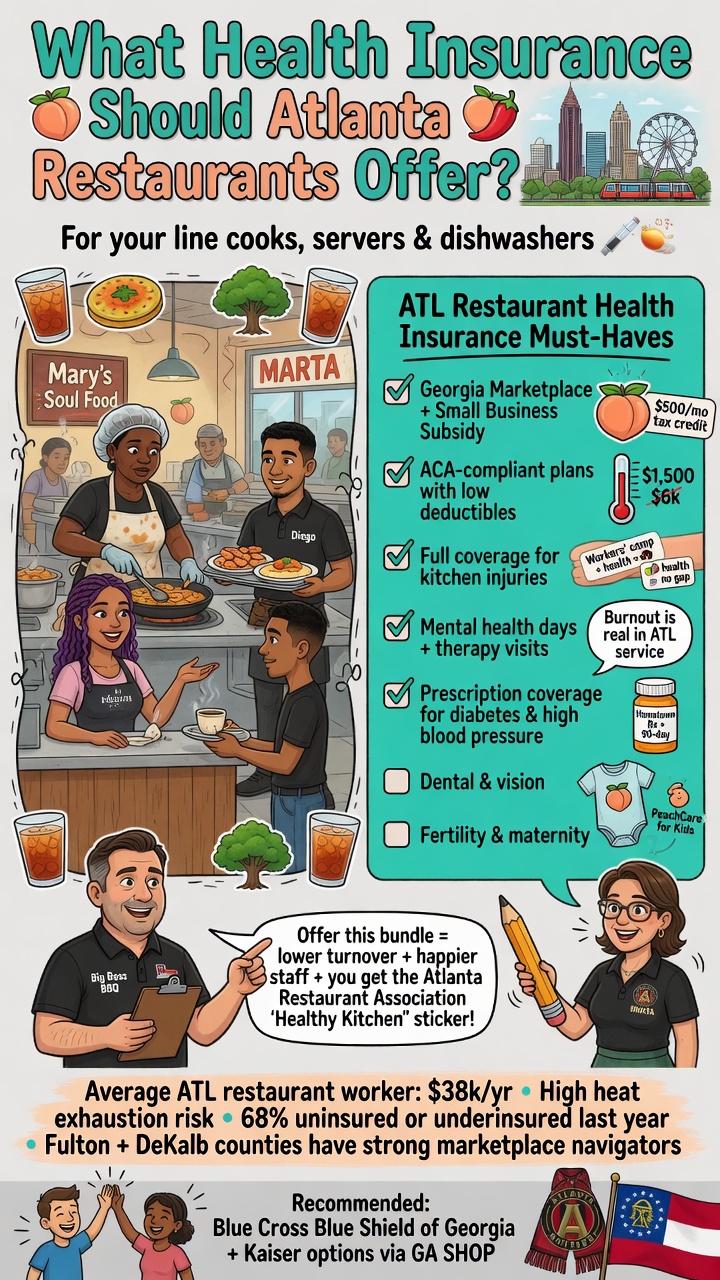
If you own a restaurant in Atlanta — whether it's a 5-person coffee shop in Decatur, a 30-person casual concept in Buckhead, or a 70-person fine dining group on the BeltLine — you've probably tried to offer health insurance at some point and run into the same problem.
Restaurants are the hardest industry in America to insure. The turnover is high. The wage mix is complicated by tips. Most servers can't afford the employee contribution at typical group rates. And the moment you try to enroll, you discover that traditional group health carriers want 70% participation before they'll write the plan — which is nearly impossible in restaurant economics.
So most Atlanta restaurant owners eventually give up and offer nothing. That's a real problem, because the right benefits stack (specifically built for restaurants) is a competitive hiring and retention tool in a labor market that has stayed brutally tight since 2021.
This post walks through why restaurants are uniquely hard to insure, the three approaches that actually work (traditional group, ICHRA, and the cash-stipend trap), the 50-employee ACA cliff, the real cost math for Atlanta restaurants in 2026, and the specific moves that turn benefits from a headache into a hiring lever.
I'm Justin Bishop, an independent broker in Atlanta. I've helped restaurant owners across metro Atlanta solve this exact problem — and I've seen the consequences of getting it wrong. Here's the honest breakdown.
The 30-Second Version
The participation problem: most ACA-compliant group health carriers require 70%+ employee enrollment. Restaurants typically can't hit it because front-of-house staff can't afford the employee contribution.
Four real approaches, in order of cost-efficiency for healthy restaurant groups: Private medically underwritten group plans (best when your group is young and healthy — typically 25-40% cheaper than ACA-compliant fully insured) ICHRA (strong fit when the group is mixed, has pre-existing conditions, or has high turnover) Traditional ACA-compliant group health (when neither of the above fits — predictable but pricey) Cash stipend (worst tax outcome — avoid)
The 50-employee cliff: at 50+ FTE employees, the ACA Employer Mandate kicks in. Private medically underwritten plans typically don't satisfy the mandate alone — strategy matters.
Tipped wages matter: the IRS affordability calculation uses W-2 Box 1 wages, which include tips. Restaurants often miscalculate affordability and trigger penalties they didn't know about.
Atlanta restaurant typical cost: $180-350/month per enrolled employee for a private medically underwritten plan in 2026; $250-450/month for ACA-compliant fully insured; ICHRA reimbursements typically $200-400/employee/month.
Common mistake: defaulting to ACA-compliant group health without exploring private medically underwritten alternatives. A young restaurant staff can save the owner $50K+/year by underwriting through the right carrier.
The right move for most Atlanta restaurants under 50 employees with a healthy team: private medically underwritten group plan. For mixed-health or high-turnover groups, ICHRA. For complex situations, sometimes a hybrid.
Why Restaurants Are Uniquely Hard to Insure
Most industries have a fairly predictable employee profile. Restaurants don't. The structural challenges:
Turnover. Restaurant turnover ran 70%+ in 2024-2025 nationally. Carriers don't like writing plans for groups where half the enrolled employees will be gone in 6 months.
Wage compression for front-of-house. A server making $4-5/hour base + tips has a different ability to pay benefit contributions than a back-of-house line cook on $18-22/hour.
Tipped vs non-tipped W-2 income. Tips count as wages for affordability calculations but feel like cash to the employee. Most servers feel "rich" on a Friday night and "poor" on Monday — making consistent benefit deductions tough.
Variable hours. A server may work 28 hours one week and 38 the next. Most plans require 30+ hours for eligibility, which means borderline-hours employees flip in and out of coverage.
Participation requirements. This is the deal-killer. Most fully insured group plans in Georgia require 70%+ of eligible employees to enroll. In a restaurant where 60% of staff are 18-25 year olds living paycheck to paycheck, you almost never hit 70%.
Industry risk underwriting. Some carriers price restaurant groups higher because of injury claims (cuts, burns, slips), workers' comp interactions, and ER-utilization patterns.
Owner-operator dynamics. Many Atlanta restaurants are owned by one or two operators who work in the business. Their needs (full coverage for themselves and their families) differ wildly from the typical line cook's needs.
The result: a system that wasn't built for the restaurant industry, applied to restaurants anyway.
Restaurants and tech startups face different but parallel benefit challenges. See What Health Insurance Should Atlanta Tech Startups Offer? for the tech-specific framework.
Approach #1 — Private Medically Underwritten Group Plans (The Best Choice When Your Group Qualifies)
This is the option most restaurant owners have never been shown — usually because the broker who pitched them isn't appointed with the carriers that write these products, or doesn't want to do the underwriting work.
What they are: fully insured group health plans, written by major carriers, that use medical questionnaires during the application process to underwrite the group. Pricing reflects the actual health profile of your staff rather than the community-rated ACA pool that fully insured plans are forced to use.
Why they exist: ACA-compliant fully insured plans must use community rating — meaning the carrier prices a 24-year-old line cook with no health history at roughly the same rate as a 24-year-old with a chronic condition. That cross-subsidy makes ACA-compliant plans expensive even for healthy groups. Private medically underwritten plans bypass that — you pay for your actual group's risk, not the average risk of everyone else's.
Why this works especially well for restaurants: the restaurant workforce skews young and healthy. Most BOH line cooks are 22-30. FOH servers are 20-28. A typical restaurant census underwrites favorably because the group is structurally lower-risk than the average ACA pool. Carriers reward that with premium 25-40% below the ACA-compliant equivalent.
The carrier landscape in Georgia for 2026:
Allstate Benefits — strong on small group medically underwritten products for healthy industries
Trustmark — flexible plan design with medical underwriting at 5-100 employee group size
Allied National — competitive for restaurant and hospitality groups
MedCost / certain ACO-affiliated products — emerging in metro Atlanta
National General (Allstate) — competitive on level-funded with underwriting overlay
Anthem and UnitedHealthcare — both offer specific medically-underwritten group products at certain group sizes, but they're not the default they quote unless asked
What the underwriting process looks like:
Employees complete a brief medical questionnaire (typically 10-15 health history questions)
Carrier reviews the group's risk profile
Carrier returns a quote that reflects the actual group's health vs the community pool
Healthy groups get pricing 25-40% below the matching ACA fully insured Bronze plan
Groups with one or two known high-claim members get pricing closer to ACA-compliant, sometimes still favorable
The trade-offs to know upfront:
Pre-existing condition exclusions can apply on some products (varies by carrier)
Renewal pricing is more sensitive to claims experience — a bad claims year can mean a steeper renewal increase than ACA-compliant
Not all state mandates apply — these plans are sometimes regulated under different rules than ACA-compliant plans, which can mean leaner benefit design
Network access varies — some medically underwritten products use narrower networks than the carrier's ACA-compliant plans
Portability — if an employee leaves the group, the individual coverage doesn't follow them; they'd go to the marketplace
When private medically underwritten is the clear winner:
Restaurant group with mostly healthy 20s-30s staff
Low historical claims (no recent maternity, no chronic conditions known)
Owner wants to offer real coverage but ACA-compliant pricing is breaking the budget
Group is stable enough to absorb a renewal increase if claims spike
When it's not the right call:
Owner or key manager has a known major health condition (pre-existing exclusions could leave them exposed)
Several employees have ongoing prescriptions or recent claims (carrier will price accordingly)
Owner needs the most generous benefits possible regardless of cost (ACA-compliant Gold plan beats medically underwritten Bronze for the high-utilization employee)
Restaurant has a heavily Medicare-adjacent owner who needs specific benefits
Cost example — 12-employee Decatur restaurant:
ACA-compliant fully insured Bronze: ~$420/month per enrolled employee → $4,200/month at 10 enrolled
Private medically underwritten Bronze-equivalent: ~$280/month per enrolled employee → $2,800/month at 10 enrolled
Annual savings: $16,800 for the same essential coverage profile
This is the number that gets restaurant owners' attention — and the one most brokers never put in front of them.
Approach #2 — ICHRA (Strong Fit for Mixed or High-Turnover Groups)
If your group doesn't underwrite favorably — too many older employees, known pre-existing conditions, or just too much turnover to make the medical questionnaire process practical — ICHRA becomes the next-best move.
ICHRA (Individual Coverage Health Reimbursement Arrangement) is the most under-used solution for mixed Atlanta restaurant groups. It solves the participation problem and absorbs turnover gracefully.
How it works:
The restaurant gives each eligible employee a tax-free monthly amount to use toward an individual health insurance plan of their choice. The employee picks any qualifying ACA marketplace plan, submits proof of coverage, and the restaurant reimburses up to the amount.
Why it solves the restaurant problem:
No participation requirements. Each employee makes their own decision. If 20% enroll and 80% decline, the plan doesn't fail.
Tiered classes work. Restaurants can structure ICHRA differently for full-time salaried managers, full-time hourly, and part-time (with specific rules). A higher reimbursement for managers, lower for hourly, none for part-time under 30 hours.
Turnover is absorbable. When an employee leaves, you stop reimbursing. No carrier cancellation, no participation drop.
Affordability for FOH staff. Employees can pick an ACA Silver plan with cost-sharing reductions (CSRs) if their income qualifies — the most generous benefits available, often impossible inside a group plan.
Subsidy compatibility. Properly structured ICHRA preserves subsidy eligibility for employees whose income makes the ICHRA "unaffordable" by IRS standards.
The ICHRA reimbursement math for Atlanta restaurants in 2026:
Tier 1 (full-time salaried managers): $400-600/month reimbursement
Tier 2 (full-time hourly, BOH or FOH): $300-450/month reimbursement
Tier 3 (part-time 20-29 hours): sometimes excluded, sometimes $150-250/month
Part-time under 20 hours: typically not eligible
When ICHRA is the right answer over private medically underwritten:
Group has known pre-existing conditions or high recent claims
Workforce is age-mixed (owners in their 50s + young staff)
Owner wants to control benefit cost as a fixed per-employee amount, regardless of how much each employee actually uses
Turnover is too high to make group-style underwriting practical (carriers re-underwrite groups when membership changes significantly)
Employees actually want choice of their own marketplace plan
For the deeper switch-decision framework, see Should My Atlanta Small Business Switch to ICHRA in 2026?
Approach #3 — Traditional ACA-Compliant Group Health Plan (When the Other Options Don't Fit)
Despite the challenges, traditional ACA-compliant fully insured group health does work for some Atlanta restaurants — typically those with:
25+ employees with low turnover
A reasonable portion of back-of-house salaried managers
An owner willing to make a strong employer contribution (75%+ of employee-only premium)
Cash flow that absorbs benefit costs even during slow months
What works in the design:
Pick a Bronze-equivalent plan with a higher deductible and lower premium. Servers will actually enroll at lower premium contributions.
Employer-pays-100% of employee-only premium if you can afford it. Eliminates the participation problem because there's no employee contribution to refuse.
Tiered eligibility: salaried managers eligible from day 1, hourly employees eligible after 60-90 days. Reduces churn-driven enrollment chaos.
Spousal/dependent contribution split: employer covers employee, employee covers their own dependents. Standard restaurant approach.
What kills it:
50% employer contribution with no benefits-savvy employees. Looks generous on paper, nobody enrolls, plan fails participation.
High-deductible HSA plans for staff making $30K/year. The HSA tax benefit is irrelevant to people who don't have $1,000 to put in it.
Switching plans every 12 months chasing premium savings. Employees lose trust, enrollment drops further.
When traditional ACA-compliant group makes sense:
30+ employees, half BOH/half FOH or higher BOH ratio
Owner committed to 75%+ employer contribution
Stable management team that helps drive enrollment
Group has health profile that won't underwrite favorably for private medically underwritten products
Owner needs the certainty of ACA-mandated coverage (no pre-existing condition risk)
For the full carrier-by-carrier breakdown of who writes ACA-compliant small group in Georgia for 2026, see Best Georgia Small Group Health Insurance Carriers for 2026
Approach #4 — Cash Stipend (The Tax Trap)
Some restaurant owners, frustrated with both traditional group and the ICHRA setup, just give employees an extra $200-400/month and tell them to buy their own coverage.
Why this seems appealing:
Simple
No paperwork
Owner doesn't have to administer anything
Why it's actually expensive:
Cash stipends are taxable income. That $300/month stipend becomes $300 of W-2 wages. The employee pays federal income tax + 7.65% FICA + Georgia state tax. They net $200-220 of actual benefit.
The employer pays payroll tax too. That $300/employee/month also triggers employer-side FICA. Total employer cost: $323/month for $200-220 of net employee benefit.
ICHRA gives the same benefit tax-free. $300 ICHRA reimbursement is worth $300 net to the employee. No payroll tax for the employer either. Identical employer outlay, ~33% more benefit to the employee.
Cash stipends don't qualify for ACA Employer Mandate. At 50+ FTE employees, cash doesn't count as an offer of affordable coverage. You still owe ACA penalties.
The simple rule: if you're going to spend money to help employees with health insurance, do it through ICHRA, not cash. Same cost to you, materially more value to them.
The 50-Employee ACA Cliff
For restaurants approaching 50 full-time-equivalent (FTE) employees, the math changes dramatically.
What is an FTE?
Full-time employees (30+ hours/week) count as 1.0 FTE each
Part-time employees count fractionally: total part-time hours per month divided by 120
A restaurant with 35 full-time and 30 part-time employees averaging 20 hours/week:
35 × 1.0 = 35 FTE from full-time
30 × (20 × 4.33 weeks) ÷ 120 = 21.65 FTE from part-time
Total: 56.65 FTE → ACA Applicable Large Employer (ALE)
This restaurant might think it has 35 employees but actually trips the 50-FTE threshold.
What happens at 50+ FTE:
You become subject to the ACA Employer Mandate. You must offer affordable, minimum-value coverage to all full-time employees (and their dependents up to age 26) or face penalties:
Penalty A (no offer at all): $2,970/year per FT employee (2026), with the first 30 employees exempt
Penalty B (offer made but unaffordable): $4,460/year per FT employee who got a subsidy on the marketplace because your plan was unaffordable
The affordability test: the employee-only premium must be no more than 9.02% of household income (2026 federal threshold). For a restaurant employee making $32,000, that's a maximum employee contribution of $241/month.
The tip miscalculation that gets restaurants in trouble: the IRS uses W-2 Box 1 wages, which include tips. A server with $25K base + $20K tips has $45K of wages for affordability purposes — the affordable employee contribution cap is $338/month, not $188/month based on base wages alone. Many restaurants get this calculation wrong.
At 50+ FTE, ICHRA can still satisfy the mandate if structured correctly. This is the path I help most growing Atlanta restaurants take.
Real Atlanta Restaurant Cost Math (2026)
Three real scenarios for typical Atlanta restaurants:
Scenario 1: 12-employee neighborhood restaurant in Decatur
3 owners (work in restaurant, all healthy 30s-40s), 4 BOH full-time (mostly 20s, healthy), 5 FOH (3 full-time, 2 part-time, all 20s)
Owners want coverage for themselves + family
FOH turnover ~40%/year, BOH turnover ~15%/year
No known major health conditions in the group
Best fit: Private medically underwritten group plan
Group of 8 enrolled (3 owners + 3 BOH FT + 2 FOH FT)
Bronze-equivalent medically underwritten plan: ~$280/month per enrolled employee
Employer pays 75% of employee-only premium: ~$210/month per employee × 8 = $1,680/month
Employee pays 25%: ~$70/month
Total employer monthly cost: $1,680 ($20,160/year)
Employees get real, primary coverage with broad network
Compared to ACA-compliant fully insured equivalent: saves ~$15,000-20,000/year
Alternative if the owners had a chronic condition: ICHRA with the owners taking ACA Gold plans with broader networks, FT hourly on Bronze. Total around $4,100/month / $49,200/year.
Scenario 2: 28-employee casual concept in Midtown
2 owners (work in restaurant, healthy), 1 GM salaried (mid-40s, healthy), 3 salaried sous chefs/managers (30s, healthy), 22 hourly (12 FT, 10 PT — mostly 20s)
Owners want strong benefits as a hiring/retention tool
Group medically underwrites favorably overall
Best fit: Private medically underwritten group plan
18 enrolled (6 salaried + 12 FT hourly): ~$280/month per enrolled
Employer pays 80% of employee-only premium: ~$224/month × 18 = $4,032/month
Employee pays 20%: ~$56/month
Total employer monthly cost: $4,032 ($48,384/year)
Compared to ACA-compliant fully insured: saves ~$30,000-40,000/year
Part-time employees offered ICHRA at $250/month as a secondary class: $2,500/month additional
Combined total: ~$6,500/month ($78,000/year)
Alternative if a key manager has a chronic condition: ICHRA-only structure, $8,100/month / $97,200/year. Higher cost, but no pre-existing condition exposure.
Scenario 3: 65-employee restaurant group with 3 Atlanta locations
65 total FTE → triggers ACA Employer Mandate
Multi-location: Buckhead, Inman Park, Brookhaven
8 salaried managers/owners (mix of ages, one with chronic condition), 57 hourly (35 FT, 22 PT)
Group is too large and mixed to underwrite cleanly under medically underwritten products
Best fit: Hybrid structure
Salaried tier (8): private medically underwritten group plan — $280/month × 80% employer = $224/month × 8 = $1,792/month (covers most managers; one with chronic condition can opt to a parallel ACA-compliant option at owner's cost)
Full-time hourly tier (35): ICHRA at $425/month (must be affordable per W-2 Box 1 calculation) = $14,875/month
Part-time (22): not eligible
Total monthly cost: ~$16,667 ($200,000/year)
Compliance reporting (Form 1095-C) handled by ICHRA TPA
Compared to full ACA-compliant Employer Mandate coverage: saves ~$30,000-50,000/year
Alternative: Full ICHRA across all tiers — $19,300/month / $231,600/year if hybrid is too complex to administer.
Common Mistakes Atlanta Restaurant Owners Make
Patterns I see repeatedly:
Defaulting to ACA-compliant fully insured without exploring private medically underwritten alternatives. This is the single most expensive mistake. A young restaurant staff often saves $30K-50K/year by medically underwriting through carriers like Allstate Benefits, Trustmark, or Allied National vs the ACA-compliant equivalent. Most brokers don't quote these because they're not appointed.
Offering a 50/50 employer contribution split and getting zero enrollment. Front-of-house employees can't afford even a $200/month payroll deduction. Plan fails participation, carrier cancels, owner concludes "benefits don't work in restaurants."
Setting up cash stipends instead of ICHRA. Same cost, 33% less value, plus payroll tax exposure on both sides.
Miscalculating ACA affordability using base wages instead of W-2 Box 1. Tips count. Many restaurants think their employee contribution is "unaffordable" by IRS standards when it's actually compliant — and vice versa.
Not knowing they crossed 50 FTE. Most owners count "employees" as full-time bodies. Part-time fractional FTE pushes many growing restaurants over the threshold without them realizing it.
Choosing the cheapest carrier without checking provider network. Atlanta has carrier-specific gaps — some plans don't cover Emory specialists, some don't cover Northside maternity. Servers and BOH workers actually use these networks.
Switching plans every year chasing $40/month savings. Restaurant employees lose trust in benefits when the carrier changes annually. Lower enrollment year over year.
Excluding part-time employees from ICHRA when they could be included as a separate class. Some part-time staff are loyal long-term employees. Excluding them entirely sends the wrong signal.
Not reviewing the plan at year-end. ICHRA reimbursements often need adjustment as marketplace premiums change. Set-and-forget loses ground every year.
The Restaurant-Specific Atlanta Carrier Landscape
For traditional group health, restaurant-friendly carriers in Atlanta for 2026 include:
Anthem Blue Cross Blue Shield of Georgia — strongest network, sometimes higher pricing for restaurant industry
UnitedHealthcare — competitive group rates, level-funded options work well for stable restaurant groups
Aetna — good for groups with BOH-heavy demographics
Allstate Benefits — competitive pricing on level-funded restaurant groups
Trustmark — flexible plan design, niche but useful for specific restaurant setups
For ICHRA-based individual marketplace plans:
Anthem Pathway PPO — broad network, slightly higher premium
Ambetter — value-priced, narrower network, popular with hourly employees
Oscar — Atlanta metro focus, strong mobile experience, popular with younger FOH staff
UnitedHealthcare — solid network, ACA marketplace presence
Cigna — competitive for specific Atlanta ZIP codes
Frequently Asked Questions
What's the catch with private medically underwritten plans? Three real trade-offs: pre-existing condition exclusions can apply (carrier-specific), renewal pricing is more sensitive to claims experience, and some state mandates don't apply (which can mean leaner benefit design). For healthy restaurant groups, these trade-offs are usually worth the 25-40% premium savings — but they need to be understood upfront.
Will my employees notice the difference between medically underwritten and ACA-compliant? For most claim experiences, no. They use the same ID card, the same provider network (within the plan's network), the same claims process. The structural difference is in how the plan was priced and what benefits are mandated — not in day-to-day usage.
Can I offer ICHRA to my managers and private medically underwritten group to everyone else? You can mix structures across legitimately separate employee classes, but it requires careful design. Typically the cleaner structure is private medically underwritten for the salaried tier and ICHRA for hourly — or vice versa depending on which group underwrites better.
Do I have to offer ICHRA to part-time employees? No. ICHRA classes typically separate FT (30+ hours) from PT (under 30). Most Atlanta restaurants exclude PT from ICHRA, though some include them at a reduced amount.
What if my employees don't want to deal with picking a marketplace plan? I help every enrolled employee through plan selection — included in the broker work. Most restaurant employees actually appreciate having choice instead of being stuck with the one group plan the owner picked.
Do I need an ICHRA TPA (third-party administrator)? Yes, for compliance. TPAs like Take Command, PeopleKeep, and Gusto handle the substantiation paperwork and IRS reporting. Setup is 30-45 days. I help select and onboard the right TPA based on your restaurant's specifics.
Can I bundle ICHRA with payroll through Gusto or Toast Payroll? Yes, several payroll platforms integrate ICHRA reimbursement into payroll runs. Streamlines the per-paycheck reimbursement so employees see it as a separate non-taxable line item.
What about my workers' comp obligation? Workers' comp is a separate policy required for any Georgia restaurant with 3+ employees. Not bundled with health benefits. See Do I Need Workers' Comp for My Small Business? for the full breakdown.
What if I want to offer dental and vision too? Standalone dental and vision plans are typically offered group-style by carriers like Guardian, Principal, Delta Dental, and VSP. Restaurants often offer dental/vision at the manager-tier only or as a fully-employee-paid voluntary benefit.
How do I handle benefits when I hire seasonal staff? ICHRA can be structured with a waiting period (typically 60-90 days). Seasonal staff who don't stay past the waiting period never become eligible. Cleaner than enrolling and disenrolling them in a group plan.
Does offering benefits actually help with hiring? Yes, but mostly for BOH and salaried positions. FOH staff are usually weighing tipped income potential first. But for any role where you're competing for talent against other restaurants offering benefits — and increasingly even fast-casual chains — having something to offer is a meaningful differentiator.
The Bottom Line
Restaurants are the hardest industry to insure, but the solution isn't to offer nothing — or to default to ACA-compliant fully insured because it's all your current broker quotes.
For most Atlanta restaurants with a young, healthy staff, private medically underwritten group plans are the best option — they price your group's actual risk rather than the community pool, and they typically come in 25-40% below ACA-compliant fully insured for the same coverage profile. Most owners never see these quotes because most brokers aren't appointed with the carriers who write them.
For groups with known pre-existing conditions, age-mixed workforces, or high turnover that makes underwriting impractical, ICHRA is the next-best move — no participation requirements, class-based tiering, and absorbable turnover.
For restaurants over 50 FTE, the ACA Employer Mandate adds compliance layers. A hybrid structure (private medically underwritten for the salaried tier, ICHRA for full-time hourly) often delivers the best cost outcome while satisfying mandate requirements.
The owners who win on benefits in 2026 are the ones who don't settle for the first product their broker quotes — and who recognize that the one-size-fits-all ACA-compliant model wasn't built for restaurant economics.
If you're an Atlanta restaurant owner trying to figure out what benefit structure fits your specific group — including ICHRA setup, ACA Employer Mandate analysis if you're approaching 50 FTE, and individual plan enrollment for your team — book a 15-minute call with me. I'll walk through your specific numbers and tell you what actually fits. Costs you nothing — I'm paid by carriers, not by you.
Want to keep reading? Check out Can a 2-Person LLC Get Group Health?, Level-Funded or Fully Insured Group Health?, or Do I Have to Provide Health Insurance to My Employees in Georgia? — parallel small business decisions.
For professional services verticals, see What Health Insurance Should Atlanta Law Firms Offer? — the K-1 partner structure changes everything
Justin Bishop is the founder of That Young Insurance Guy, an independent insurance brokerage in Atlanta, GA, licensed in 31 states. He writes the Health Coverage Chaos newsletter on LinkedIn — and yes, he answers his own texts.
This post is general education, not legal, tax, or financial advice. ACA Employer Mandate thresholds, ICHRA compliance rules, FTE calculations, and Georgia carrier offerings change.