
Best Georgia Small Group Health Insurance Carriers for 2026
Author: Justin Bishop · June 3, 2026 · 11 min read
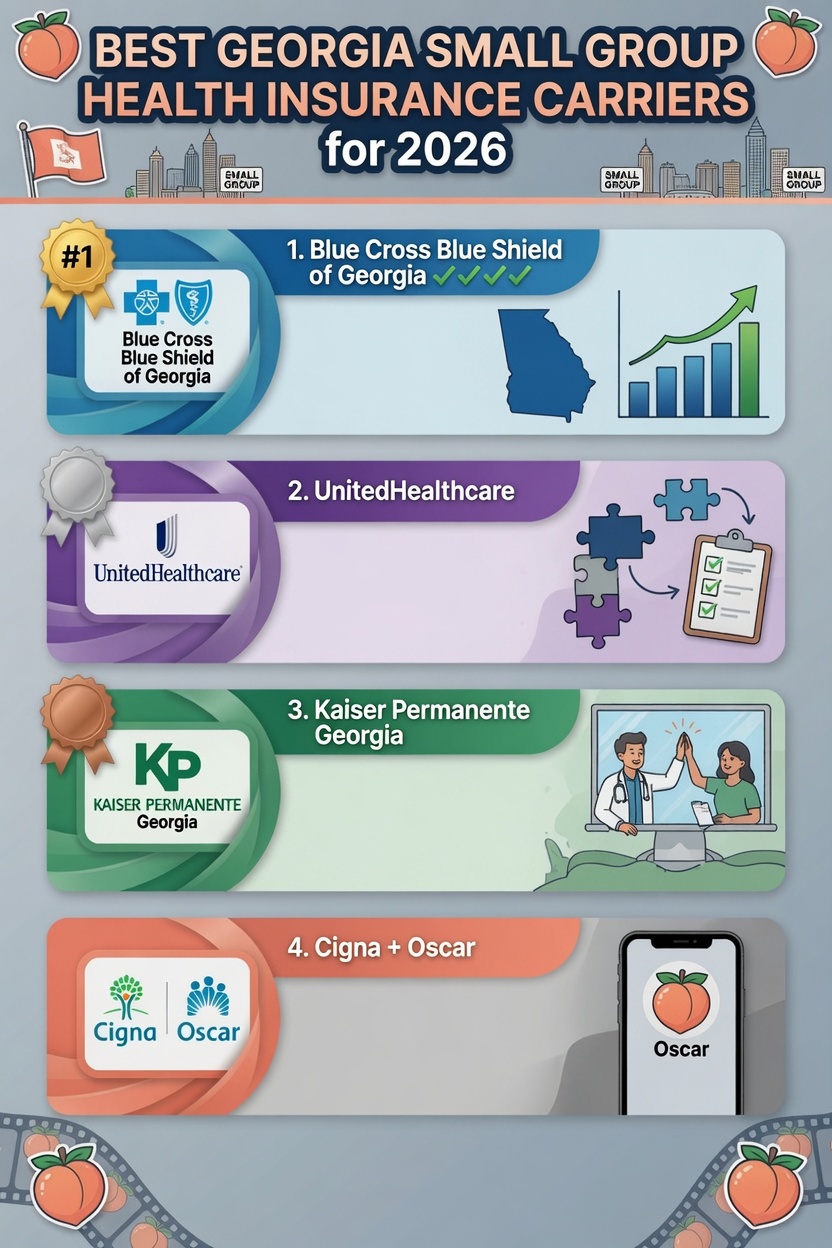
If you own a 2-to-50 employee business in Atlanta and you have started shopping group health insurance for 2026, you have probably run into the same confusing menu. Anthem. UnitedHealthcare. Aetna. Humana. Kaiser Permanente. Every broker tells you their preferred carrier is the best. Every carrier's marketing says the same thing. And the quotes you have collected all use slightly different network tiers, plan structures, and pricing methodologies, so a side-by-side comparison feels impossible.
The short version: there is no single best carrier. There is only the carrier that fits your specific business — your employees' ages, your network needs, your office locations, your budget, and your tolerance for renewal volatility. What is right for a 12-person tech company in Tech Square is wrong for a 35-person restaurant group on the BeltLine, which is wrong for a 22-person law firm in Buckhead.
This post walks through the five carriers currently writing 2-to-50 small group health insurance in Georgia for 2026, what each carrier is genuinely good at, what each one struggles with, how the 2026 networks compare across the major Atlanta hospital systems, real 2026 pricing benchmarks, and the specific business profile that wins with each carrier.
I'm Justin Bishop, an independent broker in Atlanta. I quote all five of these carriers for Georgia small businesses every week. Here's the honest breakdown — including the carriers I quote most often and the ones I quote rarely.
The 30-Second Version
Five carriers currently write small group (2-50 employees) ACA-compliant fully insured health insurance in Georgia for 2026: Anthem Blue Cross Blue Shield of Georgia, UnitedHealthcare, Aetna, Humana, and Kaiser Permanente of Georgia.
The carrier that is best for your group depends on three things: which Atlanta hospital systems your employees use most, how price-sensitive your group is, and whether your employees prefer PPO flexibility or HMO simplicity.
One-line take on each: Anthem BCBS GA — broadest PPO network, the safest default for most Atlanta small groups, typically the most-quoted carrier UnitedHealthcare — competitive on price, very strong PPO network, second-most-quoted for Atlanta small groups Aetna — strong on mixed-demographic groups and often competitive in north metro Atlanta Humana — selective in which Georgia small group markets they actively write in 2026; verify availability for your group size and ZIP Kaiser Permanente GA — the HMO outlier; integrated care model wins on cost when employees are willing to stay in-system
Hospital network reality: Anthem and UHC both include Emory, Piedmont, Wellstar, and Northside on their broadest small group products. Aetna's network is competitive but verify specialist depth. Humana's networks vary by region. Kaiser has its own physician network and hospital partnerships.
2026 pricing benchmark for Atlanta small groups: $480-720/month per enrolled employee for ACA-compliant fully insured Bronze-to-Silver tier coverage, depending on carrier, network, group age, and ZIP.
The number most owners get wrong: they shop for the lowest premium and skip the network audit. A $40/month cheaper plan that does not cover the in-network specialist your COO's daughter sees is not actually cheaper.
What this post is not: a ranking of "best ICHRA-compatible individual marketplace carriers" (that is a separate post) or "best private medically underwritten carriers" (covered in Level-Funded or Fully Insured Group Health? and the vertical-specific posts).
Why "Best" Depends on Your Group
Before ranking carriers, it helps to understand what actually differentiates them at the small group level. The carriers' marketing tries to make this opaque on purpose. The reality is simpler:
Network depth. Which Atlanta hospital systems are in-network on which product tier? Anthem and UHC compete head-to-head on broad-network PPOs. Aetna's metro Atlanta network is competitive but worth verifying for specific specialists. Humana's network varies by county. Kaiser uses its own integrated network.
Pricing methodology. All five carriers use community-rated ACA-compliant pricing for small group (no medical underwriting). But age curves, geographic factors, and tobacco surcharges vary modestly by carrier. The same 12-person group can see 5-15% spread across the five carriers' quotes.
Plan structure flexibility. Some carriers offer richer HSA-eligible high-deductible plans. Others lean into copay-heavy PPO plans. Some have tiered networks; some don't. The plan menu your employees can choose from varies.
Renewal behavior. Year-over-year renewal increases vary. Some carriers run "low new business, steep renewal" patterns. Others price conservatively at year one and renew flatter. Your broker should be able to tell you each carrier's typical renewal pattern.
Customer service experience. Claims processing speed, member portal quality, broker support, and dispute resolution all vary. Anthem and UHC have the most mature infrastructure. Kaiser's integrated model means simpler claims but less choice. Smaller carriers' service experience varies more.
Geographic availability. Not every carrier writes every Georgia ZIP. Some carriers actively serve metro Atlanta but pull back in rural counties. Some are selective by group size. Always verify the carrier writes in your specific ZIP for your specific group size before relying on a quote.
The carrier that wins on price might lose on network. The carrier with the strongest network might cost the most. The carrier with the simplest plan might frustrate employees who want choice. There is no shortcut here — the right answer comes from matching the carrier to your specific group profile.
Carrier #1 — Anthem Blue Cross Blue Shield of Georgia (The Safe Default)
Anthem BCBS GA is the most-quoted carrier for Atlanta small groups, and for most businesses, it is the right answer.
What Anthem is genuinely good at:
Broadest PPO network in Georgia. The Anthem Blue Open Access POS and Anthem Pathway PPO products both include Emory, Piedmont, Wellstar, Northside, and Grady hospital systems plus the major affiliated specialist groups. For an Atlanta workforce, the network depth is hard to beat.
Plan menu depth. Bronze, Silver, Gold, and Platinum tiers, multiple deductible/copay variants per tier, HSA-eligible HDHPs, and Anthem-administered HRA options. Employees who want a high-deductible HSA plan and employees who want a low-deductible copay plan can each find something they like.
National network for traveling employees. Anthem BCBS is part of the Blue Cross Blue Shield Association, so employees traveling outside Georgia get in-network access at Blue Cross plans in other states. This matters more than most owners realize, especially for sales teams and consultants.
Mature infrastructure. Member portal, mobile app, claims processing, and broker support are all well-developed. Fewer service issues than newer carriers.
Strong on Atlanta hospital affiliations. If your employees have established relationships with Emory primary care, Piedmont specialists, or Northside maternity, Anthem is almost always in-network.
Where Anthem can lose to other carriers:
Not always the lowest premium. UHC and Aetna sometimes underprice Anthem at year one to win the business. Anthem typically renews flatter than carriers that underpriced at acquisition.
Premium increases on renewal can be steep in years where the small group risk pool prices up sharply. This is a community-rated dynamic, not Anthem-specific.
HMO options are limited. Anthem's small group menu is PPO-dominant. If your employees specifically want HMO simplicity, Kaiser is the more natural fit.
Best for: Most Atlanta small groups, especially those that want broad network access, plan menu choice, and proven infrastructure. The default starting point for owners who do not have a specific reason to pick another carrier.
Carrier #2 — UnitedHealthcare (The Network Competitor)
UnitedHealthcare runs neck-and-neck with Anthem for Atlanta small group market share. For some groups, UHC wins outright.
What UnitedHealthcare is genuinely good at:
Competitive pricing. UHC frequently comes in 3-8% under Anthem at year one for similarly structured plans. The savings can be meaningful for cost-sensitive groups.
Strong PPO networks. UHC Choice Plus and UHC Options PPO products include Emory, Piedmont, Wellstar, Northside, and most affiliated specialists. Network depth in metro Atlanta is competitive with Anthem.
National employer presence. If your small business expects to grow or has multi-state operations, UHC has the deepest national infrastructure of any small group carrier.
HSA-eligible high-deductible plans. UHC's HSA-compatible product menu is strong, and the integration with HSA bank partners is mature.
Member tools and digital experience. The UHC app and member portal are competitive with Anthem's. Telemedicine is built in.
Where UnitedHealthcare can lose to Anthem:
Renewal patterns can be steeper in some years. UHC has historically priced acquisition years aggressively and renewed up. Your broker should show you UHC's renewal trends in your market before recommending UHC over Anthem on price alone.
Pharmacy benefit manager changes. UHC uses OptumRx for pharmacy benefits. Some employees who have established pharmacy relationships may prefer a different PBM.
Specialist network variability. UHC's network includes most major Atlanta specialists, but there are pockets of variability. Always verify specific specialists your employees use are in-network on the specific UHC product you are quoting.
Best for: Cost-sensitive Atlanta small groups, businesses with multi-state operations, and groups where the UHC quote comes in materially under the Anthem quote and the network covers what employees need.
Carrier #3 — Aetna (The Mixed-Demographic Specialist)
Aetna writes small group in Georgia and is competitive on certain group profiles.
What Aetna is genuinely good at:
Mixed-demographic groups. Aetna's pricing methodology and network design tend to work well for groups with a wide age spread — younger associates plus older managers plus mid-career staff.
North metro Atlanta strength. Aetna's network is particularly strong in north metro Atlanta — Sandy Springs, Alpharetta, Roswell, Marietta. For businesses headquartered or employee-heavy in north metro, Aetna often comes in competitive.
Behavioral health depth. Aetna's mental health and substance use coverage tends to be strong, and the in-network behavioral health provider lists are reasonably deep in metro Atlanta.
CVS integration. Aetna is owned by CVS Health, so pharmacy benefits run through CVS Caremark with MinuteClinic integration. Employees who use CVS retail pharmacies find this convenient.
Plan flexibility. Aetna's small group menu includes solid PPO and Open Access options with multiple deductible tiers.
Where Aetna can lose to Anthem or UHC:
Hospital system depth can vary. Aetna's networks generally include Emory, Piedmont, Wellstar, and Northside, but specific specialist depth within those systems can be thinner than Anthem or UHC. Verify the specific specialists your employees use.
Market share is smaller in metro Atlanta small group than Anthem or UHC. This means fewer comparable groups have run renewals through Aetna recently, so price predictability across renewal cycles is less certain.
Pharmacy formulary differences. CVS Caremark's formulary differs from OptumRx and Anthem's PBM. Employees on specific specialty medications should verify their drug is covered before the group commits.
Best for: Mixed-age Atlanta small groups, businesses in north metro Atlanta, and groups where the Aetna quote comes in competitive and the network covers what employees need.
Carrier #4 — Humana (Verify Availability First)
Humana writes small group in Georgia selectively in 2026. The carrier's small group footprint has shifted over the last several years, and availability varies by ZIP and group size.
What Humana is good at when they write your group:
Pricing can be aggressive in markets where they actively compete. When Humana is bidding for small group market share in a specific GA market, their quotes can come in under Anthem or UHC.
Network adequacy in metro Atlanta. Where Humana writes, their network typically includes the major Atlanta hospital systems and most affiliated specialists.
Strong on certain plan structures. Humana has historically offered competitive HSA-eligible HDHP options.
Customer service infrastructure is well-developed. Humana is one of the older national carriers with mature operations.
The honest framing on Humana for 2026:
Availability is selective. Always verify Humana writes in your specific ZIP and group size before relying on a Humana quote. Some markets they actively serve; others they have pulled back from.
Renewal behavior can be choppy. In markets where Humana writes selectively, renewal stability can be less predictable than Anthem or UHC.
Specialist depth varies. Humana's specialist networks in metro Atlanta are generally adequate but worth verifying for your group's specific needs.
Best for: Atlanta small groups where Humana writes in your ZIP and the quote comes in materially better than Anthem, UHC, or Aetna for a comparable network. Always confirm availability with a broker before assuming Humana is on your menu.
Carrier #5 — Kaiser Permanente of Georgia (The Integrated HMO)
Kaiser Permanente operates differently from the other four carriers. Where Anthem, UHC, Aetna, and Humana use contracted provider networks, Kaiser owns and operates its own physician group and hospital partnerships in metro Atlanta. The result is a different value proposition: integrated care with lower cost in exchange for a narrower network.
What Kaiser is genuinely good at:
Lower cost than PPO carriers for comparable benefits. Kaiser's integrated model typically prices 10-20% under Anthem or UHC for similar Bronze/Silver tier coverage. The savings come from the model, not from cutting benefits.
Coordinated care. Primary care physicians, specialists, labs, imaging, and pharmacy are all coordinated within Kaiser's system. Employees who like the "all in one place" experience often love Kaiser.
Strong on preventive care. Kaiser's model rewards prevention, and member outcomes on chronic disease management metrics are competitive.
Predictable copays. Kaiser's plan structures lean toward predictable copay tiers rather than high-deductible "you pay full price until you hit $5,000" structures.
Member experience. The Kaiser member portal and app are well-developed. Booking appointments, messaging providers, and managing prescriptions is genuinely simpler than navigating a PPO network.
Where Kaiser loses to PPO carriers:
Narrower network. Employees must use Kaiser physicians and Kaiser-partnered hospitals (or pay out-of-pocket for out-of-network care, which is expensive). Employees who have established relationships with non-Kaiser Atlanta specialists (a Piedmont cardiologist, an Emory neurologist) cannot continue seeing them on Kaiser.
Geographic constraints. Kaiser of Georgia operates in metro Atlanta with strong density in Buckhead, Sandy Springs, Decatur, and inside the Perimeter. Outer suburban and rural employees have fewer in-network options.
Out-of-state coverage is limited. Kaiser is regional. Employees traveling outside Kaiser's service areas have limited in-network options compared to a Blue Cross or UHC member.
HMO model is a lifestyle fit, not just a benefit choice. Some employees love it. Some hate it. Owners should poll employees before assuming the savings will be popular.
Best for: Atlanta small groups with inside-the-Perimeter or close-suburb employees, businesses with cost-sensitive owners willing to ask employees to switch primary care physicians, and groups where employee preference for the Kaiser model is verified in advance.
The Honest Ranking by Use Case
There is no universal "best" — there is only the best fit for a specific business profile.
If you want the safest default with no surprises:
Anthem BCBS GA on a Pathway PPO or Blue Open Access POS product. The broadest network, the most mature infrastructure, the most-quoted carrier for Atlanta small group.
If you want competitive pricing without giving up network:
UnitedHealthcare on Choice Plus PPO. Often comes in 3-8% under Anthem at year one with comparable network depth. Verify renewal patterns with your broker.
If your group skews older or sits in north metro Atlanta:
Aetna PPO or Open Access. Strong on mixed-demographic groups and competitive in north metro markets.
If Humana writes in your ZIP and bids aggressively:
Humana, with caveats. Verify availability and run the network audit before committing.
If your employees are inside-the-Perimeter, cost-sensitive, and open to switching physicians:
Kaiser Permanente of Georgia. The HMO model wins on cost when the lifestyle fit works.
If you want to look at every option including non-ACA-compliant alternatives:
Ask your broker to quote private medically underwritten group plans alongside the ACA-compliant fully insured menu. For groups with young, healthy employees, private medically underwritten can save 15-40% versus ACA-compliant. Not every broker is appointed to quote these products — make sure yours is.
What About ICHRA?
For some Atlanta small businesses, none of the five group carriers above is the right answer at all. ICHRA — Individual Coverage Health Reimbursement Arrangement — lets an employer reimburse each employee tax-free for an individual marketplace plan instead of buying a group plan. ICHRA fits especially well for:
Multi-office or multi-state employee populations
Businesses with mixed full-time and part-time workforces
Groups where employees have very different plan preferences
Restaurants and hospitality with high turnover (covered in What Health Insurance Should Atlanta Restaurants Offer?)
Tech startups with remote engineering teams (covered in What Health Insurance Should Atlanta Tech Startups Offer?)
Law firms with K-1 partners and W-2 associates (covered in What Health Insurance Should Atlanta Law Firms Offer?)
A good broker should be quoting ICHRA alongside the five group carriers above so you can compare apples to apples before committing.
For the full ICHRA decision framework — when to switch, when to stay on group, and the Atlanta reimbursement math — see Should My Atlanta Small Business Switch to ICHRA in 2026?.
2026 Atlanta Small Group Pricing Benchmarks
These are typical per-enrolled-employee monthly premiums for ACA-compliant fully insured small group plans in metro Atlanta for 2026. Actual quotes vary by group composition, ZIP, and plan tier.
Bronze tier (60% actuarial value): $380-540/month per enrolled employee
Silver tier (70% actuarial value): $480-720/month per enrolled employee
Gold tier (80% actuarial value): $620-880/month per enrolled employee
Platinum tier (90% actuarial value): $780-1,050/month per enrolled employee
Kaiser HMO equivalent Silver tier: $410-620/month per enrolled employee
Family rates: generally 2.5x-3.0x the employee-only rate
For a 12-person small group on Silver tier with employer paying 80% of employee-only premium:
Anthem PPO benchmark: ~$580/month per enrolled × 12 × 80% = $5,568/month employer cost
UHC PPO benchmark: ~$555/month per enrolled × 12 × 80% = $5,328/month employer cost
Kaiser HMO benchmark: ~$490/month per enrolled × 12 × 80% = $4,704/month employer cost
A medically underwritten private group plan for the same 12-person group, if the group underwrites favorably, often prices at $400-490/month per enrolled — saving another 15-25% over the ACA-compliant Silver benchmarks above. Worth quoting alongside the carrier-by-carrier menu.
Common Mistakes Atlanta Small Business Owners Make Choosing a Carrier
Patterns I see weekly at carrier-selection conversations:
Picking on price without auditing the network. A $35/month cheaper plan that does not cover the specialist your operations manager's spouse sees is not actually cheaper. Audit the network for the doctors your employees use before signing.
Assuming all five carriers cover the same hospital systems. They mostly do, but specialist depth within Emory, Piedmont, Wellstar, and Northside varies by product tier and carrier. Verify, do not assume.
Only quoting one or two carriers. Your broker should be quoting all five carriers that write in your ZIP plus ICHRA and (where appropriate) private medically underwritten alternatives. A two-quote shop is not a real shop.
Forgetting about renewal patterns. Year-one pricing matters less than the three-year total cost. Ask your broker about each carrier's typical renewal trajectory in your market before deciding.
Skipping the employee survey. Owners pick carriers based on owner preferences. Employees pay 20-30% of the premium and use the plan. A two-question survey ("which doctors do you see?" and "which hospitals do you prefer?") before choosing a carrier saves a lot of disappointment.
Ignoring Kaiser because of the HMO model. Owners default-rule-out Kaiser because they personally prefer PPO flexibility. For inside-the-Perimeter employees willing to switch to Kaiser physicians, the 10-20% savings is real. Worth a serious look, not a reflex skip.
Locking in for three years to chase a multi-year rate guarantee. Multi-year guarantees often come with weak renewal terms baked in. Read the actual contract before assuming the guarantee saves you money.
Not asking about plan add-ons. Dental, vision, life, and disability ride-along bundles vary by carrier and can swing the total benefit cost meaningfully. Quote the bundles, not just the medical premium.
Frequently Asked Questions
Which carrier do you quote most often for Atlanta small groups? Anthem BCBS GA and UnitedHealthcare are the two most-quoted for typical Atlanta small groups. Both have the network depth most groups need, and one or the other usually wins on price in any given quote. Aetna comes up frequently for north metro groups and mixed-demographic groups. Kaiser comes up when the group has inside-the-Perimeter employees and is cost-sensitive. Humana comes up when they write competitively in the specific ZIP.
Does it matter if my broker is "appointed" with all five carriers? Yes. An appointed broker has a contract with the carrier that lets them quote and write business for that carrier. A broker who is only appointed with two of the five is structurally unable to give you a true apples-to-apples comparison across the menu. Ask which carriers your broker is appointed with before relying on their recommendation.
Can I switch carriers mid-year? Generally no. Small group plans run on a plan-year cycle (typically January 1 or July 1). Mid-year switching is allowed only for specific qualifying events. Plan ahead for your renewal date.
What if my employees have very different doctor preferences? You have three real options: pick the carrier with the broadest network (usually Anthem), offer two plans from two carriers and let employees choose, or use ICHRA so each employee picks their own marketplace plan. Multi-carrier offerings are administratively heavier but solve the diverse-preferences problem.
Are the 2026 networks the same as 2025? Mostly, but verify. Carriers renegotiate provider contracts annually, and specific specialists or hospital systems can move in or out of network from year to year. The carriers above all generally include Emory, Piedmont, Wellstar, and Northside on their broad-network small group products for 2026, but always verify the specific product before committing.
What about Cigna for small group in Georgia? Cigna writes individual marketplace plans in Georgia for 2026 and writes large group, but their active small group (2-50) presence in Georgia is limited compared to the five carriers above. Verify availability if you specifically want a Cigna quote.
How much does using a broker cost me as an owner? Nothing direct. Brokers are paid by the carriers, not by you. The carrier's quote to a small group is the same whether you go through a broker or buy direct — but a broker shops all five carriers for you, audits the networks, and supports you at renewal. Going direct gets you one carrier's quote and no advocate.
What if my group has 51+ employees? You are out of small group and into the "large group" market, which has different pricing methodology (experience-rated rather than community-rated), different carrier options (the same five plus additional carriers), and different ACA Employer Mandate implications. Different post, but the broker conversation is similar — quote multiple carriers, audit networks, model the renewal.
The Bottom Line
There is no single best small group health insurance carrier in Georgia for 2026. There is only the carrier that best fits your specific business — your employees' ages, your office locations, your network needs, your budget, and your tolerance for renewal volatility.
For most Atlanta small groups, the right starting menu is all five carriers (Anthem, UHC, Aetna, Humana where available, Kaiser) plus ICHRA plus a private medically underwritten quote if your group might underwrite favorably. Anything narrower than that is a partial shop. Anything wider is overkill.
The carriers your broker quotes — and the rigor of the network audit — matter more than which carrier ultimately wins. A great broker can lose the Anthem quote on a deal and put you in UHC for the same benefits at lower cost. A weak broker can win the Anthem quote at full price because they did not bother shopping the alternatives.
If you are an Atlanta small business owner shopping group health for a 2026 plan year start — or pre-shopping for a 2027 renewal — book a 15-minute call with me. I'll quote all five carriers plus ICHRA plus private medically underwritten alternatives, run the network audit against your specific employee list, and walk you through which combination actually fits your business. Costs you nothing — I'm paid by carriers, not by you.
Want to keep reading? Check out What Does Group Health Insurance Cost in Atlanta in 2026? for the cost breakdown, Level-Funded or Fully Insured Group Health? for the structural decision, or the three vertical guides for restaurants, tech startups, and law firms.
Justin Bishop is the founder of That Young Insurance Guy, an independent insurance brokerage in Atlanta, GA, licensed in 31 states. He writes the Health Coverage Chaos newsletter on LinkedIn — and yes, he answers his own texts.
This post is general education, not legal, tax, or financial advice. Carrier networks, product availability, pricing methodology, and ACA-compliant small group rules change.