
Should My Atlanta Small Business Switch to ICHRA in 2026?
Author: Justin Bishop · June 8, 2026 · 11 min read
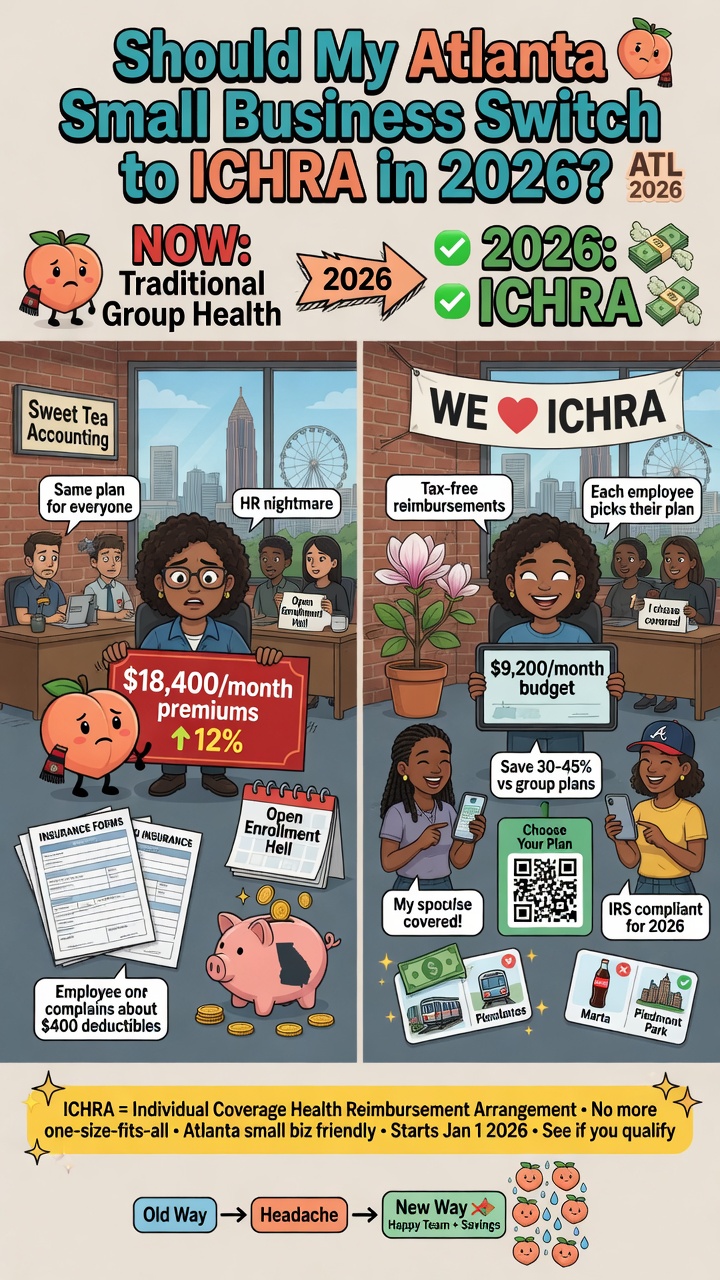
If you own a 2-to-50 employee business in Atlanta and your group health renewal just landed with another double-digit increase, you have probably heard a broker or a CPA mention ICHRA. The pitch sounds appealing: skip the traditional group plan entirely, reimburse each employee tax-free for an individual marketplace plan they pick themselves, and stop fighting carrier renewals every January.
The real question is not whether ICHRA exists. The real question is whether ICHRA is the right move for your specific business. For some Atlanta small businesses, it is the single biggest cost and complexity reduction available in 2026. For others, it is a worse deal than the traditional group plan they already have. The decision depends on your workforce structure, your geographic spread, your owner participation needs, and what your current group plan actually costs you.
This post walks through what ICHRA is in plain English, why Atlanta small businesses are switching in 2026, the specific business profiles that win with ICHRA, the profiles that lose with it, real reimbursement math for metro Atlanta groups, the 60-90 day implementation timeline, and the common mistakes owners make during the switch.
I'm Justin Bishop, an independent broker in Atlanta. I set up ICHRAs for Georgia small businesses every week — and I also tell owners to stay on their group plan when ICHRA is not the right fit. Here's the honest breakdown.
The 30-Second Version
ICHRA stands for Individual Coverage Health Reimbursement Arrangement. The employer gives each eligible employee a tax-free monthly amount to spend on any qualifying individual ACA marketplace plan, and the employee picks the plan that fits them best.
ICHRA replaces traditional group health. It is not an add-on. You either run a group plan or you run ICHRA — you do not run both for the same class of employees.
The five business profiles that typically win with ICHRA in 2026: multi-state or multi-office employee populations; high-turnover industries like restaurants and hospitality; businesses with very different plan preferences across employees; partnerships and S-corps where owner participation gets complicated; and small businesses whose current ACA-compliant group renewal jumped 15%+ year-over-year.
The four business profiles that typically lose with ICHRA: single-office groups with uniform demographics already on a competitive group plan; businesses where the owner wants employees to have an identical, predictable shared experience; groups whose individual marketplace options in their county are weak; and businesses with employees who deeply value broker-managed group plan support.
Atlanta ICHRA reimbursement benchmarks for 2026: $400-650/month for typical W-2 employees, $500-800/month for senior employees and executives, with class-based tiering allowed under the rules.
Tax treatment: ICHRA reimbursements are tax-free to the employee (no income tax, no payroll tax) and deductible to the business. Same employer outlay as a cash stipend; significantly more value to the employee.
Implementation timeline: 60-90 days from decision to first reimbursement, including TPA setup, employee notification (90-day requirement), plan year alignment, and employee plan selection.
The single most common mistake: setting reimbursement amounts based on what the owner wants to spend rather than what employees actually need to afford coverage. The right reimbursement math starts with the Atlanta marketplace silver-benchmark plan cost for your employees' ages.
What ICHRA Actually Is (Plain English)
ICHRA is a tax-advantaged structure that lets an employer reimburse employees for individual health insurance instead of buying a group plan. The mechanics are simpler than the acronym suggests.
How it works in practice:
The business establishes an ICHRA plan with a third-party administrator (TPA) who handles compliance and reimbursement processing
The business decides which class of employees the ICHRA covers (all employees, or specific classes like full-time-only, salaried-only, location-specific)
The business sets a monthly reimbursement amount per class (employee-only and family tier)
Each eligible employee chooses any qualifying individual ACA marketplace plan in their home state and county
The employee pays the premium directly to the carrier (or via payroll deduction in some setups)
The TPA verifies coverage and processes the reimbursement up to the monthly cap
Reimbursements are tax-free to the employee and fully deductible to the business
What ICHRA is not:
ICHRA is not a stipend or "extra paycheck." Stipends are taxable income. ICHRA reimbursements are tax-free because they are tied to verified health coverage purchase.
ICHRA is not the same as QSEHRA. QSEHRA has lower contribution limits and is restricted to businesses under 50 FTE. ICHRA has no contribution caps and no business size limit. See [#47 ICHRA vs QSEHRA (publishing 6/15)] for the head-to-head.
ICHRA is not "self-insurance." The employer is reimbursing premiums for fully insured individual plans, not paying claims directly.
ICHRA is not a workaround for the ACA Employer Mandate. For businesses with 50+ FTE, ICHRA can satisfy the mandate, but the reimbursement amount and employee class structure must meet specific affordability and minimum value rules.
The rules ICHRA must follow:
All employees in a covered class must receive the same reimbursement amount (with limited age-based and family-status variations allowed)
Employees must have qualifying individual ACA coverage to receive reimbursement (Georgia Access marketplace plans qualify; short-term medical and ministry plans do not)
Employer must give 90 days advance notice before the ICHRA plan year begins
Employees who participate in ICHRA forfeit their premium tax credit subsidy for marketplace plans (they cannot double-dip)
Why Atlanta Small Businesses Are Switching to ICHRA in 2026
The structural reasons ICHRA is gaining traction in metro Atlanta this year are specific.
Group renewal increases keep compounding. Most Atlanta small business owners on ACA-compliant fully insured plans have seen 10-15% renewal increases for three consecutive years. A group plan that cost $5,000/month in 2023 is now $7,500/month. ICHRA decouples your cost from the small group community rating pool — you set the reimbursement amount, period.
Workforces have spread out post-2020. Atlanta tech, professional services, and creative agencies routinely have employees in multiple states. Group health plans are state-specific; ICHRA lets each employee buy in their home state without the employer running multiple group plans.
Partner and owner eligibility is cleaner. S-corp shareholders, LLC members, partnership equity holders, and sole proprietors face complex group health participation rules. ICHRA structures can accommodate owner participation in ways traditional group plans cannot — though the tax treatment differs from W-2 employees and a CPA conversation is required.
Plan menu choice has improved on Georgia Access. Atlanta's individual marketplace now includes Anthem, Ambetter, Oscar, UnitedHealthcare, Cigna, and Kaiser. Employees can pick PPO, HMO, HSA-eligible HDHP, or copay-rich plans. The 2018-era "ICHRA only works in theory because individual plans are bad" complaint no longer holds in metro Atlanta.
The 2026 ACA subsidy cliff math hurts ICHRA-eligible employees less than you think. Yes, ICHRA-covered employees forfeit their premium tax credit. But for many Atlanta workforces, the ICHRA reimbursement amount more than offsets the lost subsidy — especially for employees over 400% of federal poverty level who get little or no subsidy anyway.
Administrative simplicity is real for some businesses. Group plan renewals require employee re-enrollment, plan design decisions, and ongoing compliance work. ICHRA, once set up, runs largely on autopilot — TPA handles compliance, employees handle plan selection, employer signs off on reimbursements.
When ICHRA Is the Right Switch
These are the five business profiles where ICHRA almost always beats a traditional group plan in Atlanta in 2026.
Profile 1: Multi-state or multi-office workforce. If you have employees in Georgia plus another state (Tennessee, Florida, Alabama, the Carolinas), a single group plan cannot cover everyone in-network. ICHRA solves this cleanly — each employee buys the marketplace plan that works in their location.
Profile 2: High-turnover industries. Restaurants, hospitality, retail, and gig-adjacent businesses face the group health participation rate problem (most carriers require 70%+ enrollment). ICHRA has no participation requirement. Each employee opts in or out individually. Covered in depth in What Health Insurance Should Atlanta Restaurants Offer?.
Profile 3: Businesses with very mixed plan preferences. When you have a 50-year-old employee who wants a Gold copay PPO, a 28-year-old who wants an HSA-eligible HDHP, and a 35-year-old family that wants a Bronze plan with rich pediatric coverage, no single group plan satisfies all three. ICHRA lets each employee pick the plan that actually fits them.
Profile 4: S-corps, LLCs, and partnerships with owner participation challenges. If you have K-1 partners, S-corp shareholders taking W-2 wages plus distributions, or LLC members who do not draw a regular salary, the owner participation rules on traditional group plans get complicated fast. ICHRA structures can accommodate owners more cleanly with the right CPA setup. See What Health Insurance Should Atlanta Law Firms Offer? for the K-1 partner detail.
Profile 5: Businesses whose ACA-compliant group renewal jumped 15%+. If your renewal letter is in the workbook and the increase is double-digit for the third year running, ICHRA is the rebuild option that decouples your cost from the small group community rating pool. You set the reimbursement; the marketplace prices the individual plans.
Bonus profile: Solo S-corps and 2-person LLCs. Small entities that do not qualify for group plans (covered in Can a 2-Person LLC Get Group Health?) can often use ICHRA to provide structured, tax-advantaged health benefits where group health is structurally unavailable.
When ICHRA Is NOT the Right Switch
These profiles do better staying on a traditional group plan — and ICHRA would be a worse outcome.
Profile 1: Single-office, uniform-demographic group already on a competitive group plan. If your group is 20 employees, all in metro Atlanta, all roughly the same age, all happy with the current plan, and your renewal increase is reasonable (under 10%), the traditional group plan is structurally fine. ICHRA adds administrative complexity without delivering enough upside.
Profile 2: Owner who wants employees to have an identical, predictable shared benefit experience. Some owners specifically value that every employee is on the same plan, with the same network, the same provider list, the same member portal, the same claims experience. ICHRA fragments that — every employee is on a different plan from a different carrier. If the unified experience matters culturally, stay on group.
Profile 3: Groups whose individual marketplace options are weak in their county. This is less of an issue in metro Atlanta than it was three years ago, but verify before switching. Some Georgia counties have only 1-2 marketplace carriers with thin provider networks. If your employees live in those counties, ICHRA might leave them worse off than the group plan.
Profile 4: Businesses whose employees deeply value broker-managed support. Group health employees often have a single broker contact for claims questions, network disputes, and plan changes. ICHRA-covered employees navigate the marketplace and their individual carrier directly. Some employees love the autonomy; others want the broker safety net. If your culture leans toward the safety net, factor that in.
Profile 5: Businesses with employees who are heavily subsidized on the marketplace. If most of your employees would qualify for substantial premium tax credit subsidies as individuals (typically 100-400% of federal poverty level for that household size), switching to ICHRA forfeits those subsidies. The reimbursement would need to be high enough to fully offset the lost subsidy, which can change the math.
The honest take: ICHRA is not universally better than group. It is structurally different. For the right business profile, it is dramatically better. For the wrong profile, it is dramatically worse. The audit comes first; the decision comes second.
The Tax Math (Why ICHRA Beats Cash Stipends)
HA common alternative owners consider is just paying employees extra cash to buy their own insurance. The tax math makes this almost always wrong compared to ICHRA.
Scenario: Owner wants to give each employee $600/month toward health insurance.
Cash stipend approach:
$600/month gets added to the employee's W-2 wages
Employee pays federal income tax (~15-22% for most W-2 earners), Georgia state income tax (~5.49%), and FICA payroll tax (7.65%)
Net to employee: roughly $400-440/month of actual buying power
Employer also pays FICA payroll tax on that $600: ~$46/month
Employer total cost: $646/month for $400-440 of employee net benefit
ICHRA approach:
$600/month reimbursement to employee tied to verified health coverage purchase
Reimbursement is tax-free to the employee — no income tax, no FICA
Net to employee: $600/month of actual buying power
Employer pays no FICA on the reimbursement
Employer total cost: $600/month for $600 of employee net benefit
Same employer outlay, ~35-50% more value to the employee. The IRS treats ICHRA reimbursements as health benefit payments, not wages — that is the entire tax advantage. If you are going to spend money on employee health benefits, do it through ICHRA, not a cash stipend.
ICHRA Implementation Timeline
The end-to-end switch from a traditional group plan to ICHRA takes 60-90 days. The rough sequence:
Days 1-15: Decision and TPA selection.
Broker runs the audit and confirms ICHRA fits your business profile
Owner selects a TPA (third-party administrator) — common Atlanta picks include Take Command, PeopleKeep, ICHRApros, and several others
Initial TPA contracting and platform setup
Business decides employee classes and reimbursement amounts
Days 15-45: Employee notification window.
ICHRA requires a 90-day advance notice to employees before the plan year begins
Educational materials distributed (TPAs typically handle this)
One-on-one employee meetings to walk through the marketplace plan selection process
Employees research marketplace plans in their county
Days 45-75: Plan selection and enrollment.
Open enrollment window on Georgia Access (or off-cycle special enrollment for ICHRA-triggered enrollment)
Each employee selects their individual marketplace plan and enrolls
Employees submit proof of coverage to the TPA
TPA verifies each employee's coverage qualifies for ICHRA reimbursement
Days 75-90: Plan year start and first reimbursement.
ICHRA plan year officially begins
First monthly reimbursements process through the TPA
Existing group plan terminates on the same day the ICHRA plan year begins (the transitions are designed to be same-day, not overlapping)
TPA handles ongoing compliance reporting
Most common plan year start dates for Atlanta small businesses:
January 1 (aligning with the calendar year and Georgia Access open enrollment)
July 1 (aligning with the mid-year ACA special enrollment window for businesses)
Off-cycle, anchored to the existing group plan's anniversary date
ICHRA Reimbursement Math for Atlanta Small Businesses in 2026
The right reimbursement amount is not what the owner wants to spend. It is what employees actually need to afford reasonable coverage in metro Atlanta. The standard methodology:
Step 1: Find the silver-benchmark plan cost in your county. This is the second-lowest-cost Silver plan on Georgia Access for a 40-year-old in your employees' county. For most metro Atlanta counties in 2026, this benchmark is roughly $480-580/month for a 40-year-old, scaling up by age curve.
Step 2: Decide whether your reimbursement should target Bronze, Silver, or Gold. Bronze leaves employees responsible for more deductible. Gold provides richer coverage. Silver is the typical anchor because it qualifies employees for cost-sharing reductions (when they have not opted into ICHRA — but this is a moot point for ICHRA-covered employees who forfeit subsidies).
Step 3: Apply age-based and family-status tiering if you want it. ICHRA rules allow modest variation by age and family status within a class.
Atlanta benchmark reimbursement amounts for 2026:
Hourly W-2 staff (single, age 25-35): $400-500/month — covers Bronze tier with modest employee contribution
Salaried W-2 employees (single, age 30-45): $500-650/month — covers Silver tier comfortably
Senior employees and managers (single, age 40-55): $650-800/month — covers Gold tier or rich Silver
Executives and owners (age varies): $700-1,000/month — covers preferred carrier on Gold or Silver
Family tier: typically 2.0x-2.5x the employee-only amount, depending on the business's contribution philosophy
Real example: 12-person Atlanta small business switching to ICHRA in 2026
4 hourly staff at $450/month × 12 = $21,600/year reimbursement
6 salaried employees at $575/month × 12 = $41,400/year
2 senior/executive at $750/month × 12 = $18,000/year
Total annual ICHRA cost: $81,000
Compared to the same group's ACA-compliant fully insured group plan at ~$580/month per enrolled employee with 80% employer contribution: $66,816/year
ICHRA in this scenario costs $14,000 more per year — but it solves multi-state hiring, accommodates partner participation, and decouples from group renewal volatility
The math goes the other way for groups with substantial geographic spread or high turnover — covered in the vertical-specific posts for restaurants, tech startups, and law firms.
Common Mistakes Atlanta Owners Make Switching to ICHRA
Patterns I see weekly at ICHRA setup conversations:
Setting reimbursement based on what the owner wants to spend, not what employees need. Start with the silver-benchmark plan cost for employees' actual ages, then tier from there. Working backward from "I want to spend $5,000/month" produces reimbursements too thin to actually help employees.
Skipping the employee survey before switching. Owners commit to ICHRA without asking employees if they prefer it. Some employees love the autonomy of picking their own plan; others would rather stay on a unified group plan with broker support. A two-question survey before the decision saves disappointment.
Forgetting to terminate the existing group plan on the right day. ICHRA and traditional group health cannot cover the same employee class simultaneously. The group plan termination date must align with the ICHRA plan year start date.
Treating ICHRA as a tax dodge for cash compensation. ICHRA reimbursements must be tied to verified individual health coverage. If you are reimbursing employees who do not actually buy qualifying coverage, the IRS treats the payments as taxable wages.
Ignoring the 90-day notice requirement. Decisions made in October for a January 1 plan year will miss the 90-day notice window. Plan ahead.
Not running the math against keeping the existing group plan. ICHRA is not categorically cheaper. For some single-office groups, the group plan wins on total cost. Run both options in parallel before deciding.
Setting reimbursement amounts that fail the ACA affordability test at 50+ FTE. For applicable large employers, ICHRA reimbursements must meet specific affordability rules to satisfy the ACA Employer Mandate. The wrong reimbursement amount triggers Section 4980H penalties.
Picking a TPA based on price alone. TPAs vary in employee experience, compliance support, and broker integration. The cheapest TPA often produces frustrated employees who think ICHRA is the problem when really the TPA is.
Underestimating the employee education effort. Most W-2 employees have never picked an individual marketplace plan. They need help. Plan for one-on-one meetings during the rollout window.
Forgetting workers' comp is separate. Workers' comp is required in Georgia at 3+ employees and is not bundled with ICHRA.
Frequently Asked Questions
Will my employees be worse off financially on ICHRA? Depends on the reimbursement amount and the employee's family situation. For employees who would qualify for substantial marketplace subsidies as individuals, ICHRA-covered employees forfeit those subsidies and might be financially better off staying on a group plan or off the ICHRA. For employees over 400% of federal poverty level who get little or no subsidy anyway, ICHRA reimbursements typically come out ahead. Run the math employee-by-employee before switching.
Can owners participate in ICHRA? Yes, with specific structuring. S-corp shareholders, LLC members, partnership equity holders, and sole proprietors can participate in ICHRA, but the tax treatment differs from W-2 employees. CPA involvement is required to structure correctly. Mishandled, the participation creates tax issues.
Does ICHRA satisfy the ACA Employer Mandate for businesses with 50+ FTE? Yes, when structured properly. The reimbursement amount must meet specific affordability and minimum value rules. A correctly structured ICHRA at the right reimbursement level satisfies the Employer Mandate for applicable large employers. A poorly structured one triggers Section 4980H penalties.
What if my employees cannot find a good marketplace plan in their county? Metro Atlanta counties have strong marketplace plan menus in 2026 (Anthem, Ambetter, Oscar, UnitedHealthcare, Cigna, Kaiser). Rural Georgia counties can have thinner menus. Verify county-specific plan availability for every covered employee before committing to ICHRA.
Can I have a group plan and ICHRA at the same time? Yes, but only for different employee classes. You cannot offer both to the same class. A common structure is group health for full-time W-2 staff and ICHRA for a separate class like part-time, remote, or 1099-eligible workers. The class structure must be defined in writing in the ICHRA plan documents.
What happens if an employee does not enroll in marketplace coverage? They get no reimbursement. ICHRA reimbursements are only paid for verified qualifying individual coverage. If an employee opts out of buying coverage (because they are on a spouse's plan, for example), they receive no ICHRA benefit. The reimbursement is not a stipend they can collect regardless of whether they have insurance.
How are ICHRA reimbursements treated for tax purposes? For the employee: tax-free (no federal income tax, no Georgia state income tax, no FICA). For the business: fully deductible as a health benefit expense. No FICA payroll tax on the employer side. This is the entire tax advantage versus cash compensation.
How long does ICHRA setup take from decision to first reimbursement? 60-90 days end-to-end. The 90-day employee notice requirement is usually the rate-limiting step. Decisions made in October typically align with a January 1 plan year start; decisions made in March-April align with a July 1 plan year start.
The Bottom Line
ICHRA is the most consequential small group health insurance development in Atlanta since the ACA itself. For the right business profile — multi-state workforce, high turnover, mixed employee preferences, owner participation challenges, or steep group renewal increases — ICHRA delivers cost control, structural flexibility, and tax-advantaged benefit value that traditional group plans structurally cannot match.
For the wrong business profile — single-office uniform group already on a competitive plan — ICHRA adds complexity without delivering enough benefit to justify the switch.
The decision is not "ICHRA or group health" in the abstract. The decision is "ICHRA or group health for my specific business in 2026." That requires a real audit: your workforce structure, your geographic spread, your owner participation needs, your current renewal trajectory, your employees' marketplace plan options by county, and your culture around benefit uniformity.
If you are an Atlanta small business owner considering ICHRA — or just trying to understand whether it actually fits your business — book a 15-minute call with me. I'll run the audit, model ICHRA against your current group plan with real numbers, and tell you honestly which structure wins for your business. Costs you nothing — I'm paid by carriers, not by you.
Want to keep reading? Check out Best Georgia Small Group Health Insurance Carriers for 2026 for the traditional group menu, Level-Funded or Fully Insured Group Health? for the structural decision when ICHRA isn't the right fit, or the three vertical guides for restaurants, tech startups, and law firms — each covers ICHRA in industry-specific context.
Justin Bishop is the founder of That Young Insurance Guy, an independent insurance brokerage in Atlanta, GA, licensed in 31 states. He writes the Health Coverage Chaos newsletter on LinkedIn — and yes, he answers his own texts.
This post is general education, not legal, tax, or financial advice. ICHRA rules, ACA Employer Mandate thresholds, Georgia marketplace carrier offerings, and tax treatment can change.