Self-Employed Health Insurance for Atlanta Freelancers, 1099 Workers & Solo Founders
Honest plan options. No corporate runaround. Built for people whose paycheck doesn't include benefits.
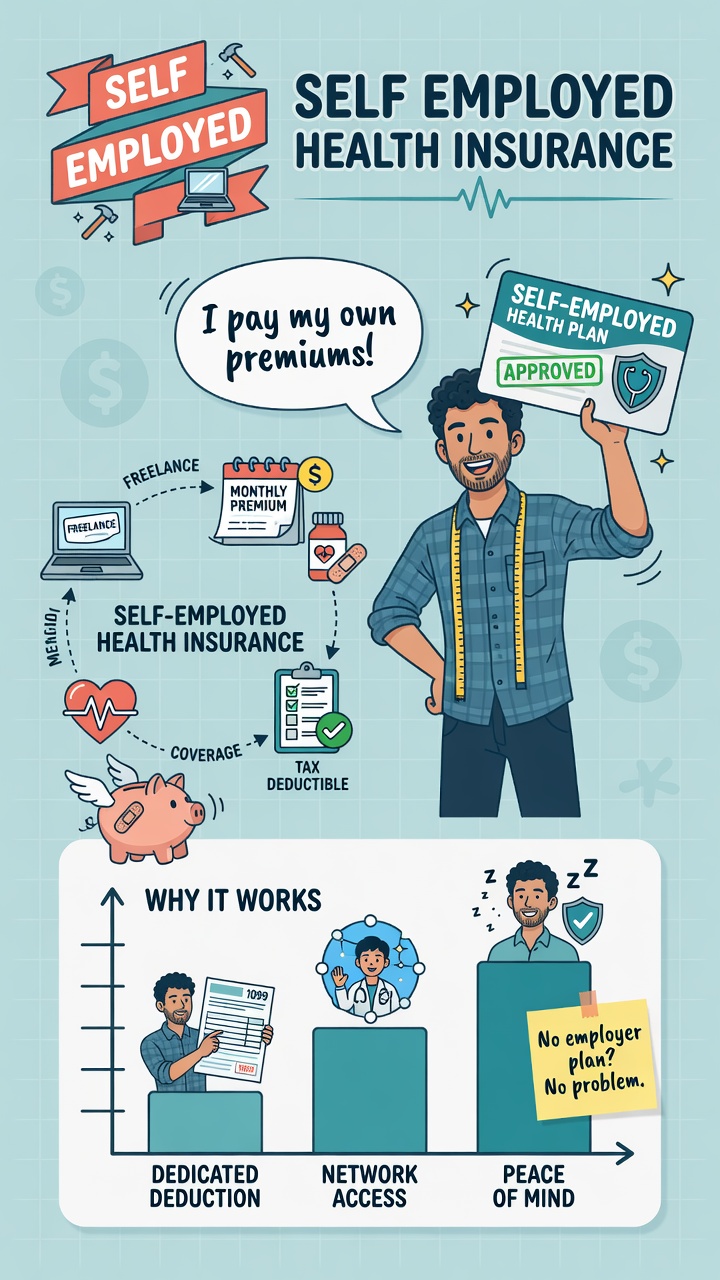
If you're self-employed in Georgia and just opened a 2026 renewal letter that doubled your premium, you're not alone — and you're not stuck.
I'm Justin Bishop, an independent insurance broker in Atlanta. I help freelancers, 1099 contractors, LLC owners, real estate agents, designers, consultants, and side-hustlers find health coverage that actually fits their income and their work. No employer HR department. No "open enrollment meeting." Just real plans, real numbers, and someone in your corner.
Let's get into what's actually going on, what your options are, and how to not overpay.
Quick Check: Is This Page For You?
If any of these sound like you, you're in the right place:
-1099 contractor or freelancer
-LLC owner (single-member, multi-member, S-corp)
-Real estate agent, broker, designer, developer, consultant, coach
-Solopreneur or content creator
-Just left a W-2 job and need coverage now
-Side-hustle income now exceeds your day job
-Spouse is self-employed and you're shopping family coverage
-Driving for Uber or DoorDash? Specific guide here: Health Insurance for Gig Workers
-Just aged off your parents' plan? See Health Insurance for Young Adults.
-Travel nurse specifically? See Health Insurance for Travel Nurses.
If you have W-2 employees of your own, you may belong on the group health insurance page instead — different rules, different math, sometimes better pricing.
If you have W-2 employees: Atlanta Group Health Insurance Cost Guide
If you're hiring 1-3 people and considering benefits, see Do I Need Group Health Insurance for My Employees?
Real estate agent specifically? See Health Insurance for Real Estate Agents.
Mortgage lender specifically? See Health Insurance for Mortgage Lenders.
1099 contractor in Atlanta? Your coverage path is structurally different from a W-2 employee. See How Do 1099 Contractors Get Health Insurance in Atlanta? for the six real coverage paths, subsidy math, and the self-employed tax deduction most contractors miss.
The 2026 Reality Check (Read This Before Anything Else)
Here's what nobody told you and what changed January 1, 2026:
The enhanced Premium Tax Credits expired December 31, 2025.
For four years (2021–2025), the federal government had expanded ACA subsidies under the American Rescue Plan and Inflation Reduction Act. Those expansions did two things:
They made marketplace plans dramatically cheaper for people earning between 100% and 400% of the federal poverty level.
They eliminated the "subsidy cliff" — meaning even high earners could qualify for some assistance if their premiums exceeded 8.5% of their income.
Both went away on January 1, 2026, when those provisions sunset.
What this means for self-employed Georgians right now:
Premiums on the marketplace jumped roughly 114% on average for unsubsidized buyers in 2026 — about $1,016/year more per person.
The subsidy cliff is back at 400% of the federal poverty level. That's roughly $63,000 for a single person, $85,000 for a couple, $105,000 for a family of four.
Earn one dollar over the cliff and you lose all premium tax credits — not a partial reduction. Full price.
Around 2.7 million self-employed workers were claiming enhanced PTCs as of 2022. A lot of them were the ones hit hardest by this change.
Translation: if your 2026 premium just doubled, this is why. And the planning game for self-employed health insurance got a lot more important than it was last year.
The good news: there are still real options, real subsidies if you qualify, and real ways to plan around the cliff. Most of which the marketplace site won't surface for you on its own.
The 5 Real Paths to Coverage When You're Self-Employed
There's no single "best" answer for self-employed health insurance — the right path depends on your income, your spouse's situation, your health, and how predictable your business is. Here are the five paths I actually walk clients through:
1. Georgia Access marketplace (ACA plans)
This is the default for most self-employed people. Georgia Access is Georgia's state-run version of the federal Healthcare.gov marketplace — it took over from the federal site for the 2025 plan year. Same plans, same subsidies, same enrollment windows.
Best for: Anyone earning between 100% and 400% of FPL who qualifies for premium tax credits. Even after the enhanced subsidies expired, ACA plans are still the best path for most subsidy-eligible self-employed Georgians.
Watch out for: The cliff at 400% FPL. If your projected income is anywhere near $60K (single) or $80K (couple), we plan for it carefully. One bad income estimate at tax time and you can owe back thousands.
Open Enrollment: Nov 1 – Jan 15 each year. Outside that window, you need a Special Enrollment Period (lost coverage, moved, married, divorced, had a baby, lost a job).
Want the full Georgia Access vs Healthcare.gov breakdown? Here it is.
For the broader Georgia marketplace overview, see Georgia Health Insurance Marketplace: A 2026 Guide
Wondering which marketplace tier fits a self-employed budget? See Bronze vs Silver vs Gold: Which Plan Do You Actually Need?
2. Spouse's employer plan
If your spouse has W-2 coverage available, run the numbers — sometimes it's the cheapest option, full stop. Most employer plans cover spouses at a moderately subsidized rate, which can beat marketplace pricing for self-employed earners over the subsidy cliff.
Best for: High-earning self-employed people whose spouse has decent employer coverage available.
Watch out for: "Spousal carve-out" plans that surcharge or refuse to cover a spouse who has access to their own coverage. Read the SBC carefully.
3. COBRA from a previous employer
If you just left a W-2 job, federal COBRA usually lets you keep your employer plan for up to 18 months. It's expensive (you pay 100% of the premium plus a 2% admin fee) but it's a known plan with no waiting period.
Best for: People who recently left a W-2 job and have ongoing medical care they don't want to interrupt — pregnancy, ongoing specialist care, or a planned procedure.
Watch out for: Cost. COBRA at full price often runs $700–$1,400+/month for a single person. For most self-employed people, a marketplace plan ends up cheaper.
Just laid off and considering going independent? Start with the layoff health insurance playbook
4. Health share ministries
Not insurance — a member-cost-sharing arrangement, usually faith-based. Members pay a monthly "share" and the ministry coordinates payment for qualifying medical needs.
Best for: Healthy self-employed people who are fundamentally opposed to the marketplace, fall above the subsidy cliff, and accept the tradeoffs.
Watch out for: No legal requirement to pay your claims. Pre-existing conditions are typically excluded. Maternity, mental health, and prescriptions often have major restrictions. Read the membership guide line-by-line before joining.
5. The "group of one" workaround
If you have an LLC, S-corp, or sole proprietorship and you put your spouse on payroll as a W-2 employee, you can sometimes qualify for a small-group health plan with two enrollees. Georgia carriers' rules vary — some require true employees, not just family on paper.
Best for: Self-employed couples earning over the subsidy cliff who would otherwise pay full marketplace prices.
Watch out for: This has to be a real employment arrangement (real wages, real W-2, real work). Don't try to fake it — carriers and the IRS will scrutinize. We'll talk through whether it's a legitimate fit.
The Self-Employed Health Insurance Tax Deduction (The One Thing Almost Nobody Mentions)
If you're self-employed and you pay your own health insurance premiums, you can deduct 100% of those premiums from your federal income taxes — above the line, on Schedule 1 of your 1040. No itemizing required, no medical expense threshold to clear.
That's a real, large, often-forgotten tax break.
Quick example: If you pay $700/month for a marketplace plan ($8,400/year) and you're in the 22% federal bracket, you're saving roughly $1,848 in federal income tax — plus state tax savings on top.
A few rules:
The deduction can't exceed your net self-employment income.
It applies to medical, dental, and qualified long-term care premiums — for you, your spouse, and dependents.
If you're eligible for an employer plan through a spouse, you usually can't claim this deduction in months you were eligible.
It doesn't reduce self-employment tax (FICA), only income tax.
Practical takeaway: when you're comparing the after-tax cost of marketplace premiums vs. spouse's employer plan vs. COBRA, this deduction can flip the answer. I run that math with clients before recommending anything.
The HSA Play (If You're Healthy and Self-Employed, Read This)
If you're reasonably healthy, run consistent income, and don't expect heavy medical spending in 2026, an HSA-eligible high-deductible health plan (HDHP) is one of the most underrated moves in self-employed health insurance.
How it stacks up:
Lower monthly premium than most non-HDHP marketplace plans.
Triple tax advantage on the HSA itself: contributions are deductible, growth is tax-free, withdrawals for medical expenses are tax-free. There's no other account that does all three.
2026 contribution limits: $4,400 for self-only HDHP coverage, $8,750 for family coverage. Both bumps from 2025.
No "use it or lose it" — unlike an FSA, HSA dollars roll over forever and become a stealth retirement account after age 65.
The catch: if you have a high-spending year (surgery, baby, big specialist work), you'll feel the deductible. We model both scenarios before recommending.
Full guide: HSA Contribution Limits 2026: How to Actually Use Them.
What About Life, Disability, and Business Insurance?
Health insurance isn't the only gap when you're self-employed. The big three other lines I'd put on your radar:
Life insurance — if anyone depends on your income, term life is shockingly cheap when you're young and healthy. A 30-year-old non-smoker can get $500K of 20-year term for around $25–35/month. Buy it before health changes make it expensive.
Disability insurance — the one most self-employed people forget. If you can't work for 6 months, who pays the bills? W-2 employees often have group disability built in; you don't. Worth pricing.
Business insurance — general liability, professional liability (E&O), and workers' comp if you have any subcontractors. If you're an LLC, this is non-negotiable.
I quote across all of these. Bundling discounts aren't huge, but having one person who knows your full financial picture is worth a lot when something goes wrong.
How I Work With Self-Employed Clients
Self-employed insurance has different rhythms than W-2 insurance. Income is lumpy. Your situation changes mid-year. The marketplace site asks questions that don't have clean answers when you're a freelancer. Here's how I handle it:
15-minute call or text exchange to understand your business, your income shape, your doctors, and your spouse/family situation.
I project your 2026 MAGI (modified adjusted gross income) carefully — accounting for self-employment deductions, retirement contributions, and the self-employed health insurance deduction itself. Your MAGI is what determines subsidy eligibility, and the marketplace site doesn't help you get this right.
I shop on Georgia Access AND off-marketplace — there are sometimes better plans the marketplace doesn't show.
You get 2–3 real options with the math: monthly premium, after-tax cost, total exposure if you have a bad year.
You decide. No pressure. If you want to think on it, that's fine. If you want to enroll today, we can have it done in 30 minutes.
Mid-year adjustments. Self-employed income changes. If your business has a great Q3 and you'll blow through the subsidy cliff, we update Georgia Access ASAP so you don't owe a giant tax surprise. That's the ongoing relationship part.
Frequently Asked Questions About Self-Employed Health Insurance in Georgia
Can I get health insurance if I'm self-employed in Georgia?
Yes — and the marketplace is actually built for you. There's no "employer" requirement for ACA coverage. As long as you live in Georgia, file taxes, and aren't eligible for affordable employer-based coverage, you can buy a Georgia Access plan. Most self-employed Georgians I quote qualify for some level of subsidy.
How do I prove income to Georgia Access if I'm self-employed?
Self-employment income verification usually means recent tax returns (Schedule C or K-1), profit-and-loss statements, and projected income for the coming year. Income often fluctuates for freelancers — we project conservatively but realistically, and update it mid-year if needed to avoid tax-time surprises.
Will I qualify for a subsidy if I'm self-employed?
Possibly — depends on your projected MAGI for the year. For 2026, the cliff is back: between 100% and 400% of the federal poverty level you may qualify (roughly $15K–$60K single, $20K–$80K couple). Above 400% FPL, no subsidy. The good news: as a self-employed person, you have more levers to manage your MAGI than a W-2 employee — solo 401(k), SEP-IRA, HSA contributions, the self-employed health insurance deduction, and timing of expenses all reduce your taxable income and can keep you under the cliff.
What if I make too much for a subsidy?
You still have options. Off-marketplace plans, the "group of one" structure, a spouse's employer plan, or short-term medical (with caveats) can all work. Above the cliff is exactly where having a broker matters most — the marketplace site won't show you the alternatives. We talk through tradeoffs and find the lowest after-tax total cost.
Is the self-employed health insurance deduction worth it?
Almost always yes. If you pay your own health premiums and have net self-employment income, you can deduct 100% of premiums from federal income tax — above the line, no itemizing. For a typical $8,000–$10,000 annual premium, that's $1,500–$2,500 in real tax savings. Talk to your CPA, but most self-employed people leave this on the table by accident.
Can I sign up for a plan outside Open Enrollment if I'm self-employed?
Only if you have a Qualifying Life Event — losing prior coverage, moving, getting married or divorced, having a baby, aging off a parent's plan at 26, becoming a US citizen. Voluntarily quitting a W-2 job to go full-time self-employed counts as a QLE if you had employer coverage. You usually have 60 days from the event to enroll. If you missed it, short-term plans can bridge the gap.
For the deeper SEP guide, see here.
Most self-employed Atlantans are also dramatically under-insured on life. Run the DIME calculation here: How Much Life Insurance Do You Actually Need in 2026?."
Most self-employed Atlantans buy the wrong type of life insurance. Read the honest comparison: What's the Difference Between Term Life and Whole Life?
For the full landscape of affordable Georgia options (including some that aren't on the marketplace), see Affordable Health Insurance Options in Georgia for 2026.
If your business has employees and you are considering structured benefits, ICHRA is often a strong fit. See Should My Atlanta Small Business Switch to ICHRA in 2026?.
Ready to Talk?
Easiest path: call or text (706) 988-1930. Tell me you're self-employed and what's going on with your coverage — I'll send you 2–3 real options inside 24 hours.
Or book a free 15-minute consult. I'll come ready with questions about your business, your spouse's coverage situation, and your projected income, so you don't waste the time.
Free. No pressure. No 47-email follow-up sequence.