
Do I Need Workers' Comp for My Small Business?
Author: Justin Bishop · May 22, 2026 · 8 min read
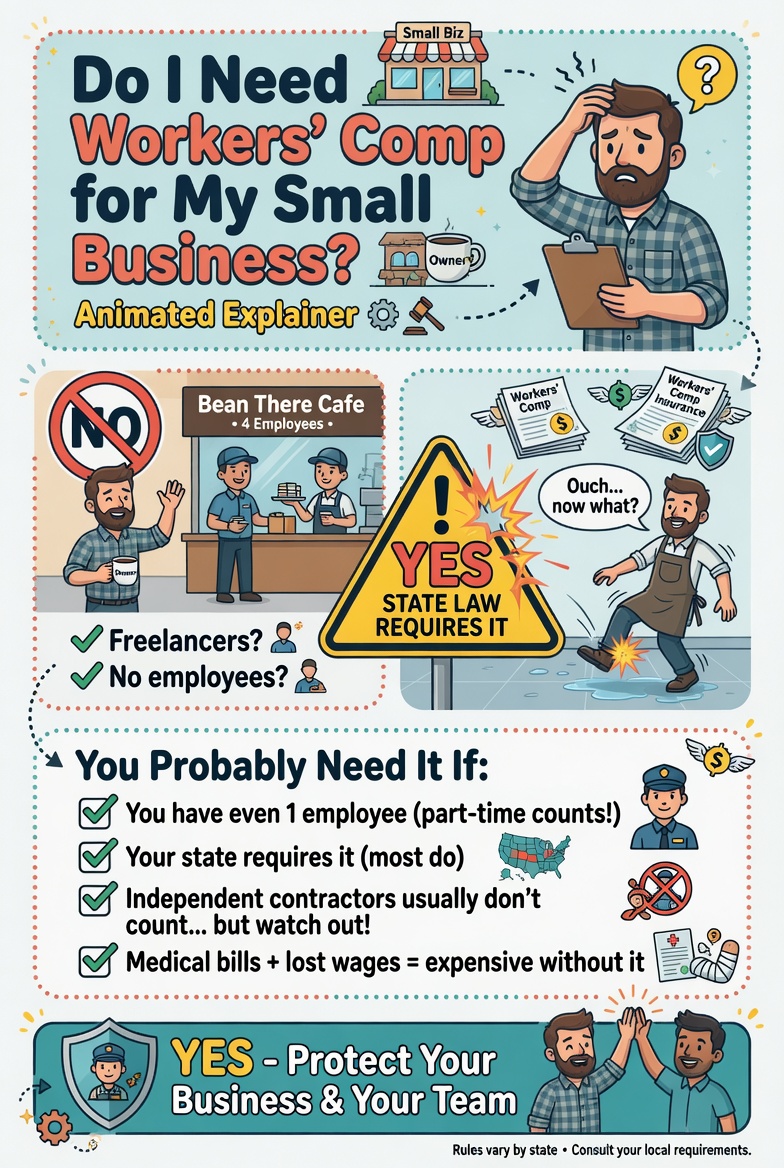
If you're an Atlanta small business owner who just hired employee number three — or who's been quietly running with "1099 contractors" instead of W-2 employees to avoid the question — you've probably wondered: do I actually need workers' compensation insurance?
The short answer for Georgia: yes, you almost certainly do. Georgia requires workers' comp at just 3 or more employees — one of the lower employee thresholds in the country. And the misclassification trap (calling employees "independent contractors" when they don't actually qualify) is the #1 trigger for state audits, penalties, and back-premium assessments.
This post walks through Georgia's specific workers' comp rules, who actually counts as an "employee," what coverage actually costs in 2026 by industry, the misclassification trap that catches Atlanta businesses every week, and modern pay-as-you-go programs that have replaced traditional audit-back-charge structures.
I'm Justin Bishop, an independent broker in Atlanta. I write workers' comp policies regularly — often for businesses that just realized they crossed the 3-employee threshold last month. Here's the practical breakdown.
The 30-Second Version
Georgia law requires workers' comp at 3+ employees (regular or seasonal). Crossing the threshold triggers required coverage.
Independent contractors don't count toward the threshold — but misclassification is the #1 enforcement trigger
Penalty for non-compliance: $1,000-$10,000 per day, plus potential criminal penalties for repeat offenders
Typical Atlanta cost: ranges from $0.30-$25 per $100 of payroll depending on industry. Office workers are cheap; construction is expensive.
What WC covers: medical bills, lost wages, disability, death benefits for work-related injuries. What it doesn't: lawsuits from injured employees beyond statutory benefits (Employer Liability covers this — usually bundled).
Pay-as-you-go programs are the modern standard for small businesses — premium billed per payroll instead of annual estimate + audit-back-charge. Better cash flow.
Sole proprietors and partners can exempt themselves from their own WC coverage in most cases, even when required to provide it for employees.
Georgia's Workers' Comp Law: The 3-Employee Rule
Georgia is one of the strictest states for workers' comp thresholds. Under O.C.G.A. § 34-9-2, any business with 3 or more regular employees (full-time, part-time, or seasonal) must carry workers' comp coverage.
Key specifics:
Threshold is 3+ employees. Counting all employees: full-time, part-time, seasonal. Not just full-time.
The clock starts at hire #3. You're required to have coverage in place once you cross the threshold — not 30 days later.
Penalty for non-compliance: $1,000-$10,000 per day for businesses operating without required coverage. Repeat offenders face criminal penalties.
Reporting: Georgia State Board of Workers' Compensation receives notifications via the Georgia Department of Labor, unemployment insurance filings, and routine state audits.
No grace period for "I didn't know." Ignorance of the requirement is not a defense.
Most Atlanta businesses cross the threshold without realizing it — typically when they hire a part-time bookkeeper, a seasonal sales associate, or a backup driver. The day you have 3 employees on your payroll, coverage is required.
Who Actually Counts as an "Employee" (and Who Doesn't)
This is where most misclassification problems start. Georgia's definition of "employee" for workers' comp purposes is broader than most owners realize:
These DO count toward the 3-employee threshold:
Full-time W-2 employees
Part-time W-2 employees
Seasonal employees
Temporary employees on your payroll (with some exceptions for staffing agency arrangements)
Family members on payroll
Officers of corporations (in most cases)
Members of LLCs who are also working for the LLC (in some cases)
These do NOT count toward the threshold:
Legitimately classified independent contractors (1099)
Genuine subcontractors with their own businesses
Volunteers (in most cases)
Sole proprietor themselves (optional self-coverage)
Partners themselves (optional self-coverage)
Real estate licensees (often statutorily excluded)
Certain agricultural workers (specific exemptions)
The 1099 question is the trap. Calling someone a "1099 contractor" doesn't make them one. Georgia uses a multi-factor test similar to the IRS 20-factor test to determine actual employment status. Key factors:
Does the worker control how and when work is done?
Does the worker use their own tools and equipment?
Does the worker provide services to multiple businesses?
Does the worker carry their own business insurance?
Is the work performed integral to the hiring business's operations?
Is the relationship continuous and long-term?
If the worker is primarily controlled by you, uses your tools, works only for you, and does work essential to your business — they're an employee for workers' comp purposes, regardless of how you label them on paper.
What Workers' Comp Actually Covers
Workers' comp is a "no-fault" insurance — the injured employee doesn't have to prove the employer was negligent, and the employer is shielded from most tort lawsuits arising from work injuries.
Coverage includes:
Medical bills — treatment for injuries arising from work, including hospitalization, surgery, prescriptions, rehab
Lost wages — typically 2/3 of the employee's average weekly wage, up to Georgia's statutory maximum (~$800/week for 2026)
Temporary total disability — payments while the employee is unable to work
Permanent partial disability — for lasting injuries that affect future earning capacity
Permanent total disability — for catastrophic injuries
Vocational rehabilitation — retraining if the employee can't return to their previous job
Death benefits — payments to dependents if a workplace injury is fatal
Funeral expenses — typically up to $7,500 in Georgia
Employer Liability coverage (usually bundled into the WC policy) covers situations where injured employees might sue you outside the WC system — typically through third-party claims, deliberate misconduct allegations, or family-member claims for loss of consortium.
What Workers' Comp Does NOT Cover
Critical exclusions Atlanta business owners need to understand:
Injuries outside the scope of employment (commuting, lunch off-premises, personal errands)
Self-inflicted injuries
Injuries while intoxicated or under the influence of drugs (in many cases)
Injuries from horseplay or willful misconduct
General liability claims (customer injuries, property damage — needs separate GL coverage)
Employment practices liability (wrongful termination, discrimination — needs separate EPLI)
Health insurance for non-work-related illness — completely separate product
Pain and suffering damages — WC is the "exclusive remedy" and excludes these types of damages
Real 2026 Atlanta Workers' Comp Pricing by Industry
WC premiums are calculated as rate per $100 of payroll based on your industry classification (NCCI class codes). Some 2026 Atlanta benchmark rates:
Office/clerical (NCCI 8810): $0.30-$0.60 per $100 payroll
Retail (most types): $0.80-$2.00 per $100 payroll
Restaurant/food service: $1.50-$3.50 per $100 payroll
Auto dealership service: $2.50-$4.50 per $100 payroll
Trucking (local delivery): $4.00-$9.00 per $100 payroll
General contractor: $5.00-$15.00 per $100 payroll
Electrical contractor: $4.00-$8.00 per $100 payroll
Plumbing contractor: $5.00-$10.00 per $100 payroll
Roofing contractor: $10.00-$25.00 per $100 payroll
HVAC: $3.50-$7.00 per $100 payroll
Landscaping: $5.00-$10.00 per $100 payroll
Healthcare (non-hospital): $1.00-$3.00 per $100 payroll
Professional services (consulting, legal, accounting): $0.30-$0.80 per $100 payroll
Example calculation: a general contractor with $400K in payroll and an $8/$100 rate = $400,000 × ($8/$100) = $32,000/year in WC premium.
Same payroll for an office services business at $0.50/$100 = $2,000/year. Industry classification matters enormously.
Experience Modification Factor (EMF): carriers adjust premiums up or down based on your claims history over the prior 3 years. Clean record = below 1.0 (discount). Recent claims = above 1.0 (surcharge). Can swing total premium 20-50% in either direction.
The Misclassification Trap (Most Common Penalty Trigger)
The single most common reason Atlanta businesses get hit with WC penalties: misclassifying employees as 1099 contractors.
Industries where this happens most:
Construction (treating crews as 1099 subcontractors when they don't qualify)
Restaurants and food service (treating servers, cooks, or delivery drivers as 1099)
Salons and barbershops (treating chair-renting workers as 1099 when they don't meet the test)
Professional services (treating support staff as 1099 contractors)
Delivery and transportation (a major area of ongoing legal debate)
Cleaning and janitorial (similar issue)
What triggers a state audit:
A worker files an unemployment claim and is determined to be an employee (cascading audit)
An injured worker files a WC claim and discovers no policy exists
A competitor reports you to the state
Random state audit (Georgia Department of Labor performs these)
Federal Department of Labor referral
IRS audit cross-reference
What happens if misclassification is found:
Back-premium owed (typically 3-7 years' worth)
Penalties of $1,000-$10,000/day for periods of non-coverage
Possible criminal penalties for willful violations
Personal liability for officers/owners in some cases
Additional federal and state tax obligations
The cost of misclassification is almost always higher than the cost of legitimate WC coverage from day one.
Pay-As-You-Go vs Traditional Annual Premium
Modern small business WC has two billing structures:
Traditional Annual Premium (the old way):
You estimate annual payroll at policy start
Pay annual premium upfront (or quarterly)
Carrier audits your actual payroll at year-end
You owe additional premium if actual exceeded estimate
The audit surprise: growing businesses routinely owe $5,000-50,000+ in audit back-charges
Pay-As-You-Go (the modern way):
Premium calculated each payroll period based on actual payroll
Carrier integrates with your payroll provider (Gusto, ADP, Paychex, QuickBooks, etc.)
Pay as you go — no annual estimate, no audit back-charge
Better cash flow for seasonal and growing businesses
For most Atlanta small businesses, pay-as-you-go is dramatically better unless you have very stable, predictable payroll year-over-year. Carriers offering modern pay-as-you-go in Atlanta include:
Pie Insurance (small business focus, fast quotes)
Next Insurance
Hourly (newer entrant, payroll-integrated)
Cake Insure
The Hartford (offers pay-as-you-go on some products)
Coterie
AmTrust (has pay-as-you-go programs)
If you're currently on a traditional annual premium structure with audit back-charges that surprise you, switching to pay-as-you-go is one of the easiest cash flow improvements available.
The Major Atlanta Workers' Comp Carriers
Beyond the pay-as-you-go innovators above, traditional WC carriers active in Atlanta:
The Hartford — strong small business focus
Travelers — broad industry coverage
Liberty Mutual — competitive pricing
Chubb — premium service, higher-end pricing
Berkshire Hathaway GUARD — competitive in many industries
Employers Holdings — small business specialty
AmTrust — broad reach
Liberty Mutual — strong in standard markets
Builders Insurance Group — Atlanta-based, strong for construction
GA Underwriting Association — Georgia's last-resort market (more expensive)
Best path: independent broker. Like every business insurance line, WC pricing varies dramatically across carriers. An independent broker can quote 5-8 carriers in one shot.
How to Lower Your Workers' Comp Premium
Specific moves that work:
Verify your class code is correct. Misclassification into a higher-risk class code is common — small businesses often get classified higher than they should.
Improve your safety record. Claims history drives the experience modification factor (EMF). A 3-year clean record can drop premium 15-25%.
Implement a safety program. Documented safety procedures, training records, hazard prevention. Some carriers offer 5-15% discounts for established programs.
Use a payroll provider that integrates with pay-as-you-go WC programs. Removes the audit surprise.
Bundle with other commercial policies. Some carriers offer multi-policy discounts.
Maintain proper documentation. Keep records of all 1099 contractor agreements showing they meet the test. Reduces audit risk.
Shop every 2-3 years. Carrier pricing changes; renewal pricing isn't always competitive.
Consider self-insured trusts — for businesses with $500K+ in WC premium, self-insurance trusts can dramatically reduce cost.
Address claims promptly — modified-duty return-to-work programs reduce wage loss benefits.
Common Workers' Comp Mistakes Atlanta Owners Make
Patterns I see weekly:
Misclassifying employees as 1099. The single biggest trigger for state enforcement. Save money short-term, pay back-premium plus penalties later.
Operating without coverage between hire 2 and hire 3. No — you have to have coverage in place when you cross the threshold, not before, but not after.
Letting coverage lapse during financial squeezes. $1K-10K/day penalty per day uncovered. Don't gamble.
Not posting required workplace notices. Georgia requires specific WC notices posted in employee-accessible areas.
Including yourself as a sole proprietor in WC coverage. You can usually exempt yourself, saving 20-40% of premium.
Not updating payroll estimates as you grow. Audit back-charge can wipe out a year of cash flow.
Carrying WC but ignoring Employer Liability limits. Most policies bundle these — but verify your Employer Liability limit is at least $500K/$500K/$500K.
Picking based on premium alone. Claims service quality matters more than premium savings on WC. A claim handled poorly can cost you in employee morale, premium increases, and possible lawsuit exposure.
Not bundling WC with general liability. Some carriers offer discounts for bundled small business policies.
Frequently Asked Questions
At exactly what point do I need workers' comp in Georgia? When you have 3 or more regular employees on payroll. Coverage must be in place from the day you cross the threshold.
Do part-time and seasonal employees count? Yes — both count toward the 3-employee threshold under Georgia law.
Can I be a 2-employee business and skip workers' comp? You can legally skip required WC at 2 or fewer employees. But you can still voluntarily carry WC if you want to protect against workplace injury claims. Some Atlanta businesses do this voluntarily for asset protection.
As a sole proprietor with employees, do I need to cover myself? No — sole proprietors and partners can exempt themselves from their own WC coverage even when required to provide it for employees. Saves money.
Are independent contractors covered by my WC policy? No — independent contractors aren't your employees. They should carry their own coverage. But: if you misclassify someone who is actually an employee as a contractor, state enforcement will find them and you'll owe back premium.
How fast can I get WC coverage? Pay-as-you-go carriers (Pie, Next, Hourly) often bind same-day for simple businesses. Traditional carriers typically 2-5 business days.
Does WC cover injuries during the commute to work? Generally no — commuting injuries are typically excluded. Injuries on company time or company property are covered. The line is sometimes blurry; check your specific policy.
What if my employee is injured during a work-from-home day? WC generally covers injuries during work-related activities, even at home. The key is whether the injury was work-related (typing-related repetitive strain) vs personal (slipping on personal stairs while not working). Coverage is increasingly important as remote work expands.
Does WC cover mental health conditions caused by work? In Georgia, generally no for pure mental health claims arising from work stress alone. Physical injuries that lead to mental health complications (PTSD after a traumatic workplace incident) can be covered.
The Bottom Line
For Atlanta small businesses growing past 2 employees, workers' comp isn't optional — it's required by Georgia law. And the misclassification trap (calling employees "1099 contractors") is the most expensive mistake you can make in this category. Better to pay legitimate WC premium from day one than face back-premium, penalties, and potential criminal liability later.
For most Atlanta small businesses: modern pay-as-you-go WC from carriers like Pie, Next, or Hourly is the right answer. Integrates with your payroll, eliminates audit surprises, and costs the same or less than traditional annual policies.
If you're an Atlanta small business owner who's hired your third employee — or who's been running with "1099 contractors" you suspect might not qualify — book a 15-minute call with me. I'll review your situation, quote WC across 5-8 carriers, identify any misclassification risk, and tell you exactly what coverage you need and what it costs. Costs you nothing — I'm paid by carriers, not by you.
Want to keep reading? Check out Where Do I Get a Business Owner Policy in Atlanta?, General Liability Insurance for Atlanta Small Businesses, or My Employee Just Quit. How Long Do They Stay on Group Health?.
If you're also evaluating group health for your small business, see Can a 2-Person LLC Get Group Health? for the qualification rules
Restaurants face workers' comp + group health challenges in tandem. See What Health Insurance Should Atlanta Restaurants Offer? for the benefits side.
Justin Bishop is the founder of That Young Insurance Guy, an independent insurance brokerage in Atlanta, GA, licensed in 31 states. He writes the Health Coverage Chaos newsletter on LinkedIn — and yes, he answers his own texts.
This post is general education, not legal, tax, or HR advice. Workers' compensation rules, Georgia employee classification tests, premium rates, and state penalty amounts change.