
What Health Insurance Should Atlanta Construction Companies Offer?
Author: Justin Bishop · June 23, 2026 · 11 min read
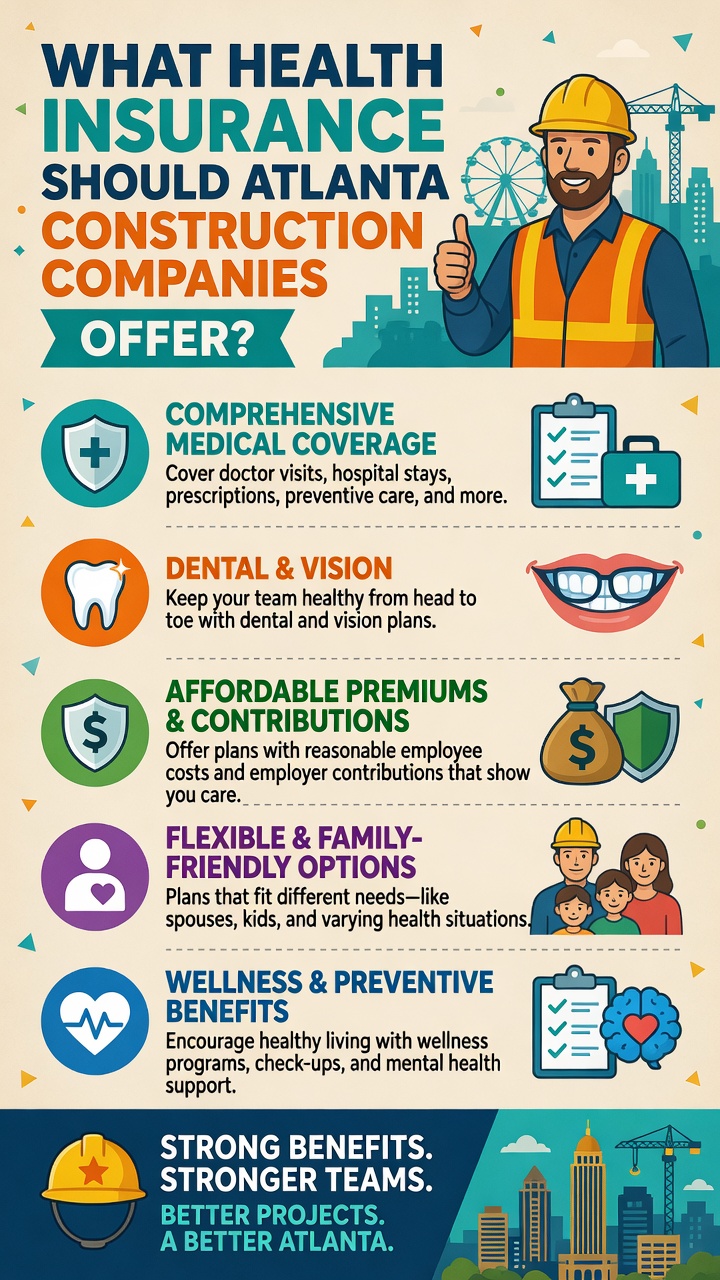
If you own or run a construction company in Atlanta — whether it is a 4-person electrical contracting business in Decatur, a 22-person framing crew working residential subdivisions across the metro, a 45-person general contractor handling commercial buildouts, or a 70-person mechanical contracting firm with project crews scattered across Georgia and into the Carolinas — you have probably found that the benefit conversations available to you don't quite fit your business.
Your workforce is mixed. Some are W-2 skilled trades (lead electricians, project managers, foremen). Some are W-2 laborers. Some are 1099 subcontractors who come and go by project. Your workers' comp premium is its own significant line item that often exceeds the entire group health budget. Your skilled trades retention depends heavily on benefits because Atlanta's labor market for licensed trades is brutally tight. And your insurance broker may or may not understand the structural realities that make construction different from other small businesses.
This post walks through the four real benefit structures for Atlanta construction companies, why the FT-vs-1099 workforce split changes the math, how WC interacts with health benefit design, where private medically underwritten plans fit for skilled trades, how ICHRA solves the 1099 subcontractor question, real cost math for solo electrical / mid-size GC / multi-state mechanical scenarios, and the common mistakes I see construction owners make.
I'm Justin Bishop, an independent broker in Atlanta. I quote benefits for construction companies across the metro every week — and yes, I understand that your WC premium and your skilled trades retention are usually a bigger deal than the group health quote. Here's the honest breakdown.
The 30-Second Version
Four real approaches, in order of fit for most Atlanta construction companies: Hybrid: private medically underwritten group plan for FT skilled trades + ICHRA for laborers + no coverage for 1099 subs (the most common right structure — captures savings on the skilled trades who underwrite favorably, gives laborers a tax-advantaged path, respects the 1099 boundary) Full ICHRA across all W-2 classes (works well for multi-state contractors or businesses with project crews scattered geographically) Traditional ACA-compliant group health for W-2 employees (when the workforce skews older with health issues, or owner wants maximum predictability) Cash stipend (worst tax outcome — avoid)
The 1099 subcontractor boundary. 1099 subs are not your employees and cannot legally be on your group health plan. You can recommend they look at the marketplace, but you cannot reimburse them through ICHRA without re-classifying the relationship (which usually creates worker classification problems). Keep the boundary clean.
WC dominates the insurance conversation. Construction WC premiums often run $4-$25 per $100 of payroll depending on trade classification (roofers, ironworkers, and electricians hit the high end; office and supervisor classes hit the low end). A typical $2M-payroll Atlanta GC pays $80K-$300K/year in WC alone. Your group health quote is a fraction of that. The broker who handles both lines together saves you more than either alone.
Skilled trades retention is benefits-driven now. Atlanta's licensed electrician, plumber, and HVAC labor market has been tight since 2022 and is not loosening. Benefits are a hiring tool, not just a cost line.
Atlanta construction company typical cost in 2026: $480-$680/month per enrolled W-2 employee for private medically underwritten Silver-equivalent coverage; $580-$820/month for ACA-compliant fully insured; $500-$750/month for ICHRA reimbursements to skilled trades.
Mental health coverage is non-negotiable. Construction has the highest suicide rate of any major US industry (CDC data, multi-year). Strong behavioral health benefits are not a bonus — they are a moral and operational necessity.
Common mistake: treating all W-2 employees the same on benefit design. Your $35/hour journeyman electrician needs a different benefit conversation than your $18/hour laborer. The class-based approach respects that.
The right move for most Atlanta construction companies: hybrid structure — private medically underwritten group plan for FT skilled trades (the retention play), ICHRA for laborers (the affordability play), no benefit obligation for 1099 subs (the legal boundary), all coordinated with WC by a single broker.
Why Construction Companies Have Unique Benefit Challenges
Most service businesses have one workforce profile. Construction has three or four, and they are very different from each other.
Owner and office staff. Office-based work, lower-risk WC classification. Typically older. Often the owner is a former tradesperson who built the business up. Tax-advantaged personal coverage matters (similar to medical practice owners — see What Health Insurance Should Atlanta Medical Practices Offer? for the owner-coverage angle).
Skilled trades (FT W-2 employees). Licensed journeymen, masters, foremen, project managers. Often family-supporting earners in their 30s-50s. The retention play. They have options — Atlanta's tight labor market means a strong benefit package is what keeps them from jumping to the competitor down the street.
Laborers and apprentices (FT W-2 employees). Lower-wage W-2 workers. Often younger, often without much benefit history. Need affordable basic coverage. High turnover risk; benefits can reduce turnover but the budget per employee is tighter.
1099 subcontractors. Project-by-project independent workers. Legally not your employees. Cannot be on your group health plan (and you cannot ICHRA-reimburse them without re-classifying the relationship, which creates worker classification exposure). Their benefits are their own problem.
Multi-state field workers (some firms). Commercial GCs and specialty trades often have crews working out-of-state. Group plans are state-specific; ICHRA accommodates the geographic spread.
The result is a benefit plan that has to satisfy:
An office staff who values predictable, comprehensive coverage
Skilled trades who view benefits as a major job-selection factor and will leave for better
Laborers who need affordable coverage that doesn't eat their take-home
A 1099 subcontractor population that legally can't be on your plan but who you'd like to keep coming back to your projects
A WC premium that towers over the group health budget and needs to be managed in coordination
Single-plan group health that works for office staff often fails the skilled trades retention test or prices the laborers out. The right answer is usually a tiered structure.
Other construction-specific realities:
WC classification drives the budget. A small office-only operation might pay 0.5-1% of payroll in WC. A roofing crew pays 15-25%. Same dollar of payroll, very different total insurance burden. Health benefits decisions have to fit inside that broader picture.
Project-based income volatility for the owner. Construction owners often have lumpy income — a great year on a commercial project followed by a slow quarter waiting for the next one. Personal benefit design has to accommodate that.
Skilled trades shortage is structural. The Atlanta tight labor market for licensed trades isn't temporary. Benefits as a hiring tool will matter more in 2027 than in 2026, not less.
Mental health crisis is real. Construction has the highest suicide rate of any major US industry per CDC data, driven by isolation, physical pain, financial pressure, and substance use. Strong behavioral health and EAP coverage is not optional.
Substance use coverage matters operationally. Job-site safety depends on workers being clear-headed. Strong substance use coverage that supports recovery is both a moral and an operational necessity.
Spouse and dependent coverage matters more than for other industries. Skilled trades workers often support full families. A benefit plan that prices the family tier prohibitively loses the retention play immediately.
Approach #1 — Hybrid: Private Medically Underwritten for FT Skilled Trades + ICHRA for Laborers (The Most Common Right Answer)
This is the structure most well-designed Atlanta construction companies end up running once they understand the trade-offs.
The structure:
FT skilled trades (foremen, journeymen, masters, project managers, office staff) enroll in a private medically underwritten group health plan
FT laborers and apprentices are in a separate class with ICHRA reimbursement so they can pick affordable individual marketplace coverage
1099 subcontractors get no benefit obligation from the company (they handle their own coverage as independent contractors)
Single broker handles both sides
Why it works:
Skilled trades retention. Private medically underwritten group plans typically save 15-30% versus ACA-compliant fully insured for a typical skilled-trades demographic profile (working-age, generally healthy enough for medical underwriting). Stronger coverage at lower cost is a hiring/retention win.
Laborer affordability. ICHRA reimbursement at $400-$550/month lets laborers buy a Bronze or Silver marketplace plan that fits their family budget. They get something; you give something tax-advantaged.
Owner has tax-advantaged path. Owner can be on the skilled trades group plan as a W-2 employee, or use ICHRA for personal coverage with CPA structuring.
1099 boundary stays clean. No benefits offered to subs means no worker classification exposure. The boundary is structural, not awkward.
Coordinates with WC. A broker handling both lines can pair the renewal cycles, watch the experience modifier on WC, and bundle the renewals for negotiating leverage with carriers.
Trade-offs to know:
Two plans to administer. The TPA handles ICHRA; the broker handles the group plan. Modest administrative complexity.
Class structure must be defined in writing. ICHRA classes need clear definitions in the plan document. "FT skilled trades" and "FT laborers" are valid classes when defined precisely.
Some carriers don't write small-class group plans. With only 8-15 FT skilled trades enrolled, some carriers won't quote. Independent broker who knows which carriers will is essential.
Best for: Most Atlanta construction companies with 8+ FT W-2 employees split between skilled trades and laborers, owners who want to retain trades in a tight labor market, and structures with a meaningful 1099 sub population that needs to stay off the company benefit plan.
Approach #2 — Full ICHRA Across All W-2 Classes (When Multi-State or Multi-Project)
If your construction company has W-2 employees working across multiple states (common for commercial GCs, road work contractors, and specialty trades that follow projects), full ICHRA often delivers the cleanest structure.
How it works:
All FT W-2 employees in a class-based ICHRA structure (skilled trades, laborers, office staff each as separate classes if desired)
Each employee picks the marketplace plan that works in their home state and county
TPA handles compliance reporting
1099 subs still get nothing from the company
Why some construction companies choose this:
Multi-state ready. Group plans are state-specific; ICHRA accommodates Georgia + South Carolina + Alabama crews without separate group plans
Geographic project flexibility. Crews following projects don't have to switch plans every time the company opens a new market
Compliance scales. ICHRA TPA handles the 50+ FTE Employer Mandate reporting; group plan compliance scales but ICHRA scales cleaner
Owner participation cleanly handled. ICHRA accommodates owner participation patterns (S-corp distributions, K-1 partnerships) that group plans can struggle with
Trade-offs:
Higher per-employee admin cost. ICHRA TPA fees ($600-$1,500/year typically) versus group plan broker fees built into commissions
Less group buying power. Group plans aggregate risk; individual marketplace plans don't. For young healthy groups, ICHRA can cost more per employee than a medically underwritten group plan would
Employee education effort. Workers who have never picked a marketplace plan need help. Construction workforces sometimes have lower benefit-navigation literacy. Plan for one-on-one rollout meetings
Subsidy interaction. Lower-wage laborers who would qualify for substantial premium tax credit subsidies forfeit them when offered ICHRA. Run the employee-by-employee math (covered in ICHRA vs QSEHRA: Which Fits My Atlanta Business?)
Best for: Multi-state construction companies, businesses with project crews that rotate geographically, contractors with significant 50+ FTE compliance complexity, and owners who specifically want to decouple the company from group health renewal volatility.
Approach #3 — Traditional ACA-Compliant Group Health (When Predictability Matters)
Some Atlanta construction companies choose ACA-compliant fully insured group plans despite the cost premium. Specific situations where it fits:
Why some construction companies prefer it:
Workforce with known chronic conditions. Pre-existing exclusions on private medically underwritten plans can leave key skilled trades exposed if they have managed chronic conditions
Owner does not want to administer medical underwriting. Some construction owners (themselves tradespeople) are uncomfortable putting their crew through medical questionnaires
Established carrier relationship. Long-standing relationship with Anthem, UHC, or similar that the owner wants to preserve
Maximum benefit certainty. Every state-mandated benefit, no carve-outs
Why it costs more than necessary for many construction companies:
Community rating means the construction company's mostly-working-age workforce is priced at the same risk pool as a 60-year-old with three chronic conditions in another company. For healthy construction crews, this represents real overpayment of 15-30%.
When traditional ACA-compliant is the right call:
Workforce has multiple skilled trades with managed chronic conditions
Owner has a strong philosophical preference for ACA's full benefit set
Long-standing carrier relationship the owner wants to keep
Owner does not want to manage the medical underwriting process or the two-class administrative complexity of the hybrid
Approach #4 — Cash Stipend (Avoid)
Some construction companies, frustrated with the WC bill already eating their margin, offer cash stipends instead of structured benefits. The tax math makes this almost always wrong.
Why it's expensive:
Cash stipends are taxable wages. A $500/month stipend becomes $500 of W-2 wages. After federal income tax, FICA, and Georgia state tax, the employee nets $330-$360/month of actual buying power
The company pays payroll tax too. That $500 stipend triggers employer-side FICA of about $38/month. Total cost: $538/month for $330-$360 of net employee benefit
WC interaction. Cash stipends often count as payroll for WC calculation purposes (depending on classification and state). You could be inflating your WC bill by adding stipends
ICHRA delivers the same dollar amount tax-free. Same company outlay, 40-50% more value to the employee, no WC inflation
If you are going to spend money on construction crew health benefits, do it through ICHRA or a group plan, not cash. Covered in depth in Should My Atlanta Small Business Switch to ICHRA in 2026?.
The 1099 Subcontractor Question
This deserves its own section because it is where most construction company benefit designs go off the rails legally.
The bright line: 1099 subcontractors are not your employees. They cannot be on your group health plan, and you cannot reimburse them through ICHRA without re-classifying the relationship as employment.
Why this matters:
The IRS, Department of Labor, and Georgia Department of Labor all use multi-factor tests to determine whether a worker is genuinely a 1099 contractor or a misclassified W-2 employee
Offering benefits (including ICHRA reimbursement) is one of the strongest factors weighing toward an employment classification
If a 1099 sub gets reclassified as a W-2 employee retroactively, you owe back payroll taxes, back WC, back unemployment insurance contributions, and potentially benefit obligations going back years
Worker misclassification penalties in Georgia can run six figures for medium-sized construction companies
What you can do (legally) for your 1099 subs:
Recommend they explore the Georgia Access marketplace for individual coverage
Recommend they consider associate health plans available through trade associations (some electrician, plumbing, and HVAC associations offer them)
Make sure your 1099 contracts clearly establish the independent relationship (no benefits offered, no exclusivity, no W-2-style management)
What you cannot do:
Add 1099 subs to your group health plan
ICHRA-reimburse 1099 subs (the IRS rules require ICHRA recipients to be employees)
Provide health insurance as "in lieu of payment" outside the W-2 wage structure
Offer benefits as a way to attract 1099 subs back to your projects (the offering itself can become evidence of employment)
Keep the boundary clean. Construction is a high-misclassification-audit industry. The benefit design should not become the evidence the auditor uses against you.
Real Atlanta Construction Cost Math (2026)
Scenario 1: Solo electrical contractor in Smyrna
1 master electrician owner (age 44) + 1 journeyman electrician (age 31) + 1 apprentice (age 23) + 1 part-time office admin (age 38)
3 FT W-2 employees + owner
Single office/shop
Modest 1099 sub usage on bigger jobs
Owner is S-corp, takes W-2 wages plus distributions
Best fit: Hybrid structure
FT W-2 trades (2 — journeyman + apprentice): Private medically underwritten group plan, ~$500/month per enrolled × 2 = $1,000/month
Owner: Same group plan as trades (takes W-2 wages for benefit eligibility)
Part-time admin: Not eligible for group plan; could ICHRA in a separate class if owner wants to offer
Practice pays 100% of employee-only premium for trades
Total monthly cost: $1,500 ($18,000/year) for owner + 2 trades on group plan
Compared to ACA-compliant fully insured: saves ~$5,000-$7,000/year
WC for the electrical work classification: separate $15K-$25K/year line item (covered in Do I Need Workers' Comp for My Small Business?)
Scenario 2: 22-person residential framing crew across north metro Atlanta
1 owner (age 52, GC license) + 2 foremen (ages 38, 44) + 12 FT W-2 framers (ages 22-45) + 4 FT W-2 laborers (ages 19-28) + 1 office admin (age 41) + 2 part-time helpers
Heavy 1099 sub usage for specialty work (electrical, plumbing, HVAC)
Two job trailers serving projects across north metro
Mixed-age FT workforce
Best fit: Hybrid structure
FT skilled trades (foremen + framers + office, 15 enrolled): Private medically underwritten group plan, ~$520/month per enrolled × 15 = $7,800/month
FT laborers (4 enrolled): ICHRA at $450/month per laborer × 4 = $1,800/month
Owner: On the skilled trades group plan as W-2 employee, CPA-structured
Part-time helpers: Not eligible
1099 subs: No benefit obligation (legal boundary)
Company pays 100% of employee-only premium for trades; 100% of ICHRA reimbursement for laborers
Total monthly cost: $9,600 ($115,200/year)
Compared to ACA-compliant fully insured for all 20 W-2: saves ~$22,000-$30,000/year
WC for framing classification: separate ~$45K-$80K/year line item
Scenario 3: 45-person commercial GC with multi-state projects
1 owner (age 58) + 3 project managers (ages 40-55) + 6 superintendents (ages 35-60) + 18 FT W-2 skilled trades (ages 26-58) + 12 FT W-2 laborers (ages 21-44) + 5 office/admin staff (ages 32-52)
Project crews in Georgia, South Carolina, and Alabama
Heavy 1099 sub usage on specialty subcontracted work
50+ FTE → ACA Employer Mandate applies
Best fit: Full ICHRA structure
Tiered ICHRA: project managers and superintendents $725/month, skilled trades $625/month, laborers $475/month, office staff $550/month
Total monthly: (9 × $725) + (18 × $625) + (12 × $475) + (5 × $550) = $6,525 + $11,250 + $5,700 + $2,750 = $26,225/month ($314,700/year)
TPA handles 50+ FTE compliance reporting
Each employee picks the marketplace plan that works in their state
Strong mental health and substance use benefits available on all major Georgia, SC, and AL marketplace plans
WC for commercial GC across multiple trade classifications: separate ~$180K-$320K/year line item
1099 sub obligations: zero (legal boundary maintained)
Hybrid alternative for Scenario 3: Private medically underwritten group plan for the Georgia-based 32 W-2 employees (~$16,640/month), ICHRA for the 12 out-of-state employees (~$6,600/month) = $23,240/month / $278,880/year. Saves another ~$36K/year if the Georgia pool underwrites favorably.
The WC and General Liability Interaction
This is the part most general-services brokers miss when quoting construction.
Workers' comp is the biggest insurance line item for most construction companies. A $2M-payroll framing contractor pays roughly $80K-$150K/year in WC. A $5M commercial GC pays $200K-$400K. The group health quote is typically 30-60% of that total, sometimes less.
Decisions made on group health interact with WC:
WC experience modifier (EMR). Your WC premium is multiplied by your EMR (above 1.0 if your loss history is bad, below 1.0 if good). Strong health benefits with mental health and substance use coverage reduce job-site incidents over time, which improves your EMR, which lowers your WC premium. The compounding savings on WC can exceed the group health investment.
Light-duty return-to-work programs. Companies that have group health coverage giving injured workers fast access to PT and specialist care return them to work faster on light duty, which keeps WC claims smaller. The group health investment pays back through lower WC claim costs.
Single-broker coordination. A broker handling both lines can time renewals together, leverage carrier relationships across products, and watch the EMR-and-claims dashboard holistically. Two separate brokers usually leaves money on the table.
For the general liability and BOP side, see General Liability Insurance for Atlanta Small Business and Where Do I Get a Business Owner Policy in Atlanta? — both directly relevant for construction.
For the WC specifics, see Do I Need Workers' Comp for My Small Business? — Georgia requires WC at 3+ employees and construction WC classifications are among the highest-cost categories.
Common Mistakes Atlanta Construction Companies Make
Patterns I see weekly:
Treating all W-2 employees the same on benefit design. A $35/hour journeyman electrician needs a different conversation than a $18/hour laborer. The class-based hybrid respects both
Offering benefits to 1099 subs to keep them coming back. Creates worker misclassification exposure. Keep the boundary clean
Skipping mental health coverage to save money. Construction has the highest suicide rate of any major US industry. Cutting mental health benefits is operationally and morally indefensible
Defaulting to ACA-compliant without exploring private medically underwritten. For most working-age construction crews, private medically underwritten saves 15-30%. Worth the medical questionnaires
Choosing the carrier the owner personally uses, regardless of crew network needs. Owners often default to whatever they have for personal coverage. Verify the network covers the specialists your crew actually uses
Forgetting how group health interacts with WC. Decisions made on health benefits compound on WC experience over time. Coordinate the two lines
Not coordinating with the BOP/GL broker. If a separate broker handles your commercial lines and a different one handles group health, you may be leaving 10-15% on the table. Single broker handling all the lines often produces savings
Ignoring spouse and dependent coverage tiers. Skilled trades workers support families. A plan that prices the family tier prohibitively fails the retention play
Forgetting that skilled trades are mobile. Your foreman can walk across the street to the competitor for a better benefit package. The retention math is real
Locking into multi-year rate guarantees without reading the renewal terms. Multi-year guarantees often come with weak renewal terms baked in. Read the contract
The Atlanta Construction Carrier Landscape
For private medically underwritten group plans in Atlanta for 2026, the carriers writing construction trades typically include:
Allstate Benefits — competitive for trade contractors, strong on plan design flexibility
Trustmark — common pick at 10-50 employees with mixed-trade workforces
Allied National — competitive for construction trades and small contractors
National General (Allstate) — level-funded with underwriting overlay, fits stable trade contractors
For ACA-compliant fully insured group plans in Georgia (covered in depth in Best Georgia Small Group Health Insurance Carriers for 2026):
Anthem Blue Cross Blue Shield of Georgia — broadest network, strong on metro Atlanta hospital affiliations
UnitedHealthcare — competitive on price, strong PPO networks
Aetna — good for mixed-demographic crews, strong in north metro
Humana — selective in which GA markets they write in 2026; verify availability
Kaiser Permanente of Georgia — integrated HMO; works for inside-the-Perimeter crews
For ICHRA-eligible individual marketplace plans (laborers and any out-of-state employees):
Anthem Pathway PPO — broad network including Emory, Piedmont, Wellstar
Ambetter — value-priced, common pick for laborer tier
UnitedHealthcare — solid marketplace presence
Oscar — strong digital experience, popular with younger crew members
Cigna — competitive in metro Atlanta
Frequently Asked Questions
Can I put my 1099 subcontractors on my group health plan if they ask? No. 1099 subcontractors are not your employees and cannot be on your group plan. Adding them creates worker classification exposure. If they want coverage, point them to the Georgia Access marketplace for individual ACA plans or to trade association group plans where available.
Will my skilled trades leave for a competitor with better benefits? Possibly. Atlanta's licensed electrician, plumber, HVAC, and journeyman labor market has been brutally tight since 2022 and isn't loosening. Benefits are a top-3 hiring factor for trades workers in surveys. Strong coverage is a retention tool, not just a cost.
How does workers' comp interact with our group health plan? WC is required in Georgia at 3+ employees and is separate from group health. Job-site injuries are covered by WC. General health is covered by group health. The two lines interact in important ways — strong group health with mental health and substance use coverage reduces job-site incidents over time, which improves your WC experience modifier, which lowers your WC premium. A broker handling both lines coordinates the renewal and watches the interaction. See Do I Need Workers' Comp for My Small Business? for the WC specifics.
What about disability insurance for my crew? Long-term disability is meaningful for construction workers whose income depends on their physical ability to do skilled labor. For lead electricians, master plumbers, and similar high-income skilled trades, individual or supplemental disability policies are worth quoting. Group LTD often caps benefits at amounts that don't cover a $90K-$130K journeyman's income.
Can my part-time helpers qualify for our group plan? Generally no. Most group plans require 30+ hours/week for eligibility. Part-time helpers under 30 hours typically don't qualify for the group plan but can be covered through ICHRA in a separate class structure if the company wants to offer benefits.
How long does benefits setup take for a construction company? Private medically underwritten and ACA-compliant group plans: 45-60 days from underwriting to effective date. ICHRA setup: 30-45 days for TPA setup plus employee plan selection. Most construction companies target a January 1 plan year start to align with the calendar year and avoid mid-busy-season transitions.
What carriers offer the strongest mental health and substance use coverage for construction workers? All the major Georgia carriers (Anthem, UHC, Aetna, Cigna) include behavioral health benefits at federally mandated parity levels. Kaiser's integrated model has particularly strong access to mental health and addiction recovery services. Verify the specific provider network depth in your crew's home areas before committing.
Can I exclude apprentices and laborers from benefits to save money? Legally, group plans must offer coverage to all eligible W-2 employees (defined by hours-worked thresholds). You can structure classes for different reimbursement amounts under ICHRA, but you cannot offer the skilled trades a benefit and refuse to offer laborers anything if both are FT W-2 employees in the same class. The hybrid structure (different benefit types for different classes) keeps you compliant while respecting budget realities.
The Bottom Line
Atlanta construction companies have a structurally different benefit problem from law firms, tech startups, or medical practices. The mixed FT W-2 + 1099 subcontractor workforce requires class-based thinking. The WC bill towers over group health and the two lines should be coordinated. Skilled trades retention in a tight labor market makes benefits a hiring tool, not just a cost line. And the industry's mental health and substance use crisis makes behavioral health coverage operationally non-negotiable.
For most Atlanta construction companies, the right structure is a hybrid: private medically underwritten group plan for FT skilled trades and office staff (the retention play), ICHRA for FT laborers (the affordability play), no benefit obligation for 1099 subcontractors (the legal boundary), all coordinated with WC by a single broker who watches the EMR interaction.
For multi-state contractors or commercial GCs with project crews scattered geographically, full ICHRA often delivers the best combination of cost control, class flexibility, and administrative simplicity.
If you own or run an Atlanta construction company and you are evaluating your benefit structure — or running your first benefit review since founding — book a 15-minute call with me. I'll walk through your specific structure, quote both private medically underwritten and ICHRA approaches with real numbers, and coordinate the conversation with your WC and BOP coverage so you see the full insurance picture. Costs you nothing — I'm paid by carriers, not by you.
Want to keep reading? Check out Should My Atlanta Small Business Switch to ICHRA in 2026? for the ICHRA decision framework, ICHRA vs QSEHRA: Which Fits My Atlanta Business? for the head-to-head HRA comparison, or Do I Need Workers' Comp for My Small Business? for the WC specifics that interact with every benefit decision you make.
Justin Bishop is the founder of That Young Insurance Guy, an independent insurance brokerage in Atlanta, GA, licensed in 31 states. He writes the Health Coverage Chaos newsletter on LinkedIn — and yes, he answers his own texts.
This post is general education, not legal, tax, or financial advice. Construction-specific WC classifications, worker misclassification rules, ICHRA compliance requirements, ACA Employer Mandate thresholds, and Georgia carrier offerings change.