Where Do I Get a Business Owner Policy in Atlanta?
Author: Justin Bishop · May 12, 2026 · 7 min read
If you own a small business in Atlanta — an LLC, an S-corp, a sole proprietorship with a storefront, a service business with an office — you've probably heard you need a "BOP" but no one explained where to actually get one. The advice usually comes from your CPA, your landlord (who wants proof of coverage), or your contract counterparty, with zero context on how to actually shop for it.
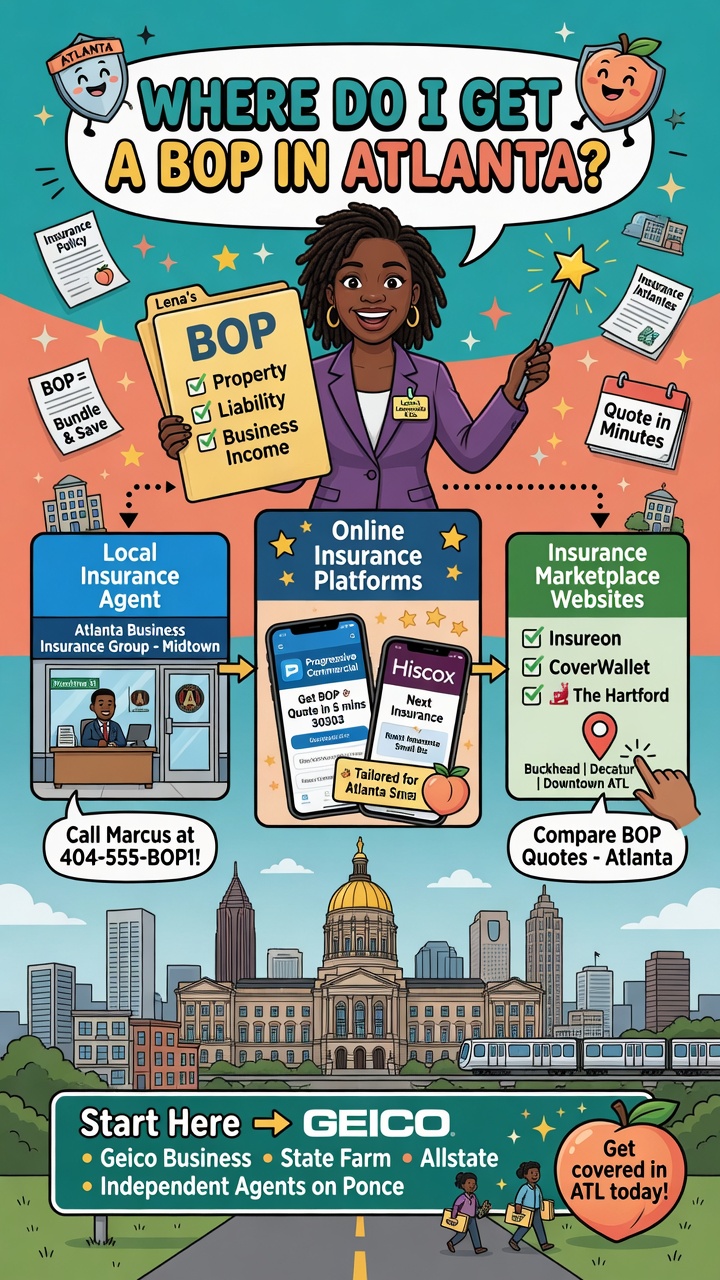
Here's the practical version: a Business Owner Policy (BOP) is the bundled small business insurance package that combines general liability, commercial property, and business income coverage into a single policy. Where you buy it matters — independent brokers can compare carriers, captive agents can only quote one, and online-direct platforms compete on speed but limit customization.
This post walks through where to actually get a BOP in Atlanta, who the major carriers are, how the buying process actually works, and what specific coverages to insist on in your 2026 quote.
I'm Justin Bishop, an independent broker in Atlanta. I write BOPs across multiple carriers weekly. Here's how it actually works.
The 30-Second Version
A BOP combines three coverages in one package: general liability, commercial property, and business income (interruption) coverage. Most BOPs also include products liability, advertising injury, and medical payments to others.
Where to get one: independent brokers (best for comparison), direct carriers (Hartford, Travelers, Liberty Mutual, Chubb, etc.), online platforms (Next Insurance, Hiscox, Pie Insurance for very small businesses), or captive agents (State Farm, Allstate, Farmers — limited carrier options).
Typical Atlanta cost: $500-1,500/year for very small businesses, $1,500-5,000/year for mid-size businesses with property and employees.
What a BOP does NOT include: workers' compensation, professional liability (E&O), commercial auto, employment practices liability, or cyber coverage. Those are separate policies.
The fastest path: call an independent broker, give them your business details, get 3-5 quotes within a week.
What a BOP Actually Is (Quick Refresher)
If you're new to the term, a Business Owner Policy bundles:
General Liability — covers third-party bodily injury and property damage claims (someone slips in your shop, your contractor damages a client's property, etc.). Typical limits: $1M per occurrence / $2M aggregate.
For the standalone deep-dive on the GL portion specifically, see General Liability Insurance for Atlanta Small Businesses
Commercial Property — covers damage to your business property (building if you own, contents, equipment, inventory) from fire, storms, theft, vandalism. Replacement cost basis is standard.
Business Income / Business Interruption — replaces lost income if a covered loss forces you to close temporarily. Critical and frequently undervalued.
Products Liability — included automatically in most BOPs; covers claims from products you sell.
Advertising Injury / Personal Injury — included; covers libel, slander, copyright issues, etc.
Medical Payments to Others — small no-fault medical bills if someone is injured on your premises. Usually $5K-10K limit.
What a BOP is designed for: small to mid-size businesses with low-to-moderate risk profiles. Typically under 100 employees, under ~$5M annual revenue.
What a BOP is NOT designed for: large operations, complex liability exposures, professional service firms with significant errors-and-omissions risk, manufacturers with major product liability concerns. Those need a customized commercial package, not a BOP.
For the deep-dive on workers' comp (which a BOP does NOT cover), see Do I Need Workers' Comp for My Small Business?.
The 4 Places You Can Actually Buy a BOP
Option 1: Independent Brokers (Recommended for Most Atlanta Businesses)
Independent brokers like me can quote across multiple carriers in one shot. You give us your business details once; we pull quotes from 5-8 carriers and present the actual comparisons.
Why this usually wins:
One application, multiple quotes
Real comparisons of coverage AND price (not just premium)
Help interpreting exclusions, sub-limits, and the fine print
Long-term relationship — same broker handles renewals, claims, policy changes
Cost to you: $0 in additional fees. Brokers are compensated by the carrier through commission, not by charging the policyholder.
When this is the right path: for ~85% of Atlanta small businesses. Especially if you have property, multiple employees, or any uncertainty about what coverage you need.
Option 2: Direct Carriers
You can apply directly through major BOP carriers' websites or by calling their commercial lines departments. Common direct-quote carriers:
The Hartford — strong small business focus, broad industry support
Travelers — wide BOP coverage, competitive in many Atlanta industries
Liberty Mutual — competitive pricing, good online tools
Chubb — premium pricing for higher-value businesses
Nationwide — solid baseline coverage, good customer service
CNA — strong in specialty industries
Cincinnati Insurance — strong claims service, slightly higher premiums
When this is the right path: if you know exactly what you want, the business is straightforward, and you don't need broker support. Time-consuming if you want comparisons (you have to apply to each separately).
Option 3: Online BOP Platforms
For very small businesses (1-3 employees, no physical location, low revenue), online platforms can be the fastest path:
Next Insurance — fast-quote, fast-bind. Strong for service businesses, contractors, freelancers.
Hiscox — good for small professional services, consultants, online businesses.
Pie Insurance — primarily workers' comp focus, also writes BOP for small businesses.
Coverwallet — broker-led online platform, multi-carrier quotes.
When this is the right path: ultra-small businesses where simplicity beats customization. Costs may be slightly higher than a broker-placed BOP, but the speed is real (sometimes bound within 24 hours).
Option 4: Captive Agents
Captive agents (State Farm, Allstate, Farmers) sell only their carrier's products. They can write a BOP, but only their carrier's version.
When this is the right path: if you already have personal auto/home with the same agent and value relationship continuity over carrier choice. Rarely the lowest-cost option for BOP specifically.
How the BOP Buying Process Actually Works
The practical timeline from "I need insurance" to "I have a policy":
Day 1 — Gather your business info. Annual revenue, # of employees, # of locations, address(es), industry classification (NAICS code), business start date, equipment value, inventory value, prior insurance history (any claims in last 3-5 years).
Day 2-3 — Contact a broker or apply directly. If using a broker, fill out their application (15-30 minutes). If applying direct, repeat per carrier.
Day 3-7 — Receive quotes. Independent brokers usually return 3-5 quotes within a week. Direct/online: faster (sometimes same-day) but only one carrier per application.
Day 7-10 — Compare and decide. Look at total premium, coverage limits, deductibles, exclusions, and AM Best rating of the carrier. Don't pick on premium alone.
Day 10-14 — Bind the policy. Sign the application, pay the first premium (or set up payment plan), receive certificates of insurance you can give landlords/clients.
Total time: typically 1-2 weeks for a thoughtful placement, faster if you're in a rush.
What to Insist On in Your BOP Quote
Specific coverages and limits to make sure are included:
General Liability: $1M per occurrence / $2M aggregate at minimum. Higher if you do work in clients' homes or handle physical products.
Commercial Property: insured to replacement cost, not actual cash value. Confirm.
Business Income/Interruption: at least 12 months of revenue coverage. Many policies default to 6 months which is often inadequate.
Equipment Breakdown: covers HVAC, computers, manufacturing equipment when they fail. Often $50-150/year add-on; almost always worth it.
Hired and Non-Owned Auto: covers liability when employees drive their personal vehicles for business. Common gap.
Inland Marine / Off-Premises Property: covers business property when it leaves your location (laptops, tools, equipment in transit). Important for service businesses.
Cyber Coverage: usually an add-on rider. Even non-tech businesses need basic cyber after a data breach hits.
Employee Benefits Liability: if you offer employee benefits, this covers admin errors. $5-15/employee/year typical.
Specific exclusions to watch for and possibly fill with separate policies:
Professional liability (E&O) — if you give advice or provide professional services
Workers' compensation — REQUIRED in Georgia if you have 3+ employees
Commercial auto — if your business owns vehicles
Employment Practices Liability (EPLI) — wrongful termination, discrimination, harassment claims
Crime/employee dishonesty — theft by employees
Real 2026 Atlanta BOP Pricing
For typical small businesses in Atlanta:
Solo service business, no employees, home office: $400-700/year
2-5 employee retail or service with a leased space: $800-1,500/year
10-20 employee professional services with office space: $1,500-3,000/year
20-50 employee business with owned property and equipment: $3,000-6,000/year
50-100 employee mid-size with multiple locations: $6,000-15,000+/year
These ranges assume no major claims in the prior 3 years and a reasonable industry classification. High-risk industries (construction, food service, transportation) typically run 30-100% higher.
Common Mistakes Atlanta Business Owners Make Buying a BOP
Patterns I see weekly:
Buying online without reading exclusions. Online platforms work for very small businesses but often have hidden sub-limits or exclusions on common claims.
Picking the cheapest premium without checking carrier rating. A carrier with AM Best rating below A- is a red flag. Slow claims service can cost more than any premium "savings."
Underinsuring business property. Insuring to acquisition cost instead of replacement cost. A $50K equipment loss replaced at $35K leaves you $15K short.
Missing business income coverage. Many owners decline this thinking they'd "just keep working" — but a fire or major storm can close you for 3-6 months. Without business income coverage, payroll and overhead come out of your savings.
Not getting professional liability separately. If you give advice, design products, or provide professional services, general liability does NOT cover errors-and-omissions claims. You need separate E&O.
Skipping cyber coverage. Even small Atlanta businesses get phished, ransomware'd, and breach victim'd. Basic cyber ($300-800/year) is almost always worth it now.
Renewing the same BOP year after year without re-shopping. Carrier pricing changes; your business changes. Re-shop every 2-3 years.
Not informing your insurer of significant business changes. New location, new vehicle, hiring employees, adding inventory — all require policy updates. Failing to update can void coverage at claim time.
Frequently Asked Questions
Is a BOP required by law in Georgia? No — Georgia doesn't require BOP. But your landlord usually requires general liability (typically $1M+), your bank may require it for a business loan, and many of your customers/clients/vendors require certificates of insurance proving you have it.
Do I need a BOP if I work from home? Probably yes. Your homeowners insurance specifically excludes business activity. Even a solo consultant from a home office needs a small BOP (or at minimum general liability) to cover work-related claims.
Can I get a BOP same-day? Online platforms can bind within 24 hours for simple cases. Broker-placed BOPs typically take 5-10 business days from application to bound policy.
What's the difference between a BOP and a Commercial Package Policy (CPP)? BOPs are pre-packaged with standard coverages — simpler, cheaper, good for most small businesses. CPPs are customized commercial packages with individually-selected coverages — more flexible, more expensive, better for complex businesses.
Will my BOP cover me if a client sues me for bad advice? No. General liability (the GL portion of your BOP) covers bodily injury and property damage. Professional advice claims need separate Professional Liability (E&O) coverage.
Do I need workers' comp if I have employees? In Georgia, workers' comp is required if you have 3 or more employees (regular or seasonal). Workers' comp is NOT included in a BOP — it's a completely separate policy.
How fast can I switch BOP carriers? You can switch any time — coverage transitions on the effective date you specify. There's no penalty for canceling mid-policy. The trick is timing the new policy's effective date to match your old policy's cancellation so there's no coverage gap.
The Bottom Line
Getting a Business Owner Policy in Atlanta isn't complicated, but where you buy matters. For most small businesses, an independent broker who can quote across 5-8 carriers is the cheapest path to comprehensive coverage. Direct carriers and online platforms are faster but limit your comparison options. Captive agents work if you value relationship continuity over carrier choice.
The trick is matching your business to the right BOP — and adding the separate policies (workers' comp, E&O, commercial auto, cyber) that the BOP doesn't include but you likely need.
If you're an Atlanta small business owner and need a BOP — for a lease, a contract, a loan, or just because — book a 15-minute call with me. I'll pull 5-8 carrier quotes, walk you through the comparison, and tell you exactly what coverage you need and what to skip. Costs you nothing — I'm paid by carriers, not by you.
Want to keep reading? Check out General Liability Insurance for Atlanta Small Businesses (publishing May 17), Workers' Comp Insurance (publishing May 21), or Group Health Insurance for Small Business in Atlanta 2026.
If you also offer health benefits (or are trying to figure out if you can), see Can a 2-Person LLC Get Group Health? — covers the W-2 employee rule that determines eligibility
Justin Bishop is the founder of That Young Insurance Guy, an independent insurance brokerage in Atlanta, GA, licensed in 31 states. He writes the Health Coverage Chaos newsletter on LinkedIn — and yes, he answers his own texts.
This post is general education, not legal, tax, or financial advice. BOP coverages, carrier offerings, premium ranges, and Georgia workers' comp law change.