
What Health Insurance Should Atlanta Medical Practices Offer?
Author: Justin Bishop · June 11, 2026 · 11 min read
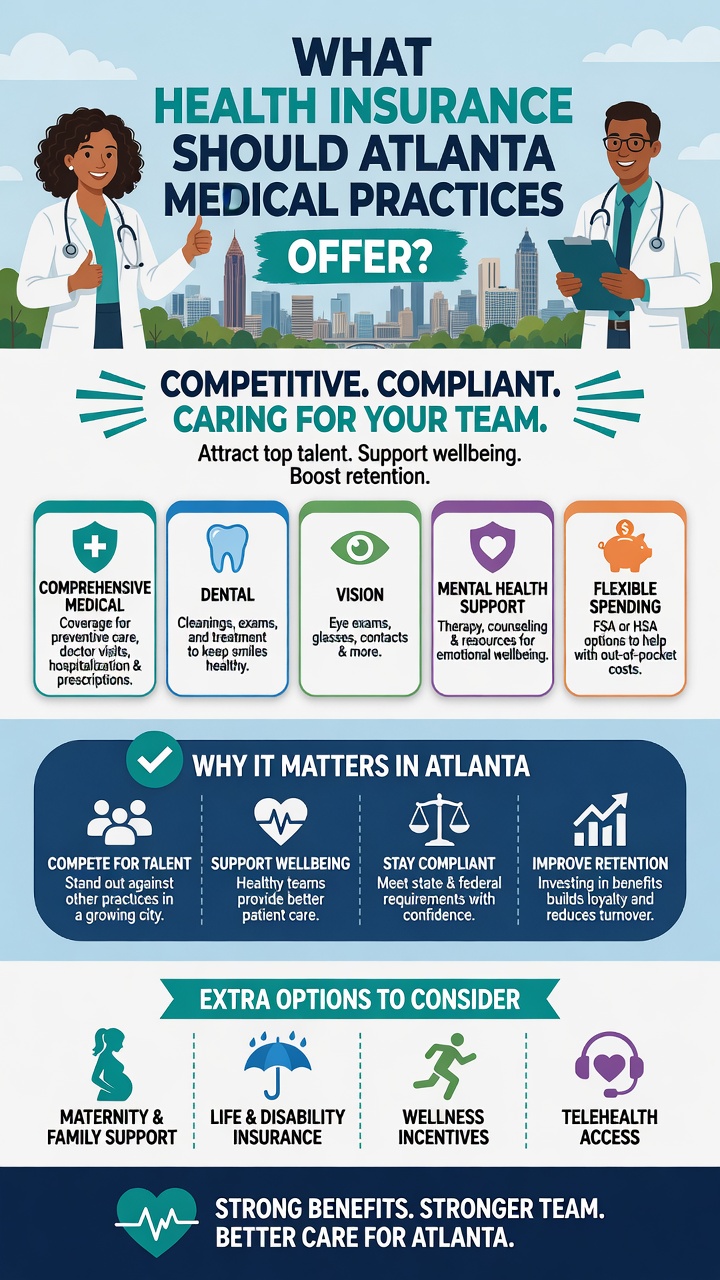
If you own or manage an Atlanta medical practice — whether it is a 4-person family medicine office in Decatur, an 18-person dental group in Buckhead, a 30-person OB/GYN practice with offices in Sandy Springs and Alpharetta, or a 45-person multi-specialty practice with locations across the metro — you have probably noticed your benefit conversations don't look like the ones your business-owner friends have.
Your practice owner is older. Your staff is younger and family-formation-aged. Your associate physicians and dentists are climbing the partner track. Your malpractice insurance bill is its own significant line item that interacts with every benefit decision you make. Your HSA contribution strategy probably matters more for your personal taxes than the practice's overall benefit cost. And your staff retention depends heavily on benefits that actually work for women in their 20s-40s — maternity coverage, mental health, dependent coverage.
This post walks through the four real benefit structures for Atlanta medical practices, why the owner-vs-staff demographic split changes the math, where private medically underwritten plans win for medical practice staff, how ICHRA solves the practice owner's personal coverage problem, real cost math for solo practitioner / mid-size / multi-location practice scenarios, and the common mistakes I see practice owners make.
I'm Justin Bishop, an independent broker in Atlanta. I quote benefits for medical and dental practices across the metro every week. Here's the honest breakdown.
The 30-Second Version
Four real approaches, in order of fit for most Atlanta medical practices: Hybrid: private medically underwritten group plan for staff + ICHRA for practice owner(s) (the most common right answer — captures staff savings while handling the owner's separate tax situation) Full private medically underwritten group plan (works when practice owner can structure to participate as a W-2 employee) Traditional ACA-compliant group health (when staff has known high-claim members or owner does not want to deal with medical underwriting) Cash stipend (worst tax outcome — avoid)
The owner-staff demographic split: practice owners typically skew 45-65 with established health needs. Staff typically skews 25-40, female-majority, family-formation years. The benefit design has to work for both populations, not just the owner's profile.
Maternity coverage is non-negotiable. Female-majority staff in their 20s-40s expect strong maternity benefits. Skipping this hurts retention immediately.
The malpractice insurance angle: an independent broker who handles both your group health AND your malpractice (or coordinates with your malpractice broker) often saves the practice 10-15% across both lines through bundle efficiency. Ask your broker if they handle both.
Atlanta medical practice typical cost in 2026: $475-650/month per enrolled employee for private medically underwritten Silver-equivalent staff coverage; $550-800/month for ACA-compliant fully insured; $600-900/month for ICHRA reimbursements to the practice owner.
The HSA strategy for practice owners: if structured properly, the practice owner can max HSA contributions ($4,150 self-only / $8,300 family in 2026) while sheltering meaningful income from tax. The plan design matters.
Common mistake: practice owners pick benefits based on what works for themselves and forget to optimize for the staff retention play. Staff who feel undervalued leave within 18 months, and replacing a trained RN or hygienist costs $30K-50K.
The right move for most Atlanta medical practices: hybrid structure — private medically underwritten group plan for W-2 staff, ICHRA for the practice owner with a CPA-coordinated tax structure.
Why Medical Practices Have Unique Benefit Challenges
Most service businesses have one demographic profile across the workforce. Medical practices have two — and they are very different from each other.
Practice owner (typically MD, DO, DDS, OD, DVM, or similar). Age range usually 40-65. Has the highest income in the practice. Often has existing health relationships (specialists they refer to, hospital affiliations). Tax strategy matters enormously because marginal tax rate is high. May be a sole proprietor, S-corp, LLC, or partnership entity for the practice.
Associate physicians, dentists, or NPs. Age range typically 30-45. On the partner track. W-2 employees of the practice. Need benefit design that handles family formation years and gives them a path to partner-level coverage when they advance.
Nursing staff (RNs, LPNs). Predominantly female. Age range 25-50. Often the longest-tenured employees outside the owner. Heavy maternity benefit users. Their retention is critical to practice continuity.
Dental hygienists. Predominantly female. Age range 25-50. Similar dynamics to nursing staff. Often part-time or split-shift, which creates eligibility complications.
Medical/dental assistants and admin staff. Mixed gender, age range varied (often 22-55). Lower individual salaries but high turnover risk if benefits are weak.
Billing/coding staff. Often older (45-60), often remote. Need benefits that work across geographic spread.
The result is a benefit plan that has to satisfy:
An older owner who values comprehensive coverage and tax-advantaged structures
Mid-career associates who care about family-formation benefits and partner-track benefit design
Younger nursing and assistant staff who use maternity, pediatric, and dental benefits heavily
A small admin team who needs basic affordability
Single-plan group health that works perfectly for the practice owner often fails the staff retention test. A plan designed for the staff might shortchange the owner. The right answer is usually a hybrid.
Other medical practice-specific realities:
Maternity coverage is a major retention factor. Most female nursing and admin staff have children during their practice tenure. Verify maternity benefits, prenatal coverage, and delivery facility access on every quote.
Mental health and substance use coverage matters. Healthcare worker burnout is well-documented industry-wide. Strong behavioral health benefits are increasingly seen as table stakes.
Network depth for specialists. Medical practice staff use specialists more than other groups (they understand the system and refer themselves). Narrow networks can frustrate clinically-literate employees more than they would frustrate a typical office worker.
Hospital network access. Atlanta has Emory, Piedmont, Wellstar, Northside, and Grady systems. Practice staff often have established relationships with one system; carriers that exclude that system create immediate friction.
Malpractice insurance interaction. Most practices already work with a malpractice broker. The same broker may or may not handle group health. Coordinating both lines through a single trusted broker often produces 10-15% savings across both.
HSA strategy for the owner. Many practice owners want to max HSA contributions for tax sheltering. The plan design (HSA-eligible HDHP) has to be available on whichever structure you choose.
Approach #1 — Hybrid: Private Medically Underwritten for Staff + ICHRA for Owner (The Most Common Right Answer)
This is the structure most well-designed Atlanta medical practices end up running once they understand the trade-offs.
The structure:
W-2 staff (associates, nurses, hygienists, assistants, admin) enroll in a private medically underwritten group health plan
Practice owner uses ICHRA to reimburse themselves tax-free for an individual marketplace plan they choose
CPA structures the owner's ICHRA participation to be compatible with the practice entity type
Single broker handles both sides
Why it works:
Staff savings. Private medically underwritten plans typically save 15-30% versus ACA-compliant fully insured for a typical Atlanta medical practice staff profile (young to mid-career, female-majority, generally healthy)
Owner's tax-advantaged path. ICHRA reimbursements are tax-free to the owner (when structured correctly), and the owner gets to pick their own marketplace plan with the network and specialist access they actually want
Maternity coverage stays strong. Private medically underwritten plans for staff include maternity coverage at the group level, satisfying the staff retention requirement
Owner picks the right network. The owner can choose an Anthem Pathway PPO, UHC Choice Plus, or any other marketplace plan that includes their preferred specialists and hospital — without the practice committing the entire staff to that same network
Scales with the practice. As the practice grows, the staff plan stays the same. New owners or partners get added to the ICHRA structure individually
Trade-offs to know:
Two plans to administer. Slightly more complex than one unified plan. The TPA handles ICHRA; the broker handles the group plan. Not a major lift but worth knowing
CPA coordination required. The owner's ICHRA tax treatment depends on the practice entity (S-corp, LLC, partnership, sole proprietor). CPA must structure it
Staff might ask why the owner is on a different plan. Communication matters. Frame it as the owner has access to the marketplace plan that includes their specific clinical network, not the owner gets better benefits
Best for: Most Atlanta medical practices with 5-40 W-2 staff, an owner who values tax-advantaged personal coverage, and a staff profile that underwrites favorably for medical underwritten group plans
Approach #2 — Full Private Medically Underwritten Group Plan (When Owner Can Participate as W-2)
If the practice owner is willing to take a W-2 wage from the practice (in addition to or instead of pure K-1 distributions or S-corp distributions), they can participate in the same group plan as the staff.
How it works:
Owner takes W-2 wages from the practice for benefit eligibility purposes
Owner and all eligible staff enroll in the same private medically underwritten group plan
Single plan, single broker, single administrative structure
Why some practices choose this:
Administrative simplicity. One plan to manage, one renewal cycle, one set of provider questions
Owner uniformity. The owner is on the same plan as the staff, which can simplify the politics of benefit conversations
Easier broker relationship. Single broker handles a single plan rather than coordinating across two structures
Trade-offs:
Owner gives up ICHRA tax flexibility. The owner is on the staff's plan rather than choosing their own marketplace plan
Network is the staff's network. If the practice owner wants a specific specialist network that the group plan doesn't include broadly, this approach fails for the owner
Underwriting includes the older owner. Adding a 55-year-old owner to a 28-year-old staff pool nudges the underwriting up slightly. Usually still cheaper than ACA-compliant but the savings are reduced
W-2 wage structure has its own tax implications. CPA must structure correctly to avoid creating tax inefficiency
Best for: Smaller practices (5-15 employees) where administrative simplicity matters more than owner tax optimization; practices where the owner's preferred network is also what's broadly available; practices where the owner specifically wants to be on the same plan as staff for cultural reasons
Approach #3 — Traditional ACA-Compliant Group Health (When Predictability Matters More Than Savings)
Some Atlanta medical practices choose ACA-compliant fully insured group plans despite the cost premium. The reasons can be valid.
Why some practices prefer it:
Maximum benefit certainty. Every state-mandated benefit, no pre-existing exclusions, no carve-outs
No medical underwriting. Staff (and owner, if participating) do not fill out health history forms
Smoother renewal cycle. Renewals are tied to the broader small group community rating rather than the practice's specific claims experience
No discomfort about underwriting. Some practice owners (themselves clinicians) are uncomfortable putting their staff through medical underwriting questionnaires
Why it costs more than necessary for many practices:
Community rating means the practice's mostly-healthy young staff is priced at the same risk pool as a 60-year-old with three chronic conditions in another company. For healthy practice staff, this represents real overpayment
Renewal increases compound. ACA-compliant small group rates have risen 10-15% annually for three years running in metro Atlanta
The cost-savings opportunity from medical underwriting goes unrealized
When traditional ACA-compliant is the right call:
Practice has multiple staff with known chronic conditions where pre-existing exclusions on private plans would create issues
Owner has a strong philosophical preference for ACA's full benefit set and consumer protections
Practice has a long-standing carrier relationship the owner wants to keep
Practice owner does not want to administer or manage the medical underwriting process
Approach #4 — Cash Stipend (Avoid)
Some practices, frustrated with rising premiums or wanting to give staff flexibility, offer a cash stipend instead of a benefit plan.
Why it's expensive:
Cash stipends are taxable wages. A $500/month stipend becomes $500 of W-2 wages. After federal income tax, FICA, and Georgia state tax, the employee nets $330-360/month of actual buying power
The practice pays payroll tax too. That $500 stipend triggers employer-side FICA of about $38/month. Total practice cost: $538/month for $330-360 of net employee benefit
ICHRA delivers the same dollar amount tax-free. $500 ICHRA reimbursement is worth $500 net to the employee. No payroll tax for the practice. Same practice outlay, 40-50% more value to the employee
Cash stipends don't satisfy the ACA Employer Mandate at 50+ FTE practices
If you are going to spend money on staff health benefits, do it through ICHRA or a group plan, not cash. Covered in depth in Should My Atlanta Small Business Switch to ICHRA in 2026?.
The Practice Owner's Personal Coverage Question
This deserves its own section because it is where most medical practice benefit designs go wrong.
The structural problem:
Practice owners typically take a mix of W-2 wages and S-corp distributions or K-1 partnership distributions. Their tax situation is materially different from a salaried W-2 employee. The benefit design that minimizes their personal tax bill is rarely the same one that minimizes the practice's total cost.
The three real paths for the owner:
Owner participates in the practice's group plan as a W-2 employee. Requires the owner to take W-2 wages sufficient to qualify. Simple, but gives up ICHRA tax flexibility and may not align with the owner's clinical network preferences
Owner uses ICHRA reimbursement from the practice. Tax-free reimbursement to the owner; owner picks any marketplace plan they want. Requires CPA structuring. The most common choice for practice owners in 2026
Owner buys individual coverage outside the practice and uses the self-employed health insurance deduction on Schedule 1. Clean separation but loses the bundling discount. Works for sole proprietor practices and some S-corps
The right path depends on:
Practice entity structure (S-corp, LLC, partnership, sole proprietor)
Owner's marginal tax rate (high earners benefit more from tax-advantaged structures)
Owner's network preferences (do they need Anthem Pathway PPO specifically?)
Owner's HSA contribution strategy (HSA-eligible HDHP needed)
Owner's existing physician/hospital relationships
This is a CPA conversation as much as a benefits conversation. The wrong structure can cost a practice owner $10K-25K/year in unnecessary tax. Talk to both your CPA and your broker before designing.
Real Atlanta Medical Practice Cost Math (2026)
Scenario 1: Solo family medicine practice in Decatur
1 MD owner (age 47) + 2 RNs (ages 32 and 41) + 1 medical assistant (age 28) + 1 billing admin (age 38)
Single office
Owner is S-corp, takes W-2 wages plus distributions
Staff has no known chronic conditions; one RN is in family-formation years
Best fit: Hybrid structure
Staff (4 enrolled): Private medically underwritten group plan, ~$465/month per enrolled × 4 = $1,860/month
MD owner: ICHRA at $800/month reimbursement, CPA-structured = $800/month
Practice pays 100% of employee-only premium for staff
Total monthly cost: $2,660 ($31,920/year)
Compared to full ACA-compliant fully insured group covering everyone: saves ~$11,000-14,000/year
Owner picks Anthem Pathway PPO on marketplace; preserves preferred specialist access
Scenario 2: 18-person dental group in Buckhead
2 DDS partners (ages 51 and 58) + 1 associate DDS (age 33) + 6 dental hygienists (ages 26-44) + 4 dental assistants (ages 22-38) + 3 front office/admin (ages 28-52) + 1 office manager (age 44) + 1 PT scheduler
2 partners take K-1 distributions; associate is W-2
Two operatory floors, one location
One partner has a managed chronic condition
Best fit: Hybrid structure with multi-tier staff plan
Staff (15 enrolled — full-time only): Private medically underwritten group plan with HSA-eligible HDHP option, ~$510/month per enrolled × 15 = $7,650/month
Associate DDS: Same group plan as staff
DDS partners (2): ICHRA at $900/month each × 2 = $1,800/month (CPA-structured for K-1 compatibility)
Practice pays 100% of employee-only premium for staff
Total monthly cost: $9,450 ($113,400/year)
Compared to full ACA-compliant fully insured: saves ~$24,000-32,000/year
Strong maternity coverage retained for hygienists and assistants
Scenario 3: 30-person OB/GYN practice with offices in Sandy Springs and Alpharetta
4 MD partners (ages 42-61) + 3 associate MDs (ages 32-39) + 8 RNs (ages 26-52) + 4 ultrasound techs (ages 28-44) + 6 medical assistants (ages 22-40) + 4 billing/admin (ages 30-55) + 1 practice manager (age 47)
Multi-office, multi-state employee population (1 remote billing staff in South Carolina)
2 partners have chronic conditions
Heavy maternity benefit use given OB practice culture
Best fit: Full ICHRA structure
Tiered ICHRA: partners $900/month, associates $750/month, clinical staff $625/month, admin $500/month
Total monthly: (4 × $900) + (3 × $750) + (12 × $625) + (10 × $500) = $3,600 + $2,250 + $7,500 + $5,000 = $18,350/month ($220,200/year)
ICHRA TPA handles compliance reporting for the 50+ FTE Employer Mandate
Each employee picks the Atlanta or out-of-state marketplace plan that fits their location and preferences
Strong maternity coverage available on all major Georgia marketplace plans
Hybrid alternative for Scenario 3: Private medically underwritten group plan for the in-Atlanta staff (eligible 26 employees, ~$13,260/month), ICHRA for partners and the 1 remote South Carolina staff (5 employees, ~$3,775/month) = $17,035/month / $204,420/year. Saves another ~$16K/year if the staff pool underwrites favorably.
Common Mistakes Atlanta Medical Practices Make
Patterns I see at practice-owner-level benefit reviews:
Designing benefits around the owner's needs and ignoring the staff retention angle. Staff who feel undervalued leave. Replacing a trained RN, hygienist, or office manager costs $30K-50K. Design for both populations
Skipping maternity coverage to save money. Female-majority staff in their 20s-40s plan family formation during their practice tenure. Weak maternity coverage hits retention immediately
Treating the practice owner as a W-2 employee for benefit purposes when they are not. S-corp distributions and K-1 partnership distributions are not W-2 wages. Structuring the benefit plan wrong creates tax issues
Defaulting to ACA-compliant without exploring private medically underwritten. For most medical practice staff profiles (young to mid-career, healthy), private medically underwritten saves 15-30%. Worth the medical questionnaires
Choosing the carrier the owner personally uses, regardless of staff fit. Owners default to whatever carrier their hospital affiliates with. That's often the right call for the owner — and the wrong call for the staff who may not need that network depth
Forgetting workers' comp. Required in Georgia at 3+ employees and especially relevant in clinical settings where needlesticks and slip-and-falls happen
Not coordinating with malpractice broker. If a separate broker handles your malpractice and a different one handles group health, you may be leaving 10-15% on the table. A single broker handling both lines often produces savings
Ignoring HSA strategy for the owner. Practice owners often have the highest marginal tax rate in the practice. Maxing HSA contributions through an HSA-eligible plan can shelter $4,150-8,300 from tax annually. Plan design has to support it
Underestimating mental health coverage importance. Healthcare worker burnout is well-documented. Strong behavioral health benefits are increasingly table stakes for clinical staff retention
Locking into multi-year rate guarantees without reading the renewal terms. Multi-year guarantees often come with weak renewal terms baked in. Read the contract before assuming the guarantee saves money
The Atlanta Medical Practice Carrier Landscape
For private medically underwritten group plans in Atlanta for 2026, the carriers writing professional services groups (which includes medical practices) typically include:
Allstate Benefits — strong on professional services, competitive on mid-size practices
Trustmark — flexible plan design, common pick at 10-50 employees
Allied National — competitive for professional services groups
National General (Allstate) — level-funded with underwriting overlay
For ACA-compliant fully insured group plans in Georgia:
Anthem Blue Cross Blue Shield of Georgia — broadest network including Emory, Piedmont, Wellstar, Northside specialists
UnitedHealthcare — competitive, strong PPO networks
Aetna — good for mixed demographic practices, strong in north metro
Humana — selective in which GA markets they write in 2026; verify availability
Kaiser Permanente of Georgia — integrated HMO model; popular with younger staff who value the all-in-one experience
For ICHRA-eligible individual marketplace plans (practice owners and any ICHRA-covered staff):
Anthem Pathway PPO — broad network, most-picked by practice owners (Emory, Piedmont in-network)
UnitedHealthcare — solid marketplace presence
Cigna — competitive in metro Atlanta
Oscar — strong digital experience
Ambetter — value-priced option
The carrier-by-carrier ranking is covered in depth in Best Georgia Small Group Health Insurance Carriers for 2026.
Frequently Asked Questions
Can I (as the practice owner) be on a different health insurance plan than my staff? Yes, and it is often the right answer. Practice owners using ICHRA can pick any marketplace plan that fits their needs while the staff is on a group plan. The structure must be communicated clearly to staff so it doesn't read as the owner has better benefits — frame it as the owner has access to the marketplace plan that includes their specific clinical network.
Will my female staff leave if maternity coverage is weak? Possibly. Maternity coverage is a top-3 benefit factor for women in their 20s-40s, which is the demographic profile of most medical practice clinical and admin staff. Skipping or weakening maternity coverage to save money typically costs more in turnover than it saves in premium.
Should I use the same broker for our practice's malpractice and our group health? Often works well. An independent broker who handles both lines coordinates renewal timing, captures bundling efficiency, and gives the practice a single relationship to manage. Verify the broker has demonstrable depth in both — malpractice and group health are different products with different specialization paths.
How does workers' comp interact with our group health plan? Workers' comp is required in Georgia at 3+ employees and is separate from group health. Clinical injuries (needlesticks, slip-and-falls, lifting injuries) are covered by WC. General health is covered by group health. Not bundled.
Can my associate physicians or dentists participate in the group plan before they become partners? Yes — associate clinicians are typically W-2 employees, so they enroll in the staff group plan like other W-2 employees. When they advance to partner, their benefit structure may shift (especially if they take K-1 distributions instead of W-2 wages). Plan for the transition.
Can my dental hygienists who are part-time qualify for our group plan? Depends on plan design and hours. Most group plans require 30+ hours/week for eligibility. Part-time staff under 30 hours typically don't qualify for the group plan but can be covered through ICHRA in a separate class structure if the practice wants to offer benefits.
How long does benefits setup take for a medical practice? Private medically underwritten and ACA-compliant group plans: 45-60 days from underwriting to effective date. ICHRA setup: 30-45 days for TPA setup plus employee plan selection. Most practices target a January 1 or July 1 plan year start.
What about disability insurance for our physicians and dentists? Long-term disability is a meaningful benefit for high-income clinicians whose families depend on professional income. For physicians and dentists earning $250K+, individual disability policies (in addition to or instead of group LTD) make sense because group LTD typically caps benefit amounts. Often underdone in medical practice benefit packages.
The Bottom Line
Atlanta medical practices have a structurally different benefit problem from law firms, tech startups, or restaurants. The owner-staff demographic split means you can't just pick the plan that works for the owner and hope the staff is fine — you have to design for both populations simultaneously. The female-majority, family-formation-age staff requires maternity coverage that some plans skimp on. The owner's tax situation favors ICHRA over W-2 group participation in most cases. And the malpractice insurance bill creates broker consolidation opportunities most practice owners don't realize exist.
For most Atlanta medical practices, the right structure is a hybrid: private medically underwritten group plan for W-2 staff (when the group underwrites favorably), ICHRA for the practice owner (CPA-structured to fit the entity type), unified by a single broker who handles both. This delivers the cost savings of medical underwriting where it works AND the tax-advantaged personal coverage flexibility where it matters.
For multi-location or multi-state practices, full ICHRA often delivers the best combination of cost control, partner participation, and administrative simplicity.
If you own or manage an Atlanta medical practice and you are evaluating your benefit structure — or running your first benefit review since founding — book a 15-minute call with me. I'll walk through your practice's specific structure and quote both private medically underwritten and ICHRA approaches with real numbers. Costs you nothing — I'm paid by carriers, not by you.
Want to keep reading? Check out Should My Atlanta Small Business Switch to ICHRA in 2026? for the ICHRA decision framework, Best Georgia Small Group Health Insurance Carriers for 2026 for the carrier-by-carrier ranking, or What Health Insurance Should Atlanta Law Firms Offer? for the parallel professional services framework that handles K-1 partner participation similarly.
Justin Bishop is the founder of That Young Insurance Guy, an independent insurance brokerage in Atlanta, GA, licensed in 31 states. He writes the Health Coverage Chaos newsletter on LinkedIn — and yes, he answers his own texts.
This post is general education, not legal, tax, or financial advice. Practice entity tax treatment, ICHRA compliance rules, ACA Employer Mandate thresholds, and Georgia carrier offerings change.