General Liability Insurance for Atlanta Small Business
Author: Justin Bishop · May 18, 2026 · 7 min read
If you own a small business in Atlanta, you've almost certainly been asked for one specific thing: a Certificate of Insurance proving you have General Liability coverage. Your landlord asks for it before you sign a commercial lease. Your clients ask for it before signing a contract. Your bank asks for it before funding a loan. Your contractors ask for it before working with you.
That document — and the underlying General Liability policy — is the most universal piece of business insurance. Every small business needs GL. The questions are: how much coverage, what does it actually do, what does it NOT do, and where do you buy it.
This post walks through what General Liability actually covers, what it doesn't cover (more important than people realize), how much Atlanta businesses typically pay, and the specific moves that get you the right coverage without overpaying.
I'm Justin Bishop, an independent broker in Atlanta. I write General Liability across multiple carriers weekly. Here's the practical breakdown.
The 30-Second Version
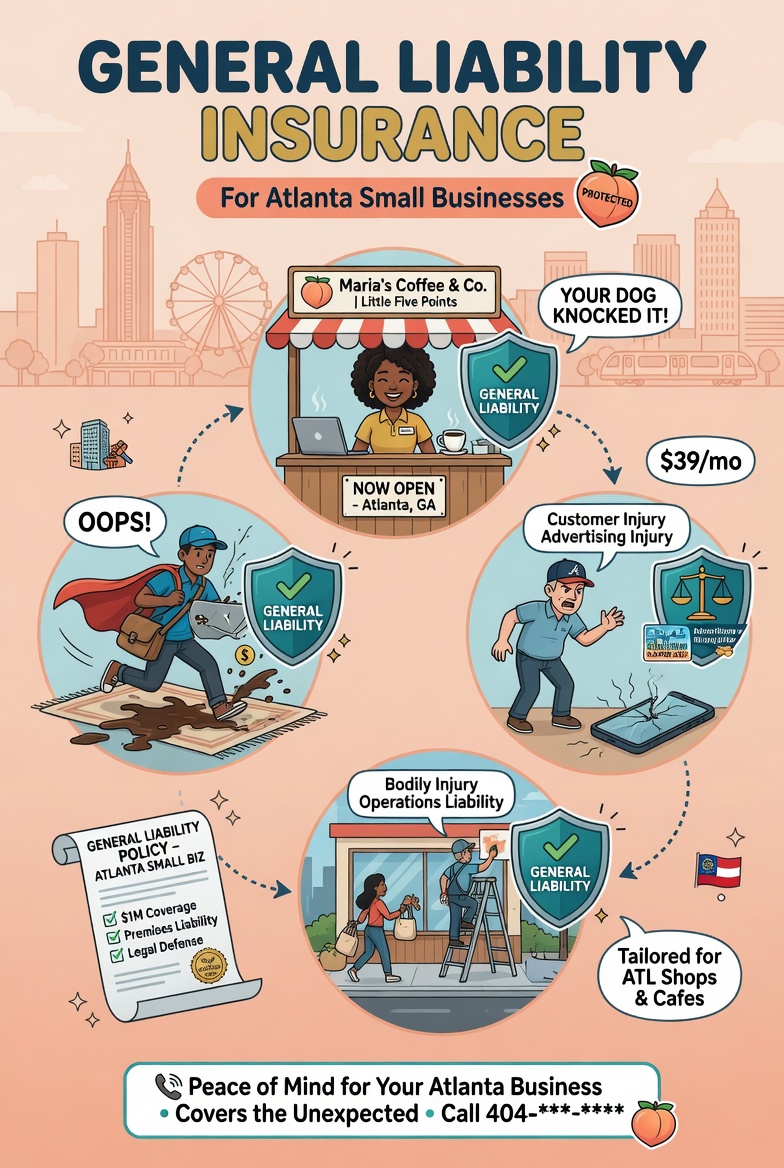
General Liability (GL) covers third-party bodily injury and property damage claims arising from your business operations, products, or premises
Typical Atlanta cost: $400-1,500/year for a 1-5 person service business, $1,200-4,000/year for businesses with employees and physical locations
Standard limits: $1 million per occurrence / $2 million aggregate. Higher for higher-risk industries
What GL does NOT cover: workers' compensation, professional advice/E&O, commercial auto, employee theft, cyber breaches, employment practices claims
Often bundled into a BOP (Business Owner Policy) along with property and business income — usually cheaper than standalone GL
Best path: independent broker who can quote 5-8 carriers at once. Costs you nothing extra; brokers are compensated by carriers.
What General Liability Actually Covers
GL is the workhorse policy. It covers four core categories:
Bodily injury to third parties — if someone is injured on your premises or by your operations (a customer slips in your shop, a contractor injures themselves on your project, your equipment causes harm), GL pays for medical bills, legal defense, and judgments.
Property damage to third parties — if you (or your operations) damage someone else's property (your contractor breaks a client's window, your truck damages a parking lot, your equipment damages a customer's car), GL covers it.
Personal and Advertising Injury — covers claims of libel, slander, copyright infringement in advertising, false arrest, and similar reputation-related claims. Important and often overlooked.
Products and Completed Operations — if your product causes injury or damage after the customer takes possession, GL covers it. If your contractor's work fails after completion and causes damage, GL covers it.
GL also typically includes a small Medical Payments to Others allowance ($5,000-10,000) for no-fault medical bills if someone is injured on your premises — pays without requiring a liability claim. Helpful for keeping minor incidents from becoming lawsuits.
What General Liability Does NOT Cover
This is where most Atlanta business owners get caught. GL is broad but not unlimited. It specifically excludes:
Workers' compensation — employee injuries are covered by Workers' Comp (which Georgia requires if you have 3+ employees), not GL
For the deep-dive on workers' comp (which GL does NOT cover), see Do I Need Workers' Comp for My Small Business?
Professional liability (Errors & Omissions) — claims arising from professional advice, services, or expertise (lawyers, consultants, accountants, contractors making design decisions, etc.) need separate E&O coverage
Commercial auto — vehicle accidents during business operations need commercial auto insurance
Employment Practices Liability (EPLI) — claims by employees (wrongful termination, discrimination, harassment, retaliation) need separate EPLI
Cyber and data breach — data breaches, ransomware, phishing scams need separate cyber coverage
Employee theft / dishonesty — covered by Crime/Employee Dishonesty policies
Property damage to your own property — covered by Commercial Property (often bundled with GL into a BOP)
Pollution / environmental claims — usually excluded; specialty environmental coverage needed
Intentional acts by the business owner — never covered
The biggest gap most owners don't realize: professional liability. A general contractor with GL who gives a client bad design advice that causes a structural problem won't be covered by GL. They need separate E&O.
How Much GL Coverage Atlanta Businesses Need
The industry standard for small businesses is $1 million per occurrence / $2 million aggregate. Most Atlanta landlords and contracts require these limits minimum.
What the limits actually mean:
Per occurrence: the maximum the policy pays for any single claim
Aggregate: the maximum the policy pays for all claims combined in the policy year
For higher-risk industries (construction, manufacturing, healthcare, products with significant injury exposure), $2M/$4M or $5M/$10M is often more appropriate.
For added protection above standard GL limits, businesses commonly add Commercial Umbrella coverage:
Adds $1M-5M+ on top of underlying GL limits
Costs $400-1,500/year for typical Atlanta small businesses
Triggers when GL limits are exhausted
Highly recommended for businesses with significant client interaction or premises exposure
Real 2026 Atlanta GL Pricing
Typical annual GL premiums in the Atlanta metro for 2026:
Solo consultant, no employees, home office, low-risk industry: $400-700/year
2-5 employee service business, leased office space: $700-1,500/year
10-20 employee professional services: $1,500-3,000/year
Retail or restaurant with foot traffic, 5-15 employees: $1,800-4,000/year
General contractor or construction, 5-15 employees: $3,500-8,000/year (higher risk)
Specialty trade contractor (electrician, plumber, HVAC): $1,500-3,500/year
Health/personal services (gym, salon, massage therapy): $1,200-2,800/year
These ranges assume no major claims in the prior 3 years. High-claim industries (construction, food service, transportation, healthcare) typically run 30-100% higher. Industries with significant injury potential (childcare, sports/fitness with contact, contact-heavy services) can run much higher.
GL Standalone vs Bundled into a BOP
You can buy GL two ways:
Option 1: Standalone GL policy
Just General Liability, no other coverages
Best for businesses without physical property to insure (consultants, online businesses, home-based businesses without significant equipment)
Often slightly cheaper than a BOP if you genuinely don't need property coverage
Option 2: BOP (Business Owner Policy) bundling GL + property + business income
All three coverages in one policy
Usually cheaper than buying each separately
Available to most small businesses (under 100 employees, under ~$5M revenue)
The right answer for ~85% of Atlanta small businesses
For the deep-dive on BOPs and where to buy them, see Where Do I Get a Business Owner Policy in Atlanta?.
The Major Atlanta GL Carriers
Carriers most active in Atlanta General Liability writing for 2026:
The Hartford — strong small business focus, broad industry support
Travelers — wide industry coverage, competitive pricing
Liberty Mutual — competitive pricing, strong online tools
Chubb — premium pricing for higher-value businesses
Nationwide — solid baseline coverage, good service
CNA — strong in specialty industries (contractors, manufacturers)
Cincinnati Insurance — strong claims service, slightly higher premiums
State Farm — limited commercial offerings but available for many small business types
Allstate Business — captive agent model, available for standard low-risk businesses
Carrier choice depends on industry classification, location, claims history, revenue, and employee count. No single carrier is "cheapest" or "best" for every Atlanta business — comparison shopping is the only way to know.
How to Lower Your GL Premium
Specific moves that work:
Bundle into a BOP if you have property to insure. Bundling discount alone often saves 10-25%.
Bundle with auto (Commercial Auto if you have vehicles). Multi-policy discounts add up.
Raise your deductible — going from $0 to $500 or $1,000 deductible typically saves 5-15%.
Maintain a claim-free record — every claim raises future premiums. Don't file claims you can self-pay.
Document your safety practices — written safety procedures, training records, signage all factor into carrier pricing.
Get classified correctly — businesses misclassified into higher-risk SIC/NAICS codes pay too much. Verify your classification with your broker.
Shop every 2-3 years — loyalty pricing is real; carrier rates change. Re-shopping catches over-priced renewals.
Add safety features — alarm systems, sprinklers, ADA-compliant access, video surveillance can earn discounts.
Consider Industry Programs — some carriers offer industry-specific programs (restaurants, contractors, professional services) with bundled discounts.
Common GL Mistakes Atlanta Owners Make
Patterns I see weekly:
Carrying minimum coverage ($300K per occurrence) when $1M is standard. A single major claim wipes out a small business with under-limits coverage.
Buying GL and assuming everything is covered. GL excludes workers' comp, E&O, commercial auto, cyber, and EPLI. Most businesses need at least 2-3 separate policies.
Not adding an umbrella above GL. $1M GL plus a $1M umbrella is often only $400-800 more per year and triples your protection.
Misclassifying their business. Classification (SIC/NAICS code) drives rate. Wrong classification = wrong pricing.
Not reading the exclusions. Every GL policy has industry-specific exclusions. Read them before binding.
Renewing without re-shopping. Carrier renewal pricing rarely matches new-customer pricing. Re-shop every 2-3 years.
Filing claims you could self-pay. A $1,500 claim raises your premium $200-400/year for 3-5 years. Net loss.
Not informing the carrier of business changes — new locations, new services, new equipment, hiring employees. Failure to update can void coverage at claim time.
Confusing GL with Professional Liability. If your business gives advice, designs, or provides expertise, you need E&O on top of GL.
Frequently Asked Questions
Is General Liability legally required in Georgia? No, Georgia law doesn't require GL. But your landlord, contracts, clients, lenders, and contractors almost certainly will. In practice, you cannot operate most small businesses without it.
Can I get GL same-day? Online platforms (Next Insurance, Hiscox) can bind GL within 24 hours for simple businesses. Broker-placed GL typically 3-7 business days from application to bound policy.
Will GL cover me if a client sues for bad advice? No. General Liability covers bodily injury and property damage to third parties. Claims arising from professional advice, expertise, or services need separate Professional Liability (E&O) coverage.
Do I need GL if I work from home? Yes. Your homeowners insurance specifically excludes business activity. Even a solo consultant from a home office needs GL to cover work-related claims.
Will my homeowners insurance cover my home-based business? Almost never. Standard homeowners policies exclude business activity. A few carriers offer "home business" endorsements for very small operations, but most home-based businesses need separate commercial coverage.
What's the difference between GL and a BOP? GL is one policy covering bodily injury, property damage, and advertising injury. A BOP is a package that bundles GL with commercial property and business income coverage. BOPs are typically cheaper than buying the coverages separately.
Does GL cover my employees? No — employee injuries are covered by Workers' Compensation (required in Georgia for businesses with 3+ employees). GL covers third parties (customers, vendors, public), not your employees.
How fast can I switch GL carriers? You can switch any time — coverage transitions on the effective date you specify. No penalty for canceling mid-policy. Standard process to time the new policy's effective date to match the old policy's cancellation.
The Bottom Line
General Liability is the one piece of business insurance every Atlanta small business needs. Your landlord requires it, your clients require it, your bank requires it, your contractors require it. The questions are how much coverage, what gaps to fill, and where to buy it.
For most Atlanta small businesses, $1M/$2M GL bundled into a BOP is the right answer — combines liability + property + business income in one policy at the lowest total cost. Add Workers' Comp, Professional Liability, Commercial Auto, and Cyber as separate policies based on your specific operations.
If you're an Atlanta small business owner who needs GL — for a lease, contract, loan, or just because — book a 15-minute call with me. I'll quote 5-8 carriers in one shot, identify the right limits for your industry and revenue, and tell you exactly what gaps GL leaves and what additional coverage you actually need. Costs you nothing — I'm paid by carriers, not by you.
Want to keep reading? Check out Where Do I Get a Business Owner Policy in Atlanta?, My Employee Just Quit. How Long Do They Stay on Group Health?, or Group Health Insurance for Small Business in Atlanta 2026.
Health benefits are a separate question with its own rules. If you're a 2-person LLC wondering if you qualify, read Can a 2-Person LLC Get Group Health?.
Justin Bishop is the founder of That Young Insurance Guy, an independent insurance brokerage in Atlanta, GA, licensed in 31 states. He writes the Health Coverage Chaos newsletter on LinkedIn — and yes, he answers his own texts.
This post is general education, not legal, tax, or financial advice. General Liability premiums, carrier offerings, and Georgia workers' compensation rules change.