
How Do 1099 Contractors Get Health Insurance in Atlanta?
Author: Justin Bishop · June 24, 2026 · 11 min read
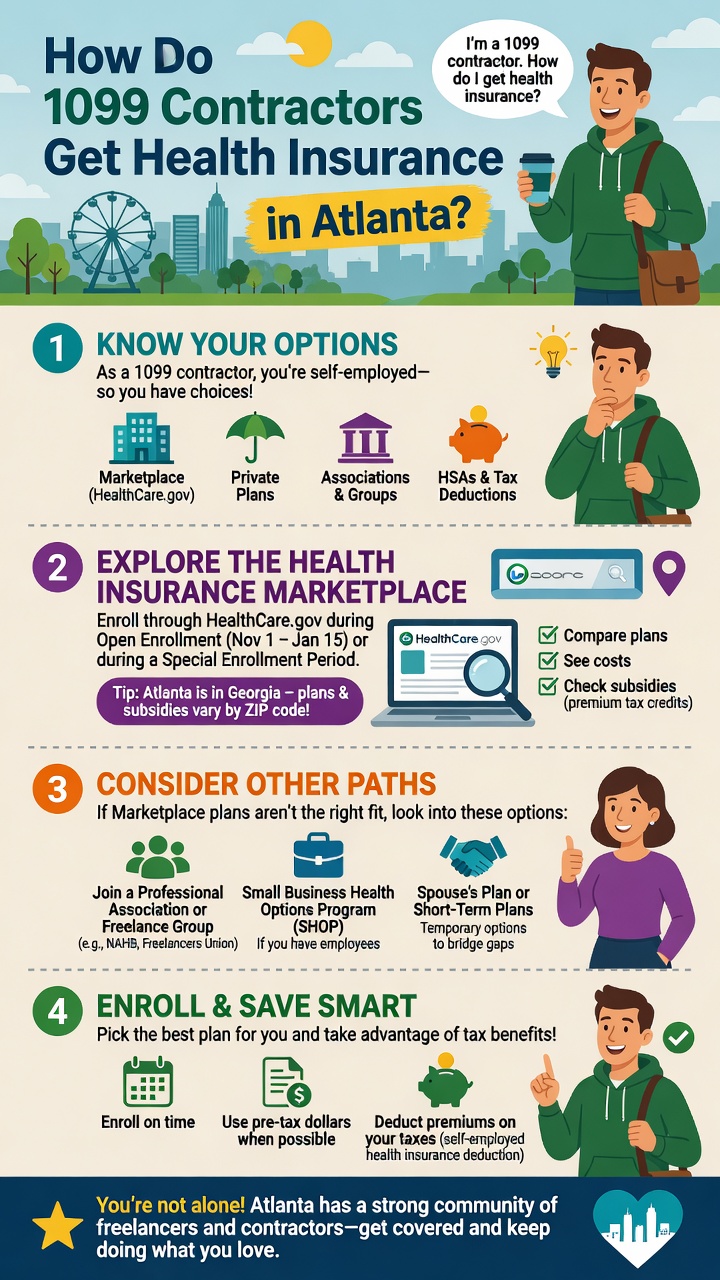
If you are a 1099 contractor in Atlanta — whether you do freelance consulting, IT contracting, design work, real estate, mortgage lending, sales on 1099, healthcare locum tenens, project-based legal work, or any other independent contractor role — you have run into the same wall everyone else in your position runs into. You don't have an employer. You don't have a group health plan. And the open marketplace can look overwhelming when you're trying to compare plans, figure out subsidies, and not get stuck paying $700/month for coverage you barely use.
The honest reality: 1099 contractors in Atlanta have six real coverage paths in 2026, and the right one depends on your income, your family situation, your spouse's employment, and what coverage you actually need. Most 1099 contractors I talk to default to the first plan they see on Georgia Access without exploring whether subsidies apply, whether off-exchange plans would be cheaper, whether their spouse's employer plan is the smarter move, or whether they're missing the self-employed health insurance tax deduction that effectively cuts their premium by 20-30% at tax time.
This post walks through the six real coverage paths for Atlanta 1099 contractors, how the subsidy math actually works (including the cliff that catches variable-income contractors off guard), the self-employed health insurance tax deduction most contractors miss, the HSA strategy that doubles as a tax shelter, the income documentation challenge that complicates applications, and the common mistakes I see new 1099 contractors make on their first coverage decision.
I'm Justin Bishop, an independent broker in Atlanta. I write individual health insurance for 1099 contractors across the metro every week — and most conversations start with "I have no idea what I'm doing here." Here's the honest framework.
The 30-Second Version
You have no employer health coverage. Every 1099 contractor in Atlanta has to source their own coverage. There is no group plan from the company that 1099s you, and there cannot be (1099 status means you are not their employee — covered in What Health Insurance Should Atlanta Construction Companies Offer? from the employer's side).
The six real coverage paths in order of typical fit: Georgia Access marketplace plan with subsidies (the most common right answer when income qualifies) Off-exchange individual plans (when subsidies don't apply or off-exchange pricing wins) Spouse's employer plan (often the cheapest path if available) COBRA from a recent W-2 job (short-term option, usually expensive but worth knowing) Trade or professional association group plans (real estate boards, freelance unions, etc.) Short-term medical (stopgap only, has major coverage gaps)
Subsidies are powerful but cliff-prone. The 2026 ACA premium tax credit can reduce premiums substantially for 1099 contractors with household income between 100% and 400% of federal poverty level. But variable-income contractors who underestimate annual income mid-year can face a "subsidy cliff" where extra income costs them $5K-15K in lost subsidies — covered in depth in The 2026 ACA Subsidy Cliff for Self-Employed Georgians.
The self-employed health insurance tax deduction is a big deal. Self-employed people can deduct 100% of their health insurance premiums on Schedule 1 of Form 1040 (above-the-line deduction, reduces both income tax AND self-employment tax). For a 1099 contractor in the 24% federal bracket plus Georgia state tax plus SE tax, that's effectively 35-40% off the premium at tax time. Most new 1099 contractors miss this.
HSA strategy doubles as tax shelter. If you pick an HSA-eligible HDHP marketplace plan, you can contribute up to $4,150 self-only or $8,300 family in 2026 tax-free, deductible against income (covered in HSA Contribution Limits 2026: How to Actually Use Them).
Atlanta 2026 marketplace pricing benchmarks (before subsidy): Bronze tier for a 35-year-old in metro Atlanta runs ~$340-440/month. Silver tier for the same buyer runs ~$430-560/month. Family-of-four Bronze runs ~$1,100-1,500/month. Subsidies can reduce these substantially depending on income.
The common mistake: picking the plan with the lowest premium without checking the network or the deductible. A $310/month Bronze plan with a $7,500 deductible looks cheap until you have a $3,000 ER visit and learn you're paying full price until you hit $7,500.
The right move for most Atlanta 1099 contractors: apply for the marketplace, claim available subsidies based on a realistic income estimate, choose a plan that fits your specific medication and provider needs (not just the cheapest premium), and claim the self-employed health insurance deduction at tax time.
The 1099 Contractor Health Insurance Reality
The structural deficit is real and worth naming upfront.
A W-2 employee typically has:
Employer-provided group health coverage (employer often pays 50-80% of premium)
One open enrollment window per year managed by HR
A benefits administrator who handles paperwork
Often a tax-advantaged Section 125 cafeteria plan that lets them pay their share with pre-tax dollars
Continuation through COBRA if they leave the job
A 1099 contractor in Atlanta typically has:
Zero employer coverage. Every dollar of premium comes out of your own pocket
No HR administrator. You handle applications, renewals, claim disputes, and plan changes yourself
Year-round shopping responsibility if your income changes mid-year and triggers a special enrollment period
Tax-advantaged opportunities (self-employed health insurance deduction) that you have to claim yourself — no one's pushing the paperwork for you
Direct exposure to premium increases without an employer cushioning them
The 1099 contractor's job is to manage what an HR department and benefits administrator would handle for a W-2 employee. That's why the right broker matters more for 1099 contractors than for W-2 employees — the broker becomes your benefits administrator.
The Six Real Coverage Paths for Atlanta 1099 Contractors
Path #1 — Georgia Access Marketplace Plan (With Subsidies)
This is the most common right answer for 1099 contractors with household income roughly between $15,000 and $120,000 (single) or between $30,000 and $250,000 (family of four), where ACA premium tax credit subsidies can substantially reduce the net premium.
How it works:
Apply on Georgia Access (the state-run marketplace that replaced Healthcare.gov for Georgia in 2024 — covered in Georgia Access vs Healthcare.gov: What Actually Changed)
Estimate your annual household income for the coverage year
Subsidies are calculated based on your estimated income and household size
Pick from Bronze, Silver, Gold, or Platinum tier plans from the carriers writing in your county
Atlanta marketplace carriers in 2026 include Anthem, Ambetter, Oscar, UnitedHealthcare, Cigna, and Kaiser Permanente
Why it usually wins for 1099 contractors:
Subsidies can cut your net premium by hundreds of dollars per month if your income qualifies
Comprehensive coverage with all ACA-mandated benefits (no pre-existing condition exclusions, maternity coverage, mental health parity, preventive care)
Annual open enrollment plus special enrollment periods when life events happen
Same plans available to employers and employees through ICHRA — comparable quality
What to watch for:
Variable-income contractors can over- or under-estimate income, creating tax surprises at filing time
Plans differ by county — verify what's available in your specific Atlanta ZIP
Network depth varies — Anthem Pathway PPO and UHC Choice Plus have broader networks than Ambetter, but cost more
Path #2 — Off-Exchange Individual Plans
If your household income is too high for subsidies (above ~$120,000 single or $250,000 family of four roughly), the marketplace becomes less attractive — you're paying full premium without the subsidy benefit. Off-exchange plans (purchased directly from the carrier or through a broker, not through Georgia Access) sometimes price better in this scenario.
Why this can win for high-income 1099 contractors:
No subsidy means no advantage to staying on-exchange
Off-exchange plans sometimes have different deductible structures or network designs that fit better
Some carriers offer off-exchange-only products with broader networks
Application process can be faster than the marketplace enrollment
What to watch for:
You forfeit the future right to subsidies if your income drops mid-year (you'd have to re-enroll on-exchange during the next open enrollment)
Some plans available off-exchange don't satisfy all ACA mandates — verify
Not every carrier offers off-exchange plans in every Atlanta county
Path #3 — Spouse's Employer Plan (Often the Cheapest Option)
If your spouse has employer-provided coverage and the employer covers a meaningful portion of family premium, this is often the cheapest path for a 1099 contractor with a W-2 spouse.
Why this often wins:
Employer typically covers 50-70% of family premium, meaning your add-on cost is materially less than buying individual marketplace coverage
One plan, one network, one set of provider relationships for the family
Often includes dental, vision, and other ancillary benefits at group rates
No subsidy paperwork or income reconciliation at tax time
What to watch for:
Some spouse plans have "spousal surcharges" if the 1099 contractor has access to other coverage (even if that other coverage is just the marketplace) — verify
Open enrollment window is typically once per year tied to the spouse's employer cycle
If your spouse leaves the job, you both lose coverage and have to scramble
Path #4 — COBRA Continuation From a Recent W-2 Job
If you recently left a W-2 job to become a 1099 contractor, COBRA lets you continue your former employer's group health plan for up to 18 months. Usually expensive but worth knowing.
Why this matters:
Same exact plan you had as an employee, no waiting periods, no re-application
Continues your existing provider relationships and medication coverage
Bridges the gap between losing employer coverage and choosing a long-term path
What to watch for:
You pay 100% of the premium plus a 2% administrative fee — so a plan that cost you $200/month as an employee suddenly costs $1,000+/month under COBRA (because the employer was paying most of it)
60-day election window from job termination, then ongoing 18-month coverage
For most 1099 contractors, COBRA is a 2-3 month bridge while you set up marketplace coverage, not a long-term solution
Georgia has a "Mini-COBRA" rule for smaller employers (3-19 employees) that extends some continuation rights — covered in My Employee Just Quit. How Long Do They Stay on Group Health?
Path #5 — Trade or Professional Association Group Plans
Some Atlanta trade and professional associations offer group health insurance to their members. These can be competitively priced and worth checking.
Examples worth investigating:
Real estate associations (Atlanta REALTORS®, GAR) often have group plans for member agents
Freelancers Union offers some coverage options
Trade-specific associations (electrical, plumbing, HVAC, etc.) sometimes offer member group plans
Industry-specific associations (legal, healthcare, IT) sometimes negotiate group rates
What to watch for:
Member-rate plans aren't always actually cheaper than individual marketplace plans, especially with subsidies factored in — compare both
Some association "plans" are actually marketing for individual marketplace plans, not true group coverage — verify
Coverage gaps or pre-existing exclusions can apply on some association plans
Association membership has its own cost that adds to the total benefit math
Path #6 — Short-Term Medical (Stopgap Only)
Short-term medical (STM) plans cover up to 3 months at a time (federal rule changes in recent years) and are pitched as cheap stopgap coverage. They have major limitations.
Why some 1099 contractors consider them:
Premiums look cheap compared to marketplace plans
Quick enrollment, no waiting for open enrollment
Useful as a 30-90 day bridge during a coverage gap
Why they're usually wrong for long-term coverage:
Do not have to cover pre-existing conditions. A condition you developed before applying isn't covered.
Do not have to include ACA-mandated benefits like maternity, mental health, or prescription drugs
Annual and lifetime caps mean a serious illness could leave you uncovered partway through treatment
Underwritten — applicants with health conditions may be denied or charged much more
Do not satisfy the ACA's individual coverage minimums (which still matter for some tax purposes)
Short-term medical is a 30-90 day stopgap during a true coverage gap. It is not a long-term replacement for real health insurance. Be careful.
The Subsidy Math (and the Cliff)
The 2026 ACA premium tax credit can substantially reduce a 1099 contractor's marketplace premium. The mechanics are worth understanding because they shape every other decision.
How it works:
Subsidy amount depends on (1) your estimated annual household income and (2) the cost of the "benchmark" Silver-tier plan in your county
For 2026, subsidies are available for households with income between 100% and 400% of federal poverty level (FPL)
The American Rescue Plan and Inflation Reduction Act extended enhanced subsidies through 2025, with possible further extension into 2026 (verify current law each year)
The subsidy you receive at enrollment is an advance payment based on your estimated income
At tax time, you reconcile actual income against estimated income — if you earned more, you pay back some subsidy; if you earned less, you may get additional subsidy
The cliff that catches variable-income contractors:
If your actual annual income exceeds 400% of FPL (roughly $60,240 single or $124,800 family of four in 2026), you lose ALL subsidy retroactively. An extra $1,000 of income earned in December could cost you $8,000-15,000 in subsidy paid back at tax time. This is "the cliff."
How to handle the cliff:
Estimate income conservatively at open enrollment if your business has growth potential mid-year
Update your income estimate on Georgia Access if your projected income changes materially during the year
Time income strategically (push December invoices to January if you're close to the cliff)
Consider HSA contributions and SEP-IRA contributions late in the year to reduce AGI below the cliff
Detailed strategies in The 2026 ACA Subsidy Cliff for Self-Employed Georgians
The Self-Employed Health Insurance Tax Deduction
This is the part most new 1099 contractors miss completely.
The deduction:
1099 contractors and self-employed people can deduct 100% of their health insurance premiums (and dental and long-term care premiums) on Schedule 1 of Form 1040
The deduction is "above-the-line" — it reduces your Adjusted Gross Income (AGI), which has compounding effects on other tax calculations
Available for the contractor, spouse, and dependents
Limited to your net self-employment income — you can't deduct more in premiums than you earned
Why it matters so much:
For a 1099 contractor in the 24% federal tax bracket plus Georgia 5.49% state tax plus 15.3% self-employment tax, the deduction effectively cuts the premium by roughly 35-40% at tax time. A $500/month premium effectively costs about $310-325/month after the deduction.
Mechanically:
Claim it on Schedule 1, Line 17 (Self-employed health insurance deduction)
Cannot be claimed if you or your spouse were eligible for employer-subsidized coverage at any point during a given month
Marketplace subsidies and the SE health insurance deduction interact — your CPA needs to coordinate these properly
Common error:
Many new 1099 contractors don't know about this deduction and just pay the full premium without claiming it. If you've missed it in prior years, your CPA can often amend recent returns to claim it retroactively (subject to the 3-year amendment window).
HSA Strategy for 1099 Contractors
If you choose an HSA-eligible high-deductible health plan (HDHP), you get an additional tax-advantaged savings vehicle that doubles as a long-term retirement asset.
The basics:
2026 HSA contribution limits: $4,150 self-only / $8,300 family
Contributions are tax-deductible (reduces AGI on top of the SE health insurance deduction on premiums)
Investment growth inside the HSA is tax-free
Withdrawals for qualified medical expenses are tax-free
After age 65, withdrawals for non-medical purposes are taxed as ordinary income (like a traditional IRA)
Why this works for 1099 contractors:
Triple tax advantage (deduction, growth, withdrawal for medical) makes it the most tax-efficient savings vehicle available
1099 contractors with HSA-eligible HDHPs can shelter $4,150-8,300/year on top of retirement account contributions
HSA balance carries forward year to year — no "use it or lose it" deadline
Can be invested in mutual funds, ETFs, etc. once the balance exceeds the cash threshold (usually $1,000-2,000)
Caveats:
HDHPs have higher deductibles, so you pay more out-of-pocket before insurance kicks in
HSA-eligible plans are not always the cheapest premium — verify the total math
You can't contribute to an HSA if you're also covered by a non-HDHP plan, are enrolled in Medicare, or have certain other coverage
Detailed mechanics in HSA Contribution Limits 2026: How to Actually Use Them.
The Income Documentation Challenge
This is the part that catches new 1099 contractors off guard during the marketplace application.
What Georgia Access wants to verify:
Your projected household income for the coverage year
Sometimes 1-2 years of tax returns to support the projection
Documentation of household members and dependents
Citizenship or lawful presence verification
Where the friction shows up for 1099 contractors:
New contractors (under 2 years 1099 history). No prior tax returns showing this income source. Projected income has to be defended with contract documentation
Highly variable income. Marketplace expects a single annual estimate, but your business may swing $80K-180K year over year
Recent W-2 to 1099 transition. Last year's tax return shows W-2 income; this year's is all 1099. Subsidy estimate has to reflect the changed situation
Heavy deductions. A 1099 contractor with significant business expenses can show much lower "net" income on Schedule C than their gross receipts. Subsidy calculations use AGI which reflects the deductions
Spousal income complications. If your spouse has W-2 income plus you have 1099 income, the household income calculation is straightforward but the splits matter for some calculations
How to handle it:
Estimate income conservatively but realistically — too high and you lose subsidies you'd qualify for; too low and you owe at tax time
Have last year's tax return ready when applying
Update your income estimate on Georgia Access mid-year if your projection materially changes
Work with a broker who can model the subsidy implications of different income estimates
Common Mistakes Atlanta 1099 Contractors Make
Patterns I see weekly:
Not enrolling at all because the application feels overwhelming. Skipping coverage exposes you to bankruptcy-level medical bills if something goes wrong. Even a Bronze plan is better than nothing
Picking the lowest-premium plan without checking the network. A $310/month plan that excludes your preferred specialists or hospital system isn't actually cheap when you can't use it
Picking the lowest-premium plan without checking the deductible. Bronze plans with $7,000-9,000 deductibles look cheap monthly but you pay full price for everything until you hit the deductible
Estimating income too low to maximize subsidies, then owing at tax time. Conservative is fine; intentionally lowballing is a bad call
Missing the self-employed health insurance tax deduction. Most new 1099 contractors don't know about it. Talk to your CPA at the first opportunity
Buying short-term medical thinking it's the same as real insurance. It isn't. The pre-existing condition exclusion alone disqualifies STM for most long-term planning
Not updating coverage when life events happen. Marriage, kids, moves, income changes all trigger special enrollment periods. Failing to update creates coverage gaps
Going direct on the carrier site instead of using a broker. Brokers cost you nothing (paid by carriers), help you compare across multiple carriers, model subsidy scenarios, and serve as your year-round point of contact
Forgetting about disability insurance. Health insurance covers your medical bills; disability covers your income if you can't work. Different products, both relevant for self-employed contractors
Forgetting about life insurance. Self-employed contractors have no employer life coverage and often have business obligations that don't disappear if something happens — covered in Do I Need Life Insurance If I'm Self-Employed in Atlanta?
Choosing an HSA-eligible plan without actually contributing to the HSA. The plan is only tax-advantaged if you use the HSA. If you're not going to fund it, a different plan structure may fit better
Frequently Asked Questions
Do I have to enroll during open enrollment, or can I sign up anytime? Open enrollment for the 2026 coverage year on Georgia Access runs November 1, 2025 through January 15, 2026. Outside that window, you can only enroll if you have a qualifying life event (loss of other coverage, marriage, baby, move, income change that triggers subsidy eligibility, etc.). Recently becoming 1099 — losing employer coverage — is a qualifying event that opens a 60-day special enrollment window.
Can I deduct my health insurance premiums as a business expense? Generally no in the way other business expenses work, but yes through the self-employed health insurance deduction on Schedule 1 of your personal return. The deduction reduces your AGI, which reduces both income tax and self-employment tax. Most 1099 contractors miss this; ask your CPA.
What happens if I underestimate my income for subsidy purposes? At tax time, you reconcile estimated income against actual income on Form 8962. If you earned more than estimated, you owe back some of the subsidy you received. If you earned less, you may receive additional subsidy as a refund. The reconciliation is automatic if you do your taxes correctly. The big risk is the 400% FPL cliff — exceed it by even $1 and you owe back the entire subsidy.
Should I take my spouse's employer plan or get my own? Compare total cost. Add up your share of the spouse's family premium plus any spousal surcharge versus what an individual marketplace plan (with subsidies if you qualify) would cost. Often the spouse's plan wins because the employer is covering most of the premium. Sometimes the marketplace wins for high-income households where subsidies don't apply and the spouse's family premium is steep.
How do I show income for the marketplace if I just started 1099 work? Project realistically based on contracts in hand and pipeline. Georgia Access accepts good-faith projections supported by documentation (contracts, 1099 history, P&L statements). If you have prior-year tax returns even with W-2 income, those help establish the projection. Work with a broker who has handled similar applications.
Can I keep my marketplace plan if my income jumps mid-year? Yes, you can keep the plan. But if your actual income exceeds your estimate, you'll reconcile the subsidy difference at tax time. If your income changes materially (you take on a big new client, for example), update your income estimate on Georgia Access to avoid surprise reconciliations.
What if I have a pre-existing condition? Marketplace plans (Georgia Access) cannot deny coverage or charge more for pre-existing conditions — this is the strongest ACA protection. Off-exchange ACA-compliant plans have the same protection. Short-term medical, association plans, and ministry plans may NOT cover pre-existing conditions — verify before enrolling in any non-ACA-compliant coverage.
Does the 1099 company I work for have any obligation to help me get coverage? No. The whole point of 1099 status is that you're an independent contractor, not their employee. They cannot offer you benefits without re-classifying the relationship (covered from the employer's side in What Health Insurance Should Atlanta Construction Companies Offer?). If they're offering you benefits, that may actually be a sign your relationship should be W-2 employment — talk to a CPA or attorney.
The Bottom Line
If you are a 1099 contractor in Atlanta, you have to source your own health insurance — but the menu of options is broader than most people realize. The six real paths cover most situations, and the right one depends on your income, your family setup, your spouse's coverage availability, and your tolerance for managing the process yourself.
For most Atlanta 1099 contractors with household income between roughly $25,000 and $120,000 (single) or $50,000 and $250,000 (family of four), the Georgia Access marketplace with subsidies plus the self-employed health insurance tax deduction delivers the strongest combination of coverage and affordability. Layer in an HSA-eligible HDHP plan if you can budget the deductible, and you have a tax-advantaged structure that doubles as a long-term savings vehicle.
For 1099 contractors with a W-2 spouse, the spouse's employer plan is often the cheapest path — don't skip checking it.
For everyone, avoid short-term medical as long-term coverage and don't pick the lowest premium without checking the network and deductible.
If you are a 1099 contractor in Atlanta trying to figure out which path fits your specific situation — or you've been winging it on coverage and want a real review — book a 15-minute call with me. I'll walk through your income picture, your family situation, your spouse's coverage if applicable, and run the subsidy math against multiple plan options. Costs you nothing — I'm paid by carriers, not by you.
Want to keep reading? Check out The 2026 ACA Subsidy Cliff for Self-Employed Georgians for the subsidy mechanics that determine your premium, HSA Contribution Limits 2026: How to Actually Use Them for the tax-shelter strategy, or Do I Need Life Insurance If I'm Self-Employed in Atlanta? for the parallel self-employed coverage decision that often gets skipped.
Justin Bishop is the founder of That Young Insurance Guy, an independent insurance brokerage in Atlanta, GA, licensed in 31 states. He writes the Health Coverage Chaos newsletter on LinkedIn — and yes, he answers his own texts.
This post is general education, not legal, tax, or financial advice. Subsidy eligibility rules, marketplace carrier offerings, ACA tax provisions, and Georgia-specific rules can change.