How Much Does Group Health Insurance Actually Cost in Atlanta?
Author: Justin Bishop · May 3, 2026 · 8 min read
If you run a small business in Atlanta and you're trying to figure out whether group health insurance makes sense — or what it would actually cost — this is the post for you. The internet is full of national articles that say things like "group health insurance varies by state and team size" and then refuse to give you a number. That's not useful when you're trying to decide whether to offer benefits to a 4-person team.
For the broader overview, see Group Health Insurance for Small Business in Atlanta 2026.
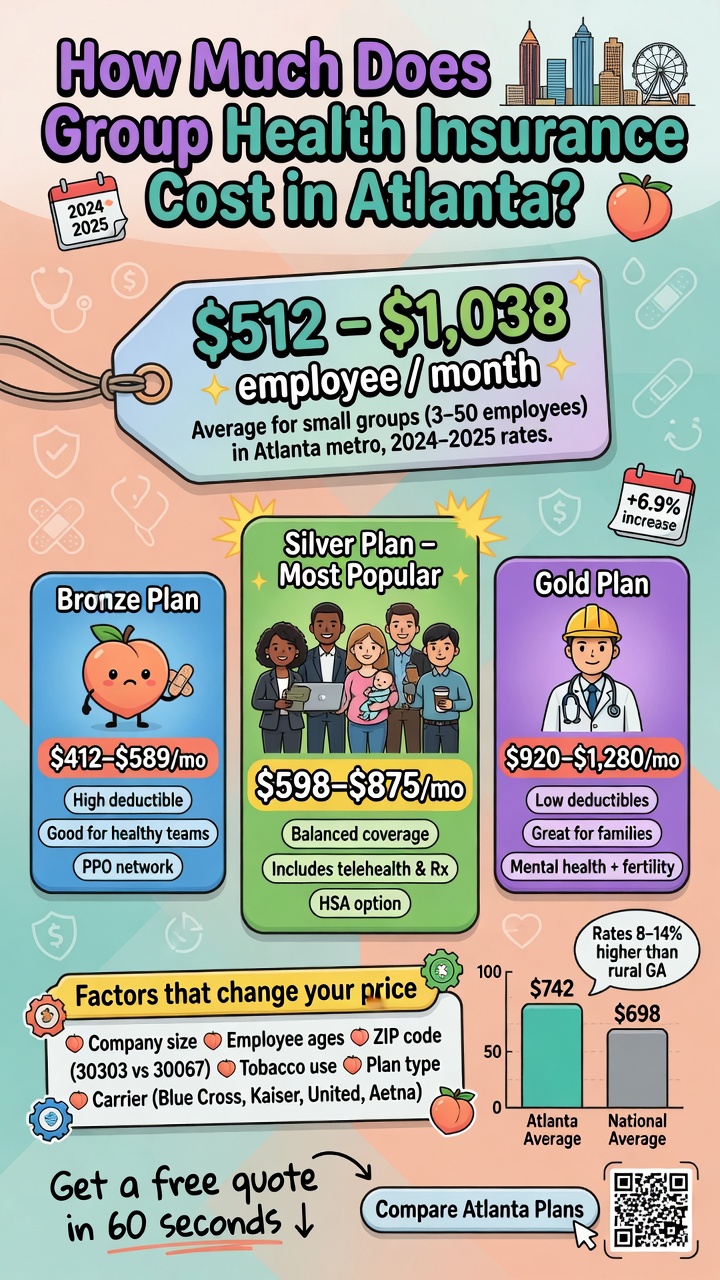
Here's the honest version: group health insurance for an Atlanta small business in 2026 typically runs $400-$800 per employee per month for a decent mid-tier plan. That's a real number. The actual figure depends on your team's age mix, the plan you choose, and how much of the premium you contribute as the employer. We'll break it down by team size, plan tier, and carrier.
Wondering if you're required to offer it at all? See Do I Have to Get My Employees Insurance in Georgia?
I'm Justin Bishop, an independent broker in Atlanta. I write group health for small Atlanta businesses every week — solo founders adding their spouse, 5-person agencies, 25-person restaurants. Here's what it actually costs and how the rules work.
The 30-Second Version
Minimum team size for group health in Georgia: 2 employees (one of whom can be the owner)
Typical Atlanta cost: $400-$800 per employee per month for a mid-tier plan in 2026
Employer contribution: most carriers require you to pay at least 50% of the employee-only premium
Available carriers: Blue Cross Blue Shield, UnitedHealthcare, Aetna, Humana, Cigna, Kaiser Permanente, Anthem
Plan types: fully insured (predictable, traditional) vs level-funded (potentially cheaper for healthy groups)
Setup timeline: 30-45 days from "let's do this" to coverage effective
Tax-deductible: employer contributions are deductible as a business expense
That's the framework. The rest is the detail.
How Small Can Your Business Be?
The first question every small business owner asks: do I even qualify? Yes, if:
You have at least 2 W-2 employees — and one of them can be the owner. So a husband-and-wife LLC where both are on payroll qualifies. A solo LLC with no employees does not.
The business is registered in Georgia — most carriers require the business to be Georgia-based for Georgia group plans
You have a real employer-employee relationship — meaning real wages, real W-2s, real work being done. Carriers (and the IRS) will scrutinize "fake" employees added solely to qualify for group coverage
You can meet minimum participation requirements — most carriers require 70-75% of eligible employees to enroll, with some flexibility
If you're a solo LLC with no employees, you're on the individual marketplace (see self-employed health insurance Georgia for that path). If you have at least 2 W-2s, group health is on the table.
What It Actually Costs in Atlanta in 2026
Here's the real cost breakdown by team size, based on typical Atlanta-market 2026 pricing for a mid-tier (Silver-equivalent) plan:
2-person business (husband-wife LLC, owner + 1 employee): $800-$1,600 total per month for the team. Per-person rate runs higher because there's no group rating leverage. Often the right move at 2 employees is for the owner to take a "group of one" plan plus the employee on a separate marketplace plan with subsidy.
5-person team (typical small agency or restaurant): $2,000-$4,000 per month total ($400-$800 per employee). Group rating starts working in your favor here.
10-person team: $4,000-$8,000 per month total. Carriers compete more aggressively for groups of 10+.
25-person team: $10,000-$20,000 per month total. By this size you have meaningful negotiating leverage and may want to consider self-funded or level-funded options.
50-person team: $20,000-$40,000+ per month. Now you're approaching ALE (applicable large employer) status under the ACA — different compliance rules apply, and your insurance strategy changes accordingly.
For COBRA admin costs and what employers owe after an employee leaves, see My Employee Just Quit. How Long Do They Stay on Group Health?
These numbers are heavily dependent on:
Team age mix. A team where the average age is 28 pays meaningfully less than one averaging 52. Each carrier has age-rating bands.
Plan tier. Bronze, Silver, Gold, Platinum — same definitions as individual ACA. Going from Silver to Gold typically increases premium ~15-25%.
Network. PPO networks (broader, more expensive) vs HMO networks (narrower, cheaper). Atlanta has both.
Geography. Specific Atlanta zip codes (and outlying metro areas) have slightly different rating areas.
How Much the Employer Has to Pay
Most Georgia group health carriers require the employer to cover at least 50% of the employee-only premium. Specifically:
You pay 50%+ of the premium for the employee themselves — the most common arrangement is 50%, 75%, or 100%
You don't have to pay anything toward dependent coverage (spouse, kids) — most small employers don't, and that's fine
You can offer the same contribution percentage to all employees in the same class (full-time, part-time, executive)
Whatever you contribute is tax-deductible as a business expense
Real example: a 10-person Atlanta marketing agency choosing a Silver plan at $700/month per employee. The employer pays 60% ($420/month per employee), the employee pays 40% ($280/month). Annual cost to the employer: $420 × 10 × 12 = $50,400/year.
Some employers go higher than 50% to attract and retain talent. Others stick at the minimum. There's no wrong answer — it's a recruiting/retention decision, not a compliance one.
Atlanta Group Health Carriers in 2026
The carriers that actually compete for Atlanta small-group business in 2026:
Blue Cross Blue Shield of Georgia (Anthem) — largest network, broadest provider access. Often the default choice. Premium is rarely the cheapest but rarely the most expensive either.
UnitedHealthcare — strong national network, good for businesses with employees in multiple states. Sometimes priced aggressively for small groups.
Aetna — solid Atlanta coverage, competitive on level-funded plans, decent telehealth integration.
Humana — strong on Medicare side, also writes small group. Less common for small group than the above three.
Cigna — typically better fit for slightly larger groups (15+) than tiny ones.
Kaiser Permanente — only works if your team is concentrated in metro Atlanta where Kaiser has facilities. Significantly cheaper if you fit Kaiser's HMO model; useless if your team is spread out.
Ambetter (Centene) — narrower network, lowest premiums of the major carriers. Works for cost-conscious teams who don't need broad provider access.
For most Atlanta small businesses, the right move is comparing 3-4 carriers rather than going straight to one. A broker with access to all of them runs the comparisons in 20 minutes — without needing to set up separate quote sessions with each carrier.
Fully Insured vs Level-Funded: The 2026 Decision
Two main plan structures Atlanta small businesses choose between:
Fully Insured. The traditional approach. You pay a fixed premium each month. The carrier takes the risk. Predictable, simple, the default for most small groups historically. If claims come in higher than expected, the carrier eats it. If lower, the carrier keeps the difference.
Level-Funded. A self-funded structure with stop-loss protection. You pay a fixed monthly amount that covers expected claims plus an admin fee. If actual claims come in lower than expected, you get money back at year-end (often 15-30% refund for healthy groups). If higher, the stop-loss kicks in and protects you.
When level-funded makes sense:
Healthier-than-average team (younger demographics, no major chronic conditions known)
At least 5-10 employees (smaller groups don't have enough claims data to predict)
Tolerance for some year-to-year variability in cost
Comfort with looking at claims data quarterly
When fully insured makes sense:
Older team or known health conditions that would make level-funded underwriting expensive
Preference for predictable monthly cost (no surprise refunds, no surprise expenses)
Smaller groups (2-5 employees, where claims volatility makes level-funded too risky)
Simplicity over potential savings
For a healthy 8-person team in Atlanta, level-funded often saves 15-30% over fully insured. For an older team or one with known health issues, fully insured is usually the right call.
How Long Does Setup Take?
The realistic timeline from "let's offer group health" to "coverage effective" in Atlanta:
Week 1: Initial conversation, gather employee census (names, ages, dependents, salary), get carrier quotes
Week 2: Compare carrier quotes, pick a plan, finalize employer contribution structure
Week 3: Open enrollment with employees — they make their elections, complete forms, choose coverage levels for dependents
Week 4-5: Carrier finalizes underwriting, generates plan documents, sets up billing
Week 6: Coverage effective on the 1st of the following month
Total: typically 30-45 days from kickoff to active coverage. If you have an urgent need (your current group plan ending, or you need to start by a specific date), some carriers can expedite. Otherwise, plan to start the conversation 60 days before you want coverage active.
Common Mistakes I See
The specific mistakes that cost real money or create real headaches:
Picking the cheapest carrier without checking the network. A plan that's $50/month cheaper but doesn't include the doctors your employees actually use will tank morale fast. Network match matters more than premium for employee satisfaction.
Not getting the dependent contribution math right upfront. Some employers say "I'll cover 50%" without specifying whether that's of employee-only or family premium. They become very different numbers. Decide before you announce.
Skipping level-funded for a healthy team. Many young agencies/startups miss savings of $10K-$30K/year by sticking with fully insured out of habit.
Adding family members as "employees" to qualify. This is fraud. Real W-2s, real wages, real work — or skip group entirely and use the individual marketplace.
Not using a broker because "we want to save money." Brokers are paid by the carrier, not by you. Skipping a broker doesn't save you money — it just means you do all the work yourself with less expertise.
Setting up too late before a deadline. A common pattern: company decides in October to offer group health by January 1 — and runs out of time by mid-November. Start 60 days out, not 30.
Ignoring ICHRA as an alternative. For some small businesses (especially with employees in multiple states or wanting employee plan choice), an ICHRA — Individual Coverage Health Reimbursement Arrangement — is a better fit than traditional group health. Worth comparing.
When ICHRA Beats Traditional Group Health
A quick note for awareness — we'll deep-dive in a future post:
ICHRA (Individual Coverage Health Reimbursement Arrangement) is a 2020+ option where instead of buying a group health plan, you reimburse employees for individual marketplace plans they choose themselves. Often a better fit when:
Your employees are spread across multiple states (group plans get complicated; ICHRA scales nationally)
You want employees to have plan choice (rather than picking one plan for everyone)
You have a young, healthy team that would do well on the marketplace
You want fixed-budget predictability without the fully-insured-vs-level-funded decision
When traditional group health beats ICHRA:
Most of your team is concentrated in Atlanta (group rating is more efficient)
You have older employees (group rating averages out the cost; ICHRA exposes them to age-based individual market pricing)
You want a single carrier relationship (group is one phone call; ICHRA can mean 10 different carriers across employees)
A quick conversation with a broker tells you which structure fits your situation. Both are legitimate; neither is universally better.
How to Decide if Group Health Is Right for Your Atlanta Business
The 5-question framework:
Do you have at least 2 W-2 employees (including yourself)? If yes, you can qualify. If no, individual marketplace is your path.
Are most of your team based in Atlanta or Georgia? If yes, traditional group is efficient. If they're spread across many states, consider ICHRA.
Is your team younger and reasonably healthy? If yes, level-funded plans can save 15-30% over fully insured. If older or with known health issues, fully insured is safer.
Can you commit to paying at least 50% of employee-only premiums? Required by most carriers.
Do you have 60 days until you want coverage active? Setup takes time; rushing rarely produces a good result.
If all five answers are yes, group health is probably your right path. If you're missing one or two, ICHRA, individual marketplace, or short-term solutions might fit better.
Want a Real Group Health Quote for Your Atlanta Business?
If you want to know what your specific small business would actually pay, the fastest path is to text me at (706) 988-1930 with:
Number of W-2 employees (including yourself)
Rough age range of the team (avg age, oldest, youngest)
Whether dependents (spouses, kids) need coverage
Atlanta-area zip code where the business is registered
I'll come back inside 24-48 hours with quotes from 3-4 carriers, broken out by plan tier and contribution scenario. You'll see what each option actually costs in real dollars, not generic ranges.
Free. Independent broker. No pressure.
I write Atlanta small business group health every week — agencies, restaurants, professional services, retail, e-commerce. Most of my clients want one person who can compare options across all carriers in 20 minutes, not 5 different sales conversations with each carrier individually. That's what an independent broker does.
For an alternative to traditional group health entirely, see Do I Need Group Health Insurance for My Employees?
The funding model (level-funded vs fully insured) is one of the biggest cost levers in group health. See Level-Funded or Fully Insured Group Health? for the side-by-side math.
Beyond group health, every Atlanta business needs General Liability. Full breakdown: General Liability Insurance for Atlanta Small Businesses
Shopping carriers for your 2026 plan? See Best Georgia Small Group Health Insurance Carriers for 2026 for the honest ranking across Anthem, UHC, Aetna, Humana, and Kaiser
Justin Bishop is the founder of That Young Insurance Guy, an independent insurance brokerage in Atlanta, GA, licensed in 31 states. He writes the Health Coverage Chaos newsletter on LinkedIn.
This post is general education, not legal or insurance advice. Group health rules, carrier participation, and pricing change.