
Group Health Insurance for Small Business in Atlanta 2026
Author: Justin Bishop · May 7, 2026 · 8 min read
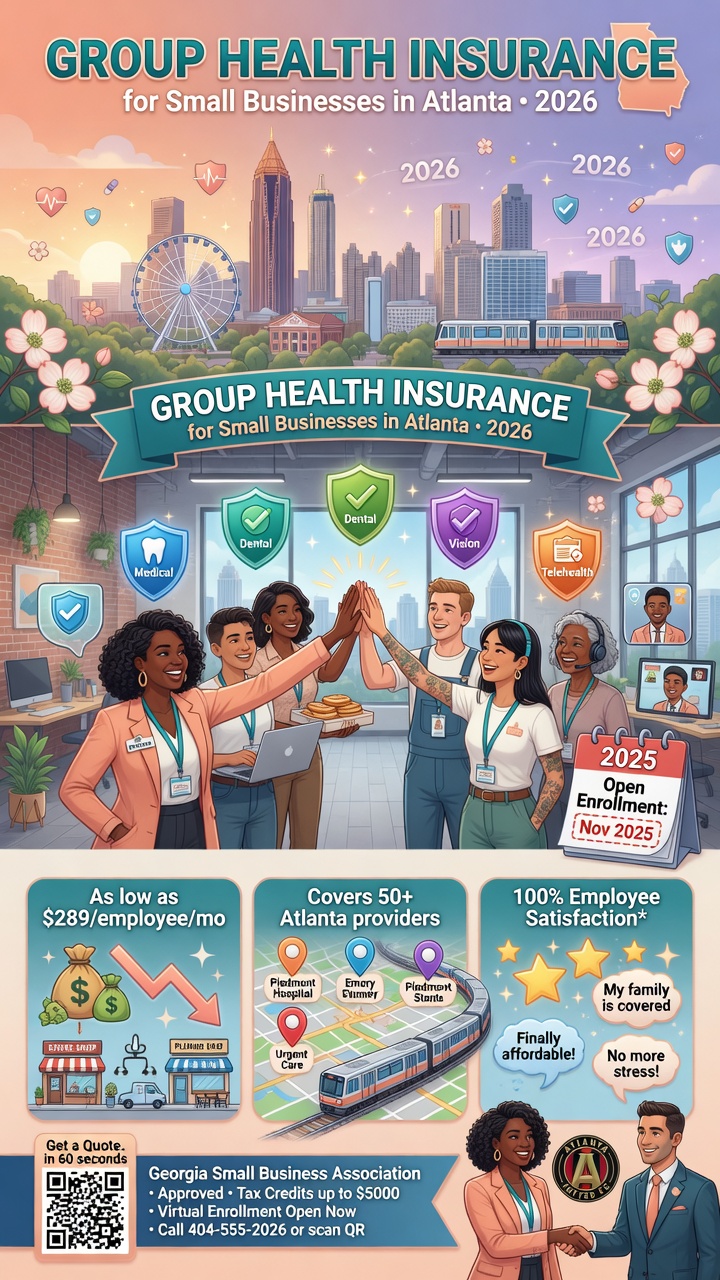
If you run a small business in Atlanta and you're thinking about offering health insurance to your team, the landscape in 2026 is more confusing than it's ever been. Premiums keep climbing. Renewals come back with double-digit increases. New options like ICHRAs are technically available but nobody explains them clearly. And the "do I even have to do this?" question doesn't have a simple yes-or-no answer.
This is the plain-English overview of group health insurance for Atlanta small businesses in 2026 — what it costs, how it works, when it's the right call, and what your alternatives are if it isn't.
I'm Justin Bishop, an independent broker in Atlanta. I write health insurance for Atlanta-area small businesses regularly — solo S-corps, 5-person LLCs, 30-person agencies, mid-size companies approaching 50 employees. Here's the lay of the land.
What Is Group Health Insurance, Exactly?
Group health insurance is a single health plan that covers multiple employees of the same business. The employer signs the contract with the insurance carrier, the employer typically pays a portion of the premium, and employees pay the rest through payroll deduction.
Three quick clarifications most Atlanta owners get wrong:
You don't need 20+ employees to qualify. In Georgia, a "small group" plan is available for businesses with as few as 2 eligible employees. Some carriers will write a plan for 1 employee + the owner.
Group health is not the same as employer-sponsored insurance. Big-company plans you've experienced as an employee are technically group plans, but the small-group market in Georgia operates on different rules and pricing than the large-group market.
Owners can typically be on the plan. As long as you're a W-2 employee of your own company (or an active LLC member), you can be on the group plan along with your team. There are some exceptions for S-corp 2%+ owners — talk to your CPA.
Are You Required to Offer Group Health Insurance?
The short answer for most Atlanta small businesses: no.
Federal law (the ACA's "employer mandate") only requires businesses with 50 or more full-time-equivalent employees to offer affordable health insurance to full-time staff. Below 50 FTEs, it's optional.
There are nuances — Applicable Large Employer (ALE) calculations, what counts as "full-time," what counts as "affordable," and what happens if you cross the threshold mid-year. The full breakdown is here: Do I Have to Get My Employees Insurance in Georgia?
For most owners reading this, you're under 50 FTEs. Offering health insurance is a recruiting and retention decision, not a legal one.
How Much Does Group Health Insurance Cost in Atlanta?
The honest answer: it depends on the size of your group, the average age of your employees, the plan tier you pick, and which carrier you use.
A few rough benchmarks for 2026 small group plans in the Atlanta market:
Single coverage: roughly $500-750/month per employee (pre-employer-contribution)
Family coverage: roughly $1,400-2,200/month per employee (pre-employer-contribution)
Typical employer contribution: 50-75% of the single premium, sometimes less for family coverage
Out-of-pocket employee cost (after employer contribution): roughly $150-300/month for single, $400-700/month for family
These are starting points, not quotes. Real numbers depend on your specific group. For the deeper breakdown — including which carriers tend to win on price in Atlanta and what drives the year-over-year increases — see the dedicated cost guide: How Much Does Group Health Insurance Cost in Atlanta?
The Plan Types You'll See Quoted
When a broker presents you with group health quotes, you'll typically see four kinds of plans:
HMO (Health Maintenance Organization) — lowest premium, narrow network, requires a primary care doctor and referrals for specialists. Common in Atlanta with Kaiser Permanente.
PPO (Preferred Provider Organization) — higher premium, broader network, no referrals required. Most flexible. Most common in Atlanta with Anthem and UnitedHealthcare.
EPO (Exclusive Provider Organization) — middle ground; PPO-like flexibility but no out-of-network coverage.
HDHP (High-Deductible Health Plan) — lower premium, higher deductible, eligible to pair with an HSA. Increasingly popular for owners who want lower employer cost and employees who can handle the deductible.
Beyond plan type, there's a separate question of funding structure: fully insured vs level-funded vs self-funded. That's a deeper trade-off most small businesses don't think about until they hit 25+ employees, but it matters for renewals and risk pooling.
When Group Health Is the Right Call
Group health insurance is typically the best path when:
You have 5 or more employees with a mix of ages, family situations, and health profiles
You compete for talent against larger employers who offer benefits
You want simplicity — one plan, one renewal date, one carrier relationship
Your team values the prestige of a name-brand carrier (Anthem, BCBS, UHC, Kaiser)
You can afford to absorb a 10-15% renewal increase per year without it breaking the budget
If most of those describe your situation, traditional group health is probably the move. Get 2-3 broker quotes (we can help) and pick the plan that balances cost, network, and benefits for your specific team.
When Group Health Isn't the Right Call (And What to Do Instead)
Group health is a poor fit when:
You have fewer than 5 employees, especially with one or two older or higher-claims employees driving up the small-group rating
Your team is scattered across multiple states (group plans are state-specific; remote-heavy companies struggle)
Your renewals keep climbing 15%+ per year and you can't sustain the trajectory
Most of your employees would qualify for big ACA subsidies on the individual marketplace
You hate dealing with renewal cycles and broker handoffs
When group isn't working, the main alternative is an ICHRA (Individual Coverage Health Reimbursement Arrangement) — a tax-free monthly stipend that lets each employee pick their own individual marketplace plan. ICHRAs work for businesses of any size, including 1-2 person shops where group health isn't even available.
The full ICHRA breakdown is here: Do I Need Group Health Insurance for My Employees?
There are also two narrower alternatives worth knowing:
QSEHRA (Qualified Small Employer HRA): similar to ICHRA but with annual reimbursement caps. Available only to businesses under 50 employees.
Cash bonus / taxable stipend: technically not a benefits plan. You give employees a raise so they can buy their own insurance. Simple, but they pay taxes on the money and you lose the deduction structure.
How to Actually Get a Group Health Quote
The real process:
Step 1: Decide what you can budget per employee per month. $400/month? $600? Walk in knowing the number.
Step 2: Pull a list of your employees with their dates of birth, ZIP codes, and dependent counts. Carriers need this to quote.
Step 3: Get quotes from 2-3 brokers (or one broker who works with multiple carriers). Independent brokers can quote multiple carriers in one shot — captives can only quote their own.
Step 4: Compare quotes on premium, deductible, in-network providers, and prescription coverage. Don't pick on premium alone.
Step 5: Decide whether group is actually the best fit. Sometimes the quotes come back, you do the math against ICHRA, and ICHRA wins. The point of getting quotes is to know your actual options.
For the carrier-by-carrier breakdown of which insurer fits which small business profile, see Best Georgia Small Group Health Insurance Carriers for 2026
A few specific questions to ask any broker before you commit: 6 Questions to Ask Any Insurance Broker Before You Hire Them
Common Group Health Scenarios
A few situations that come up regularly:
You're a 2-person LLC (you and your spouse). You can usually get group coverage but the rules vary by carrier and ownership structure. Your spouse-as-employee status matters.
An employee just quit and wants to keep coverage. Federal COBRA (employers 20+) or Georgia Mini-COBRA (employers 2-19) lets them stay on the plan for a defined period at full premium plus admin fee.
For the full COBRA + Mini-COBRA walkthrough when an employee leaves, see My Employee Just Quit. How Long Do They Stay on Group Health?
You're approaching 50 employees. ALE compliance kicks in. The math, paperwork, and consequences all change. Plan ahead.
Your renewal came back 22% higher than last year. Rarely the answer is "switch carriers" — usually the answer is to negotiate with the carrier, adjust plan design, or evaluate level-funded as an alternative.
Each of these gets its own dedicated post in the cluster. As of this writing, several are still in the works — keep an eye on the blog index.
The Bottom Line
Group health insurance for an Atlanta small business in 2026 isn't a single decision — it's a series of decisions. Are you required to offer it? What can you afford? What's the right plan type? Is group actually better than an ICHRA for your team? Which carrier and which broker?
The good news: none of these questions are hard once you have the right information. The bad news: most brokers won't walk you through the alternatives because their commission depends on you picking group.
I'm an independent broker who works with multiple carriers and can quote group, ICHRA, and individual plans. If you're a small business owner in Atlanta wondering whether group health is right for your team — or what you should do instead — book a 15-minute call with me. I'll run real numbers against your specific situation, give you a straight take on what makes sense, and never charge you for the answer.
Want to keep reading? Check out Health Insurance for the Self-Employed, How Much Does Group Health Insurance Cost in Atlanta?, or Do I Need Group Health Insurance for My Employees?.
What other coverage your business needs
Most Atlanta small businesses also need a Business Owner Policy. See Where Do I Get a Business Owner Policy in Atlanta? for the buying process
Justin Bishop is the founder of That Young Insurance Guy, an independent insurance brokerage in Atlanta, GA, licensed in 31 states. He writes the Health Coverage Chaos newsletter on LinkedIn — and yes, he answers his own texts.
This post is general education, not medical, tax, or legal advice. Group health insurance regulations, ACA employer mandate rules, and small business benefit programs change