
6 Questions to Ask Any Insurance Broker Before You Trust Them With Your Family
Author: Justin Bishop · April 29, 2026 · 6 min read
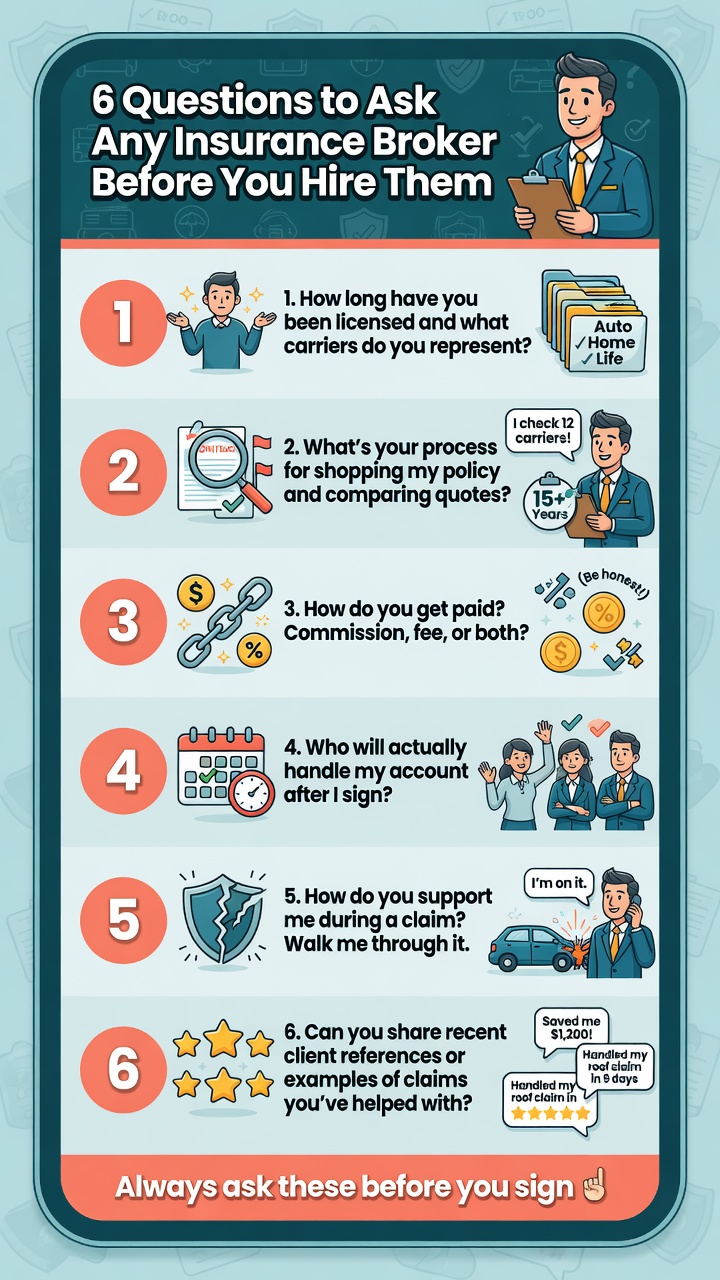
I get asked all the time how to find a good insurance broker. People expect me to say something like "look for someone with 20 years of experience" or "ask for their license number."
That's not really what matters.
The truth is, most insurance brokers are competent on the policy side. They know products. They've passed the licensing exams. The thing that actually separates a broker who makes you money from one who costs you money is how they work — and you can figure that out in 15 minutes if you know what to ask.
Here are the 6 questions I tell people to use. Doesn't matter if the broker is 27 or 67 — these work either way.
1. Are You Independent, Or Do You Work for One Carrier?
This is the most important question by far. There are two kinds of insurance professionals:
Captive agents — they work for one carrier (think a State Farm agent, Allstate agent, or Farmers agent). They can only sell that company's products.
Independent brokers — they're contracted with multiple carriers and can shop the market on your behalf.
For most people most of the time, you want independent. Captive agents have a place — if you genuinely love one specific carrier and don't want to compare, fine. But the moment you ask "what's a better deal?" a captive agent only has one answer.
What a good answer sounds like: "I'm independent. I'm contracted with [list of carriers]. For your situation I'll probably quote [these 3-4]."
Red flag: "We're an authorized agency for [Brand X]." That's a captive relationship dressed up. Ask whether they can quote anyone else.
2. How Many Carriers Did You Actually Quote For Me?
"I shop the market" is what every broker says. Three real quotes from three different carriers is what proves it.
When a broker comes back with options, ask them point-blank: "How many carriers did you quote? Can I see all of them, including the ones you didn't pick?"
A good broker will show you 2-4 quotes side by side, with the math, and tell you why one beat the others. A weak broker hands you "the best plan" and skips the comparison entirely. Sometimes that's because they really did the work and only one made sense — but more often, it's because they only quoted one or two carriers (often the ones that pay them best).
What a good answer sounds like: "I quoted 5 carriers. Here are the 3 that came back competitive. Here's the one I'd pick if it were me, and here's why."
Red flag: "This is the best plan for you." Followed by no comparison. Insist on seeing the runners-up.
3. Do You Explain the Math, Or Just Point At One Option?
Insurance is fundamentally a math problem. Premium vs. deductible. Network vs. out-of-network. Premium tax credit vs. tax bracket. HSA contribution vs. expected medical spend. The right plan depends on numbers a good broker can run with you in real time.
A weak broker hands you a quote and says "this is great." A strong broker walks you through:
What you'd pay monthly vs. what you'd potentially pay in a bad year
What's covered, what's not, and where the surprise costs lurk
What changes if your income, family size, or doctor preferences shift
You don't need to become an actuary. But you should leave the conversation with at least three real numbers: monthly premium, max out-of-pocket, and a realistic estimate of what an average year actually costs you.
What a good answer sounds like: "On Plan A you'd pay $400/month and could be on the hook for up to $8,000 if you have a bad year. Plan B is $550/month but caps you at $5,000. Given that you have ongoing physical therapy, Plan B is probably the better bet — let me show you why."
Red flag: "It's just a really good plan." That's not analysis, that's marketing.
4. Who Do I Call When Something Goes Wrong?
The job isn't selling you the policy. The job starts after you've signed.
When you have a claim issue six months from now, when your prescription's been denied, when your network changed and your doctor isn't in it anymore — who picks up the phone? Is it a 1-800 number routed to a different country, or is it the actual broker who sold you the plan?
The answer to this question tells you whether you're hiring a broker or just buying a policy through one.
What a good answer sounds like: "You call me. I'll usually pick up the same day, or call you back by end of day. If I'm out, my team has full access to your file. We don't outsource service."
Red flag: "You'd contact the carrier directly for claims issues." Translation: I'm done with you the moment the policy is in force. A broker who hands you off to a 1-800 number after the sale isn't really your broker — they're a referral source.
5. Do You Push the Highest-Commission Product?
Brokers get paid commissions. That's not a secret. But commission rates are not equal across products:
Term life pays modest commissions. Whole life and IUL pay much higher commissions — sometimes 5-10x.
Medicare Advantage typically pays brokers more than Medicare Supplement (Medigap).
Final expense pays high commissions on small policies.
A broker who always steers toward the higher-commission option, regardless of your situation, is selling themselves, not advising you. The vast majority of people raising young families are best served by term life, not whole life. Most retirees with stable income and a desire for predictability are better off with Medigap, not Advantage. A broker who never recommends the lower-commission product is a red flag — full stop.
The good news: you don't need to memorize commission rates. You just need to ask.
What a good answer sounds like: "Term is right for most people in your situation. Whole life makes sense for estate planning or specific tax strategies, but if you're asking me whether you need it — probably not. Here's why I'm recommending term."
Red flag: "Whole life is always better than term — let me explain compound interest." Run.
6. Are You Actually Licensed in My State?
This sounds basic. It's surprisingly common. Insurance is regulated state-by-state — a broker licensed in Georgia can't write a policy for someone living in Tennessee unless they're also licensed in Tennessee.
If you live somewhere other than where the broker's office is, ask directly:
"Are you licensed in [my state]?"
"What's your NPN (National Producer Number)?" — that's the public, federally tracked ID. You can verify any agent's licensing at niprdb.com.
A real broker won't blink. They'll either confirm or tell you honestly they aren't licensed there and refer you to someone who is.
What a good answer sounds like: "Yes — licensed in 31 states. My NPN is [number]. You can verify at nipr.com."
Red flag: "It doesn't matter, we can write it through a partner agency." Maybe that's true, but you want to understand the chain. If your broker isn't actually the licensed party, who's responsible if something goes wrong?
What All Six Have in Common
Notice what these questions are not: they're not about the broker's age, their tenure, their office, their certifications, or their LinkedIn endorsements.
They're about how the broker works. Are they independent? Do they actually shop? Do they explain math? Do they answer your phone calls? Do they push the high-commission product? Are they licensed where you live?
Six honest answers to those six questions tell you more in 15 minutes than a 30-minute "discovery call" usually does.
If your current broker fails on any of these, it might be worth a second opinion. If a broker you're considering passes all six — independent, multi-carrier, math-explained, accessible after the sale, doesn't push high-commission products, properly licensed — they're worth working with regardless of whether they're 27 or 67.
That's the framework.
Want a Real Answer to All Six?
If you'd like to ask me these questions on a call, the easiest path is call or text (706) 988-1930. I'll answer them directly — no sales pitch, no follow-up sequence. If after the call I'm not the right fit for you, I'll point you to someone who is.
I'm an independent broker in Atlanta, licensed in 31 states. I quote multiple carriers for every client, explain the math, answer my own texts, and don't push products I wouldn't buy myself.
Whether you decide to work with me or not, I'd rather you ask the right questions than wing it.
Justin Bishop is the founder of That Young Insurance Guy, an independent insurance brokerage in Atlanta, GA. He writes the Health Coverage Chaos newsletter on LinkedIn — and yes, he answers his own texts: (706) 988-1930.