Do I Need Group Health Insurance for My Employees?
Author: Justin Bishop · May 6, 2026 · 7 min read
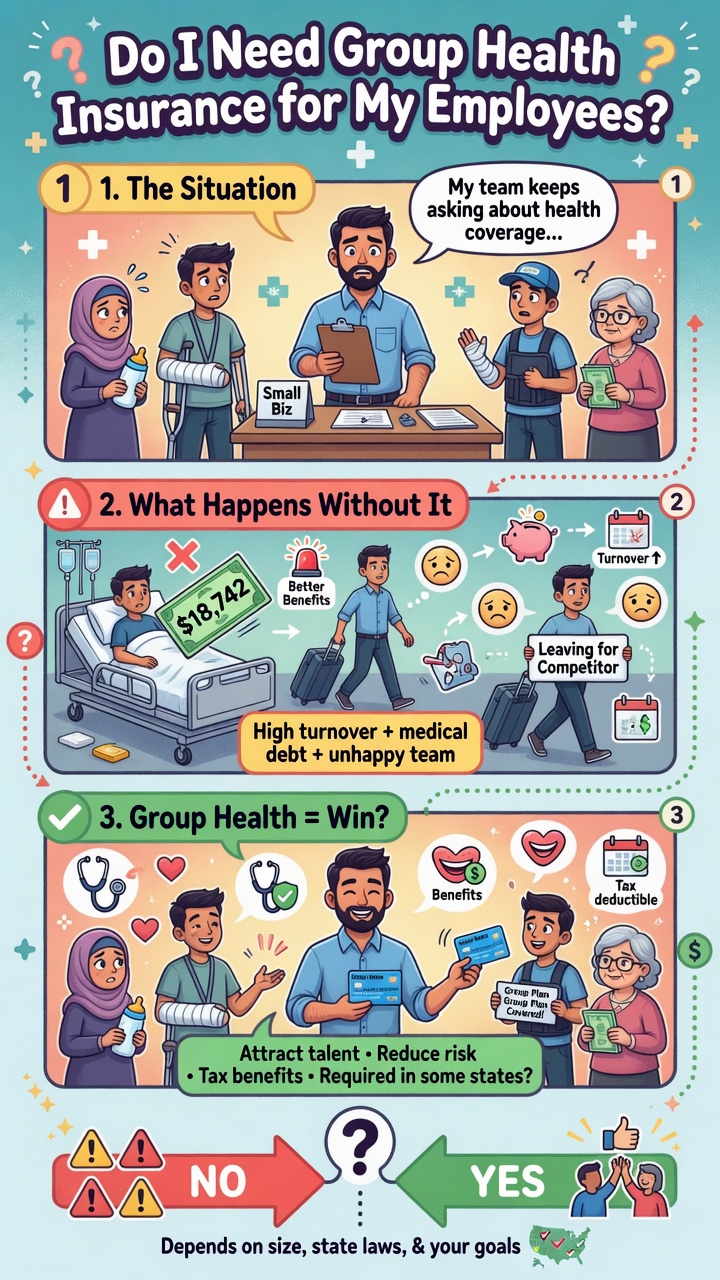
If you're an Atlanta small business owner who's looked at group health renewals lately, you already know: the math is brutal. Premiums up, deductibles up, networks shrinking, and the broker who sold you the plan three years ago suddenly stops calling.
For the broader overview, see Group Health Insurance for Small Business in Atlanta 2026.
Short answer: no, you don't need group health insurance — and there's a different option that almost no local broker is talking about. It's been legal since 2020, the IRS approves it, and for the right business it can cut benefit costs 20-40% while giving employees better coverage.
It's called an ICHRA, and most owners I talk to have never heard of it.
I'm Justin Bishop, an independent broker in Atlanta. I write health insurance for Atlanta-area small businesses regularly — solo S-corps, 5-person LLCs, 30-person agencies. Here's the plain-English version of how ICHRAs actually work in 2026, and how to decide whether you need group health at all.
The 30-Second Version
An ICHRA (Individual Coverage Health Reimbursement Arrangement) lets you, the business owner, give each employee a tax-free monthly allowance to buy their own individual health insurance plan on the marketplace. You don't pick the plan. You don't manage the network. You don't take a renewal hit if one employee gets sick.
You set the dollar amount. They pick the plan. The IRS treats your reimbursement as tax-free for both sides.
That's it. That's the whole concept.
What Does ICHRA Actually Stand For?
Individual Coverage Health Reimbursement Arrangement.
It was created by federal rule in 2019 and went live January 1, 2020. It's not a loophole, not a workaround, not a gray-area tax move. It's a fully sanctioned IRS and HHS program designed specifically to let employers offer health benefits without buying a traditional group plan.
ICHRAs are available to businesses of any size — solo S-corps, 5-person LLCs, 50-person agencies, 500-person companies. There's no employee minimum and no employee maximum.
That's a big deal because the older program (QSEHRA) is capped at businesses under 50 employees. ICHRAs have no cap.
How an ICHRA Actually Works (Step by Step)
Here's what the process looks like in real life for an Atlanta small business:
Step 1 — You decide on a monthly allowance. Maybe $400/month for each full-time employee. Maybe $600. There's no IRS minimum or maximum. You decide what your budget is.
Step 2 — You pick which "employee classes" get the ICHRA. Full-time only? Full-time and part-time? Salaried only? You can split classes (with rules) and offer different amounts. You cannot offer ICHRA and traditional group health to the same class — it's one or the other.
Step 3 — Employees go to Healthcare.gov (or work with a broker like me) and pick their own individual plan. They can pick anything that's actually a qualified ACA plan — Bronze, Silver, Gold, whatever fits their family.
Step 4 — They submit proof of coverage to your ICHRA administrator. This is usually a third-party software platform that handles the paperwork.
Step 5 — You reimburse them tax-free, up to the allowance you set. Reimbursements typically come through payroll. The employee pays no income tax on the reimbursement. You pay no payroll tax on it.
The employee owns the plan. If they leave your company tomorrow, the plan goes with them. You're not paying COBRA. You're not paying for someone who quit three weeks ago.
Who Wins With an ICHRA (Instead of Group Health)?
ICHRAs work best for these types of Atlanta businesses:
Small businesses with 2-50 employees that have been priced out of group health, or whose group renewals keep climbing 15%+ per year
Companies with employees scattered across multiple states (which is increasingly common with remote work). Group health plans are state-specific. ICHRAs work across all 50 states because each employee picks their own plan in their own state.
Owners with one or two older or chronically-ill employees who are driving up the small-group rating. With an ICHRA, the cost of one high-claims employee no longer crushes the renewal for everyone else.
Companies with a wide range of ages (a 25-year-old developer and a 58-year-old salesperson). On group health, the older employee subsidizes nothing because rates are pooled. On ICHRA, both employees pick the plan that fits their actual age and life stage.
Owners who hate dealing with renewals. ICHRA contributions stay flat unless you change them. There's no "your renewal came back 22% higher, sign here" surprise.
Who Should Stick With Group Health?
I'm not going to pretend ICHRAs are right for everyone. They aren't.
Businesses with employees who hate paperwork. Even with a good administrator, an ICHRA puts more responsibility on the employee than a traditional group plan.
Businesses where most employees would qualify for big ACA subsidies on their own. If your team is mostly low-to-moderate income, they may already get subsidized marketplace plans cheaper than what your group plan offered. Worth running the math.
Owners who want a "we offer the same plan to everyone" simplicity. ICHRAs intentionally let each employee pick their own — that's a feature, but if your culture is "everyone gets the same thing," it can feel weird.
Anyone who needs the prestige of a name-brand group plan for recruiting. Big-name employees still react to "we offer Blue Cross Blue Shield." That said, with ICHRA your employees can buy a Blue Cross Blue Shield individual plan — they just buy it themselves.
ICHRA vs Traditional Group Health: The Real Trade-Offs
Here's where most online articles get vague. Let me give you the actual trade-offs:
Cost predictability: ICHRA wins. You set the budget, the budget stays. Group health renewals are unpredictable.
Employee plan choice: ICHRA wins. Employees pick what fits their family. Group health gives them whatever you picked.
Administrative burden: Group health wins, slightly. The carrier handles most of it. ICHRA requires a third-party administrator (usually $5-15/employee/month).
Tax treatment: Tie. Both are tax-free for the employee and tax-deductible for the employer.
Network access: ICHRA usually wins because employees can pick any plan in any network. Group plans lock everyone into one network.
Risk pooling: Group health pools risk inside your company; one sick employee can spike the renewal. ICHRA pools risk across the whole individual marketplace; one sick employee doesn't move your cost.
Recruiting feel: Group health still has a slight edge in perceived prestige. ICHRA is catching up fast.
How Much Does It Cost to Set Up an ICHRA in Atlanta?
The administrative side is cheaper than most owners assume.
ICHRA administrator software: Typically $5-15 per employee per month. Some platforms offer flat-rate pricing for very small businesses. Annual administrator cost for a 10-employee business: roughly $600-1,800.
Setup fees: Usually $0-500 depending on the platform.
Broker assistance: I help my Atlanta small business clients set up ICHRAs with no separate fee — it's part of the relationship.
The bigger cost is the allowance itself. If you give each of 10 employees $500/month, that's $60,000/year in benefits spending. But you'd already be spending that (or more) on a traditional group plan.
The math that matters: compare your current group health total cost to (proposed monthly allowance × number of employees × 12) + administrator fees. For most small Atlanta businesses I look at, ICHRA comes in 15-30% lower for equal or better employee coverage.
Frequently Asked Questions
Can I offer an ICHRA to some employees and group health to others? Yes — but only by employee class (full-time, part-time, salaried, hourly, geographic, etc.). You cannot mix ICHRA and group inside the same class.
What happens to ACA subsidies? If the ICHRA is "affordable" by IRS standards, employees who accept it can't also claim premium tax credits. If it's "unaffordable," employees can decline the ICHRA and claim subsidies instead. This is a real wrinkle and worth running the numbers on every employee individually.
Do I have to give the same amount to every employee? You can vary by class (FT vs PT, by location, by age — within rules). Within a class, the amount can vary by family size and age, but not arbitrarily.
How much notice do I have to give employees? 90 days before the plan year starts. Atlanta businesses thinking about a January 1 ICHRA need to start the conversation by early October.
Can my spouse and I both be on it if we own the business together? Depends on entity type and ownership structure. S-corp owners with 2%+ ownership are typically excluded from ICHRA participation as employees. Run this one with your CPA.
What happens when an employee leaves a group plan? See My Employee Just Quit. How Long Do They Stay on Group Health? for the full COBRA and Mini-COBRA breakdown
For the broader picture of small business coverage beyond health, see Where Do I Get a Business Owner Policy in Atlanta?
The Bottom Line
So — do you need group health insurance for your employees? No. You need to offer them quality, tax-advantaged health coverage. Group health is one way to do that. ICHRA is another. For the right Atlanta small business, ICHRA is cheaper, more flexible, and lower hassle.
ICHRAs aren't magic. They're not always cheaper. They're not always the right move.
But for the right Atlanta small business — usually 2-30 employees, mixed ages, scattered locations, or stuck in a 15%+ renewal cycle — they can be the cleanest exit from the small-group health insurance hamster wheel.
The hard part isn't the ICHRA itself. It's deciding whether your specific business is the right fit, and running the actual numbers against your current plan.
If you're an Atlanta small business owner staring at a renewal you can't justify, book a 15-minute call with me and let's run the math. I'll tell you straight whether ICHRA makes sense for your team or whether you should stay on group — and I won't charge you for the answer.
Want to keep reading? Check out Health Insurance for the Self-Employed, How Real Estate Agents Get Health Insurance in 2026, or How Mortgage Lenders Get Health Insurance in 2026.
If you decide to offer group health, the next decision is funding structure. Read Level-Funded or Fully Insured Group Health? for the math
Restaurants struggle most with traditional group. See What Health Insurance Should Atlanta Restaurants Offer? for the restaurant-specific solutions.
For tech startups, see What Health Insurance Should Atlanta Tech Startups Offer? — covers the PEO trap and the cheaper alternatives
Justin Bishop is the founder of That Young Insurance Guy, an independent insurance brokerage in Atlanta, GA, licensed in 31 states. He writes the Health Coverage Chaos newsletter on LinkedIn — and yes, he answers his own texts.
This post is general education, not medical, tax, or legal advice. ICHRA rules, IRS thresholds, and small business benefit regulations change.