
What Is an Umbrella Policy?
Author: Justin Bishop · May 21, 2026 · 8 min read
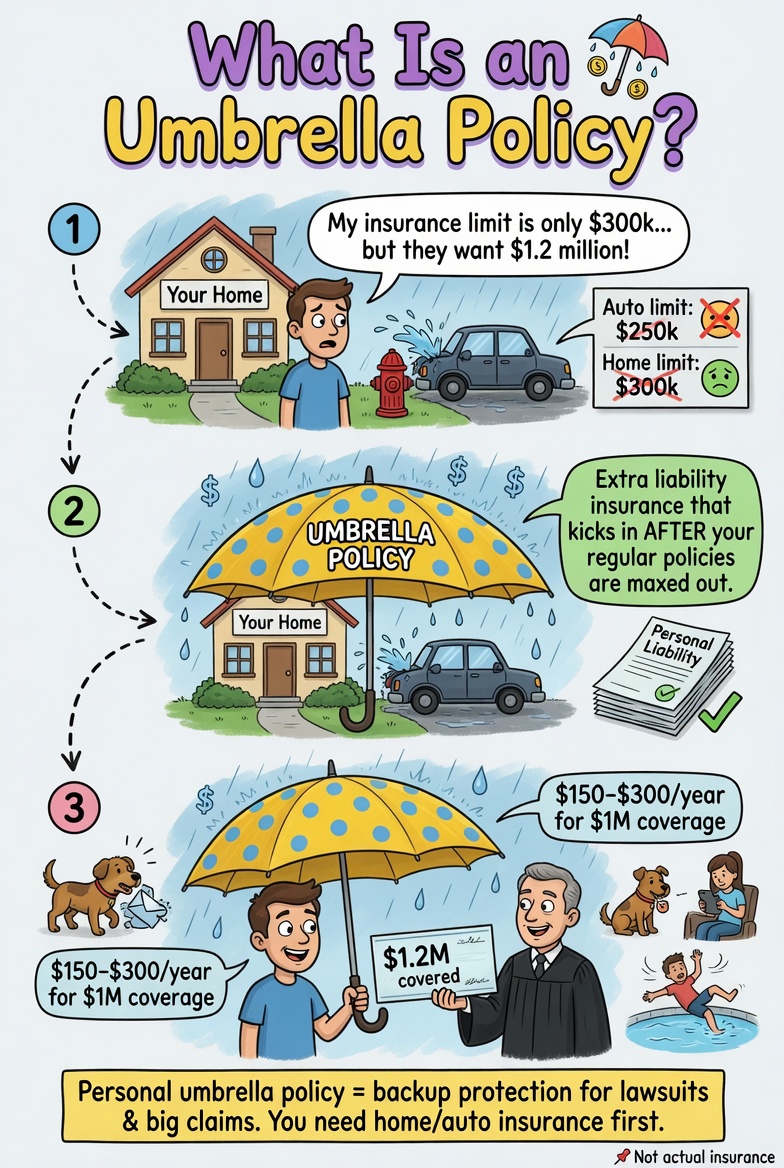
If you've shopped for home or auto insurance lately, you've probably heard your agent mention an "umbrella policy" — usually as a quick add-on suggestion at the end of the conversation. Most Atlanta homeowners say "I'll think about it" and never come back to it. Then they get into a serious accident, get sued, find out their standard $300K liability isn't enough, and realize they should have spent the extra $200/year for $1M of additional protection.
An umbrella policy is the cheapest insurance product on the market relative to what it actually does. For $150-500 per year, it adds $1M to $5M of extra liability coverage that sits on top of your existing home and auto policies. It's the difference between "one accident wipes out my savings" and "I'm protected even in a worst-case scenario."
This post walks through what an umbrella policy actually is, how it works, real examples of when it kicks in, who genuinely needs one (more people than realize it), and the specific moves that make umbrella the highest-value insurance purchase most Atlanta adults can make.
I'm Justin Bishop, an independent broker in Atlanta. I write umbrella policies regularly — usually after a client realizes their standard liability limits are way lower than their actual exposure. Here's the honest breakdown.
The 30-Second Version
An umbrella policy is extra liability insurance that sits on top of your existing home and auto liability coverage. When the underlying policy limit is exhausted, umbrella kicks in.
Typical cost in Atlanta: $150-300/year for $1 million. $250-450 for $2 million. $400-750 for $5 million.
Coverage amounts available: $1M up to $10M+ from most major carriers
Required underlying limits: typically 100/300/100 on auto, $300-500K on home (must maintain these to keep umbrella in force)
What it covers: bodily injury and property damage you cause to others, personal liability claims (libel, slander, false arrest), and protection for swimming pools, dog bites, teen drivers, rental properties, and more
Who genuinely needs one in Atlanta: anyone with $200K+ in assets, dual-income professional families, anyone with teen drivers, pool owners, dog owners, rental property owners, or anyone who could be a lawsuit target
The math: $1M of additional coverage for $200/year = the lowest cost-per-dollar-of-coverage product in personal insurance
What an Umbrella Policy Actually Is
An umbrella policy is a personal liability insurance policy that adds excess liability coverage on top of your existing home and auto insurance.
The mechanics:
Your underlying policies (home + auto) have liability limits. Standard home liability is $300-500K. Standard auto is 100/300/100 (or sometimes higher).
When a covered claim exceeds those limits, the umbrella policy kicks in to pay the difference up to the umbrella limit.
The umbrella starts at $1M and goes up in $1M increments — most Atlanta homeowners buy $1M-3M; high-net-worth families often buy $5M-10M.
Important: umbrella policies are not standalone insurance. They sit on top of existing home and auto policies. You can't buy umbrella by itself — you have to maintain the underlying policies at minimum required limits to keep umbrella in force.
How It Actually Works (Real Examples)
This is where the value becomes obvious. Real claim scenarios where umbrella saved Atlanta homeowners from financial ruin:
Scenario 1: Teen driver auto accident A 17-year-old Atlanta driver causes a serious multi-vehicle accident on I-285. Two people are seriously injured. Settlements total $1.8M.
Auto liability limit: 100/300/100 = $300K maximum
Umbrella picks up: $1.5M
Out-of-pocket: $0
Without umbrella: family loses home equity, retirement, and faces wage garnishment
Scenario 2: Slip-and-fall at home A guest at an Atlanta house party slips on a wet deck and suffers a serious head injury. They sue for medical bills, lost wages, and pain & suffering. Total claim: $850K.
Home liability limit: $500K
Umbrella picks up: $350K
Out-of-pocket: $0
Scenario 3: Dog bite A family's dog bites a delivery driver, causing severe injuries requiring surgery and ongoing therapy. Lawsuit settles at $1.2M.
Home liability limit: $300K
Umbrella picks up: $900K
Out-of-pocket: $0
Scenario 4: Pool injury A neighbor's child slips at a homeowner's pool, suffers severe injury. Parents sue. Settlement: $2.3M.
Home liability limit: $500K
Umbrella picks up: $1.8M (assuming $2M umbrella)
Out-of-pocket: $0
Scenario 5: Defamation / personal injury claim An Atlanta homeowner makes negative statements about a contractor on social media. Contractor sues for defamation. Legal defense + settlement: $400K.
Home liability: doesn't cover defamation
Umbrella picks up: $400K (includes personal injury beyond bodily injury)
Out-of-pocket: $0
The pattern is consistent: standard liability limits are dangerously low compared to actual modern claim amounts. Umbrella fills the gap.
What Umbrella Policies Actually Cover
Umbrella coverage is broader than most people realize:
Bodily injury you cause to others (above auto/home limits)
Property damage you cause to others (above auto/home limits)
Personal injury claims: libel, slander, defamation, false arrest, invasion of privacy, malicious prosecution, wrongful eviction
Legal defense costs (often above and beyond the coverage limit)
Worldwide coverage for most types of claims
Rental property liability (if you own rental property)
Boat and recreational vehicle liability (extending auto-type coverage)
Family member liability (extends to spouse, kids living at home, dependent relatives)
What umbrella typically does NOT cover:
Intentional acts (you deliberately harming someone)
Business activities (need separate commercial umbrella)
Punitive damages in some states (Georgia generally allows them)
Workers' compensation (separate coverage)
Damage to your own property (covered by home/auto)
Professional liability (E&O — separate coverage)
Real 2026 Atlanta Umbrella Pricing
Typical annual premiums for personal umbrella policies in the Atlanta metro:
$1 million umbrella: $150-300/year
$2 million umbrella: $250-450/year
$3 million umbrella: $350-600/year
$5 million umbrella: $400-750/year
$10 million umbrella: $700-1,400/year
Add-ons that affect premium:
Each additional residence/property: +$25-75/year
Each driver: typically included up to 4 drivers, then +$25-50/year each
Teen drivers: can add $50-150/year per teen
Swimming pools: +$25-100/year (sometimes excluded entirely without umbrella)
Dog breeds with bite history: some carriers exclude or surcharge specific breeds
Trampolines, boats, rental properties: varies by carrier
The cost-per-dollar math: $1M of liability protection for $200/year = $0.0002 per dollar of coverage. There is no other insurance product that protects this much per premium dollar.
Who Actually Needs an Umbrella Policy in Atlanta
Strong candidates include anyone with:
$200K+ in total assets (home equity, savings, retirement, investments)
Dual-income professional household (you're a higher-value lawsuit target)
Teen drivers (highest-risk auto exposure)
Swimming pool (one of the most common Atlanta umbrella triggers)
Dogs, especially specific breeds (pit bulls, German shepherds, Rottweilers)
Rental property (landlord liability exposure)
Boats, jet skis, RVs, ATVs (additional liability exposure)
High-traffic Atlanta commute (I-285, I-75, GA-400 — high accident risk)
High income ($150K+ annual) — you're attractive to plaintiffs' attorneys
Public profile or social media presence (defamation lawsuit exposure)
Volunteer board positions (some carriers extend coverage; otherwise separate D&O needed)
Most Atlanta professional families have at least 3-4 of these factors. That's why umbrella is one of the most under-purchased insurance products despite being among the most cost-effective.
Who Probably Doesn't Need Umbrella
You can skip umbrella if all of these apply:
Total assets under $50K (limited financial exposure to lawsuits)
No teen drivers in the household
No swimming pool, dogs, boats, or rental property
Low-traffic driving patterns
Renter (less liability exposure than homeowner)
Single income, modest earnings, no significant savings
For very young adults, very low-income households, or those without significant assets, umbrella is overkill. The lawsuit exposure isn't there.
The Math: Why Umbrella Wins for Most Atlanta Adults
Let me show you the cost-effectiveness math:
Standard liability you already have: typically $300-500K on home, 100/300/100 on auto. Combined effective protection: ~$500K-700K depending on claim type.
Cost to add $1M umbrella: $200/year on average.
Math: you're adding $1,000,000 of coverage for $200/year.
Per dollar of coverage: $0.0002 per year.
Compare: the same $200/year spent on additional home coverage adds maybe $20K-30K of extra dwelling coverage. Same money, 30-50x less protection.
The lifetime math: over 30 years of paying $200/year umbrella, you spend $6,000 in premium. The first time you avoid a $200K+ claim wiping you out, you've gotten back orders of magnitude more than what you paid in.
This is the most cost-effective insurance product in personal lines, period.
How to Actually Buy an Umbrella Policy in Atlanta
The buying process:
Step 1: Verify your underlying limits meet umbrella requirements. Most umbrella carriers require 100/300/100 minimum on auto and $300-500K minimum on home. If you're under, you need to raise underlying limits first.
Step 2: Decide on umbrella limit. Most Atlanta professional families pick $1M-3M. Higher-net-worth families ($1M+ assets) typically go $5M+.
Step 3: Get quotes from 3-5 carriers. Independent brokers can quote umbrella across multiple carriers in one shot.
Step 4: Pick based on price AND existing bundle. Often umbrella is cheapest with your existing home/auto carrier (bundle discount). Sometimes a different carrier wins overall.
Step 5: Set effective date to align with home/auto renewals for cleanest administration.
Major carriers writing personal umbrella in Atlanta for 2026:
State Farm
Allstate
GEICO (through Berkshire Hathaway)
Travelers
Liberty Mutual
Chubb (specialty in high-net-worth)
USAA (military families only)
Nationwide
The Hartford
Auto-Owners
Pro tip: umbrella carriers often require all underlying policies (home + auto + landlord, etc.) to be with the SAME carrier as the umbrella, or at least insured at minimum required limits. Verify before binding.
Common Mistakes Atlanta Homeowners Make
Patterns I see weekly:
Skipping umbrella because "it'll never happen to me." It happens to about 1 in 4 households over a 20-year period. The math says it's worth carrying.
Buying $1M when $2-3M is more appropriate. For Atlanta professional families with significant assets, $1M is often the floor, not the ceiling.
Not maintaining required underlying limits. If you drop home liability below the umbrella minimum, your umbrella may not pay claims.
Forgetting to disclose exposures. Swimming pool, trampoline, specific dog breed, rental property — all need to be disclosed at binding. Failure to disclose can void coverage.
Letting umbrella lapse during financial stress. $200/year is cheap; lapsing for one renewal can leave you uncovered for the one event that would have justified the policy.
Buying umbrella but ignoring underlying limits. Some people buy $5M umbrella but keep $250K auto liability. Better to raise auto to 100/300/100 first, then add umbrella.
Confusing umbrella with excess liability for business. Personal umbrella doesn't cover business activities. If you have a business, you need a separate commercial umbrella.
Assuming auto carrier umbrella covers home risks (and vice versa). Make sure your umbrella explicitly covers both auto AND home risks.
Frequently Asked Questions
Is umbrella insurance required by law? No, it's optional. But for anyone with significant assets, it's one of the most cost-effective protection moves available.
Do I have to keep all my home and auto with one carrier to get umbrella? Not always, but it's often cheaper. Some umbrella carriers require all underlying policies with them. Others (like Chubb) write umbrella standalone but charge accordingly.
Will my umbrella cover me if I'm sued for something I did at work? Probably not — personal umbrella excludes business activities. You need a separate commercial umbrella for business exposure.
Does umbrella cover defamation on social media? Yes, in most cases — most personal umbrellas include personal injury coverage that extends to libel, slander, and similar claims. Verify your specific policy.
What happens if a claim exceeds my umbrella limit? You're personally responsible for the excess. This is why higher-net-worth families often carry $5M-10M umbrella limits.
Can I buy umbrella same-day? Usually 1-3 business days from application to bound policy. Faster than home or auto initial placements.
Does umbrella cover punitive damages? Depends on state and policy. Georgia generally allows insurance coverage of punitive damages, but specific policies may exclude. Check your policy.
How fast can I switch umbrella carriers? Same as other policies — set effective date of new policy to match cancellation date of old policy. No coverage gap.
Will umbrella cover me when I travel internationally? Most personal umbrellas extend worldwide coverage for liability arising from personal activities. Business activities, professional activities, and certain hazardous sports may be excluded. Verify before traveling.
The Bottom Line
An umbrella policy is the single most cost-effective insurance product most Atlanta adults can buy. For $150-500 per year, you add $1M-5M of liability protection that sits on top of your existing home and auto coverage. The lifetime cost is tiny compared to the catastrophic financial exposure it protects against.
For most Atlanta professional families — anyone with significant assets, teen drivers, a swimming pool, a dog, or a high-traffic commute — umbrella isn't optional, it's essential. The lawsuit exposure in modern America is real, and standard home/auto liability limits haven't kept pace with claim amounts.
If you don't have an umbrella policy in place — or you have one but aren't sure your limits are right — book a 15-minute call with me. I'll review your underlying home and auto coverage, identify gaps, quote umbrella across multiple carriers, and recommend the right limit for your specific asset and exposure profile. Costs you nothing — I'm paid by carriers, not by you.
Want to keep reading? Check out Atlanta Homeowners Insurance: A 2026 Buyer's Guide, Should I Get Liability or Full Coverage for My Car in Atlanta?, or How Much Does Car Insurance Cost in Atlanta in 2026? — all natural bundle partners.
Atlanta's tort environment is one of the 8 structural reasons auto rates are so high here. See Why Is Car Insurance So Expensive in Atlanta? for the full picture.
Justin Bishop is the founder of That Young Insurance Guy, an independent insurance brokerage in Atlanta, GA, licensed in 31 states. He writes the Health Coverage Chaos newsletter on LinkedIn — and yes, he answers his own texts.
This post is general education, not legal, tax, or financial advice. Umbrella insurance rules, premium ranges, carrier requirements, and Georgia liability law change.