
How Much Does Car Insurance Cost in Atlanta 2026?
Author: Justin Bishop · May 14, 2026 · 7 min read
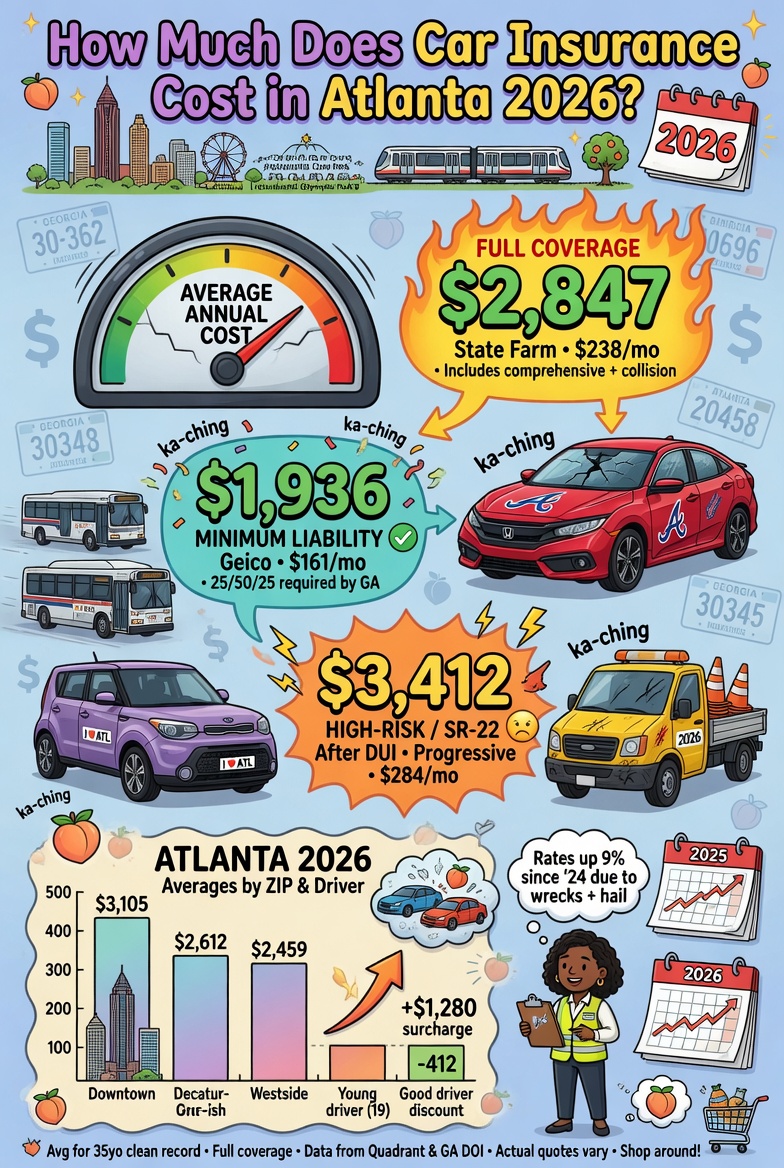
If you just got a renewal notice from your auto insurance carrier and your jaw hit the floor, you're not alone. Atlanta auto insurance has climbed faster than nearly any major metro over the past three years. The average Atlanta driver now pays $1,800-2,800 per year for full coverage on a single vehicle — and renewal increases of 15-30% have been common for the past two years.
The cost isn't random. There are specific reasons Atlanta is one of the more expensive auto markets in the country, and there are specific moves that can lower your premium by hundreds per year without dropping the coverage you actually need.
This post walks through the real 2026 Atlanta auto insurance costs by driver profile, what drives the pricing, the major carriers, and the actual moves that lower your premium without leaving you exposed.
I'm Justin Bishop, an independent broker in Atlanta. I write auto insurance across multiple carriers weekly. Here's the honest breakdown.
The 30-Second Version
Atlanta average full coverage: $1,800-2,800/year for a clean-record adult driver with a standard sedan
Atlanta average liability-only: $700-1,100/year
The cost drivers: ZIP code, your age, driving record, credit-based insurance score, vehicle, annual mileage, and coverage limits
State minimum (25/50/25) is dangerously inadequate. One accident at minimum limits can leave you personally liable for tens to hundreds of thousands of dollars.
The fastest savings: bundle home + auto (5-25% off), raise your deductible, shop carriers every 2 years, fix any credit issues, take a defensive driving course if eligible
Real expectation: premiums will continue climbing 5-10% annually through 2027. Shopping every 2 years is the only way to stay near market rates.
Real 2026 Atlanta Auto Insurance Costs
Here are typical 2026 full-coverage annual premiums in the Atlanta metro for common driver profiles:
30-year-old, clean record, 2022 Honda Civic, mid-Atlanta ZIP (30309, 30312, 30318): $1,500-2,200/year
30-year-old, one speeding ticket in last 3 years, same vehicle: $1,900-2,800/year
30-year-old, one at-fault accident in last 3 years: $2,400-3,500/year
22-year-old, clean record, 2022 sedan: $2,500-3,500/year
22-year-old, clean record, 2022 SUV: $2,800-4,200/year
50-year-old, clean record, 2022 Honda Accord, suburb ZIP: $1,200-1,700/year
70-year-old, clean record, 2022 sedan: $1,500-2,300/year
Married couple, both clean, two 2022 vehicles, family of 4: $2,800-4,500/year combined
Add a teen driver to a family policy: typically $1,500-2,800 additional per year per teen. Atlanta-area teen drivers are among the more expensive groups in any auto market.
For liability-only (state minimum 25/50/25): typical annual cost is $700-1,100 for a clean-record adult in Atlanta. But state minimum is rarely the right coverage choice — more on that below.
What Drives the Price in Atlanta Specifically
Several Atlanta-specific factors push premiums higher than national averages:
High traffic density. I-285, I-75, I-85, I-20, GA-400 — the Atlanta highway system has some of the worst congestion in the South. More cars + more miles = more accidents.
Uninsured motorist rate. Roughly 12% of Georgia drivers carry no insurance — among the higher uninsured rates nationally. Carriers price for the risk of insured drivers having to absorb uninsured-driver collisions.
Vehicle theft rates. Atlanta has consistently ranked in the top 25 metros for vehicle theft. Comprehensive coverage prices reflect that.
ZIP code variation. Atlanta ZIPs (30309, 30312, 30318) typically run 20-40% higher than suburb ZIPs (Marietta, Alpharetta, Sandy Springs). Your address matters.
Storm exposure. Severe weather (hail, falling trees, flooding) drives comprehensive claims.
At-fault tort state. Georgia is an "at-fault" state, not a no-fault state. Means injured parties sue at-fault drivers for full damages. Carriers price liability accordingly.
Credit-based insurance scoring allowed in Georgia. Drivers with poor or no credit pay 20-50% more for the exact same coverage on the exact same vehicle.
Liability-Only vs Full Coverage: The Real Cost Difference
This is where most Atlanta drivers make the wrong call.
Liability-only covers damage you cause to other people and their property. It does NOT cover:
Damage to your own vehicle from an accident
Theft of your vehicle
Storm damage to your vehicle
Hit-and-run incidents (you cover your own car)
Uninsured/underinsured motorist coverage (your damages from drivers without insurance)
Full coverage adds collision (your vehicle in accidents), comprehensive (theft, storm, vandalism), and typically uninsured/underinsured motorist.
The price difference: typically $800-1,500 per year (full vs liability-only).
The risk difference: if your car is totaled in an accident you caused, liability-only means you eat the full replacement cost yourself. For a $25,000 vehicle that's $25,000 out of pocket on top of remaining loan balance.
When liability-only makes sense:
Your vehicle is worth under $3,000-5,000 (the premium difference exceeds the vehicle value)
You can comfortably absorb a total loss from cash
Your vehicle is paid off (lenders require full coverage on financed vehicles)
When full coverage is essential:
You have an active auto loan (lender requires it)
Your vehicle is worth more than ~$5,000
You can't comfortably absorb a $20-50K out-of-pocket vehicle replacement
You drive in Atlanta traffic regularly (high accident exposure)
For most Atlanta drivers with vehicles under 10 years old, full coverage is the right call.
For the full decision framework and real Atlanta math, see Should I Get Liability or Full Coverage for My Car in Atlanta?
The Major Atlanta Auto Carriers in 2026
The carriers most active in Atlanta auto insurance for 2026:
State Farm — largest market share in Georgia. Strong service, captive agent model, consistent pricing.
GEICO — direct-quote model. Often competitive on price, especially for younger drivers and clean records.
Allstate — second-largest market share. Aggressive new-customer discounts; pricing tends to climb at renewals.
Progressive — competitive pricing through Snapshot telematics program. Strong for drivers with previous tickets/accidents.
Travelers — solid pricing for older/established drivers and homeowners bundling.
USAA — military families and veterans only. Generally the lowest rates for those eligible.
Liberty Mutual — competitive across most Atlanta ZIPs.
Farmers — strong for bundling with home insurance.
Auto-Owners — strong claims service, slightly higher premiums.
The General, National General, Direct Auto — non-standard market (drivers with tickets, accidents, DUIs, no credit history). More expensive.
No single carrier is "cheapest" for everyone in Atlanta. Your specific combination of age, ZIP, driving record, credit, and vehicle determines which carrier wins for you. The only way to know is shop multiple carriers.
How to Actually Lower Your Atlanta Auto Premium
Real moves that work:
Bundle auto and home/renters. Typical savings 5-25% across both policies. Almost always the easiest win.
For typical 2026 Atlanta homeowners pricing (bundle savings 5-25% with auto), see How Much Does Homeowners Insurance Cost in Atlanta in 2026?
Raise your collision/comprehensive deductible. Going from $500 to $1,000 deductible saves 10-15% on the collision portion. Going to $1,500 or $2,000 saves more. Worth it if you can absorb the higher out-of-pocket.
Shop carriers every 2 years. Loyalty doesn't pay in auto insurance. Carrier pricing changes; your renewal is rarely the most competitive rate.
Improve your credit. Georgia allows credit-based insurance scoring. Moving from "poor" to "fair" credit can save 15-25%.
Add a telematics/safe-driver program. Progressive Snapshot, Allstate Drivewise, State Farm Drive Safe & Save. Discounts of 10-30% for safe drivers.
Use a defensive driving course. Some carriers offer 5-10% discount for completion. Georgia drivers with eligible court records may also qualify for ticket dismissal.
Increase your liability limits to actually safe levels. Counterintuitive — increasing liability often raises premium very modestly while dramatically reducing your risk exposure. Going from state minimum 25/50/25 to 100/300/100 typically adds only $80-150/year and protects you from major financial loss.
Remove unnecessary coverage. If your car is worth $3,500 and you're paying $900/year for collision, the math may not work.
Pay annually or semi-annually instead of monthly. Most carriers add 5-15% to monthly billing.
Multi-vehicle discount. Insure all household vehicles with one carrier.
Good student discount if you have a teen driver with B+ or better GPA.
Garage parking discount if you store the vehicle in a garage or driveway (vs street).
Common Mistakes Atlanta Drivers Make
Patterns I see weekly:
Carrying state minimum liability (25/50/25). This is the single most common mistake. State minimum is grossly inadequate for any serious accident. One accident with injuries can leave you personally liable for $100K+ in damages beyond your $25K coverage.
Picking the cheapest premium without checking complaint ratios. Cheap carriers often have slow or contested claims service. A 10% premium savings is worthless if your claim drags 6 months.
Ignoring uninsured motorist coverage. ~12% of Georgia drivers are uninsured. If they hit you and disappear, your own UM coverage pays for your injuries and vehicle damage. Skipping it is dangerous.
Not adding a teen driver to the policy. Some parents leave teen drivers off "to save money." If the teen is in your household and drives any household vehicle, they must be listed. Otherwise the claim can be denied.
Not reporting address changes. Your premium changes with ZIP. Failing to update your address can constitute misrepresentation and void coverage.
Filing every small claim. A $1,200 claim raises your premium $200-300/year for 3-5 years. You're collecting $1,200 but paying $900-1,500+ in premium increases. Often not worth it.
Auto-renewing without shopping. Most carriers price loyal customers at higher rates than new customers. Shopping every 2 years catches this.
Carrying full coverage on a 12-year-old car worth $2,500. The collision/comprehensive premium can exceed the entire value of the vehicle. Drop to liability-only at some point.
Frequently Asked Questions
Is auto insurance required in Georgia? Yes. Georgia law requires minimum liability coverage of 25/50/25 (bodily injury $25K/person, $50K/accident, property damage $25K). Driving without proof of coverage is a misdemeanor.
What's the cheapest legal coverage I can carry? The 25/50/25 state minimum. Typical cost $700-1,100/year in Atlanta. But almost no broker recommends carrying state minimum — the exposure is too high.
Will my insurance go up if I get a speeding ticket? Usually yes. Typical premium increase: 15-30% per ticket. The increase typically applies for 3-5 years before falling off. Defensive driving may help with first-time minor tickets.
Will my insurance go up if I have an at-fault accident? Yes. Typical premium increase: 30-50% per at-fault accident. Increase typically applies for 3-5 years.
Does Georgia have no-fault insurance? No. Georgia is an "at-fault" tort state. Means the at-fault driver's insurance pays for damages, and injured parties can sue for medical expenses, lost wages, and pain/suffering.
Can I shop carriers without canceling my current policy? Yes. Get quotes from multiple carriers, decide which to switch to, set the new policy's effective date to match your current policy's cancellation date so there's no gap. Standard process.
How fast can I get a new auto policy? Same-day binding is common for most personal auto policies. Direct carriers (GEICO, Progressive) often quote and bind online within 30 minutes. Broker-placed policies typically 1-3 business days.
What's the deal with the "ride-share" insurance for Uber/Lyft drivers? Standard personal auto policies typically exclude commercial use (Uber, Lyft, DoorDash). If you drive for any rideshare or delivery platform, you need either rideshare coverage (some carriers offer) or commercial auto. Most platforms provide some coverage during active trips but not between rides.
The Bottom Line
Atlanta auto insurance in 2026 is more expensive than most US metros for real reasons — traffic density, uninsured motorist rate, theft rates, storm exposure, and credit-based pricing. You can't fix the market, but you can shop it.
The single most important move: don't carry state minimum 25/50/25 liability. The premium savings is small (~$50-150/year vs 100/300/100) but the exposure is enormous. One accident at state minimum can wipe out your savings, retirement, and home equity.
The second most important move: shop carriers every 2 years. Loyalty pricing is real and rarely benefits you.
If your renewal just came in and you can't believe the number, book a 15-minute call with me. I'll pull quotes across all major Atlanta auto carriers in one shot, identify any gaps in your current coverage, and tell you exactly what coverage you actually need vs what you can skip. Costs you nothing — I'm paid by carriers, not by you.
Want to keep reading? Check out Liability vs Full Coverage: Which Does Your Atlanta Car Need? (publishing May 19), Why Is Car Insurance So Expensive in Atlanta? (publishing May 23), or Atlanta Homeowners Insurance: A 2026 Buyer's Guide (the natural bundle partner).
For the full breakdown of why Atlanta rates are higher than the national average, see Why Is Car Insurance So Expensive in Atlanta? — covers all 8 structural reasons.
Coverages you should add
For high-asset Atlanta drivers, adding umbrella above auto liability is the most cost-effective coverage move available. See What Is an Umbrella Policy?.
Justin Bishop is the founder of That Young Insurance Guy, an independent insurance brokerage in Atlanta, GA, licensed in 31 states. He writes the Health Coverage Chaos newsletter on LinkedIn — and yes, he answers his own texts.
This post is general education, not legal, tax, or financial advice. Auto insurance premiums, Georgia state minimum requirements, carrier pricing, and credit-based scoring rules change.