
How Do Mortgage Lenders Get Health Insurance in 2026?
Author: Justin Bishop · May 5, 2026 · 7 min read
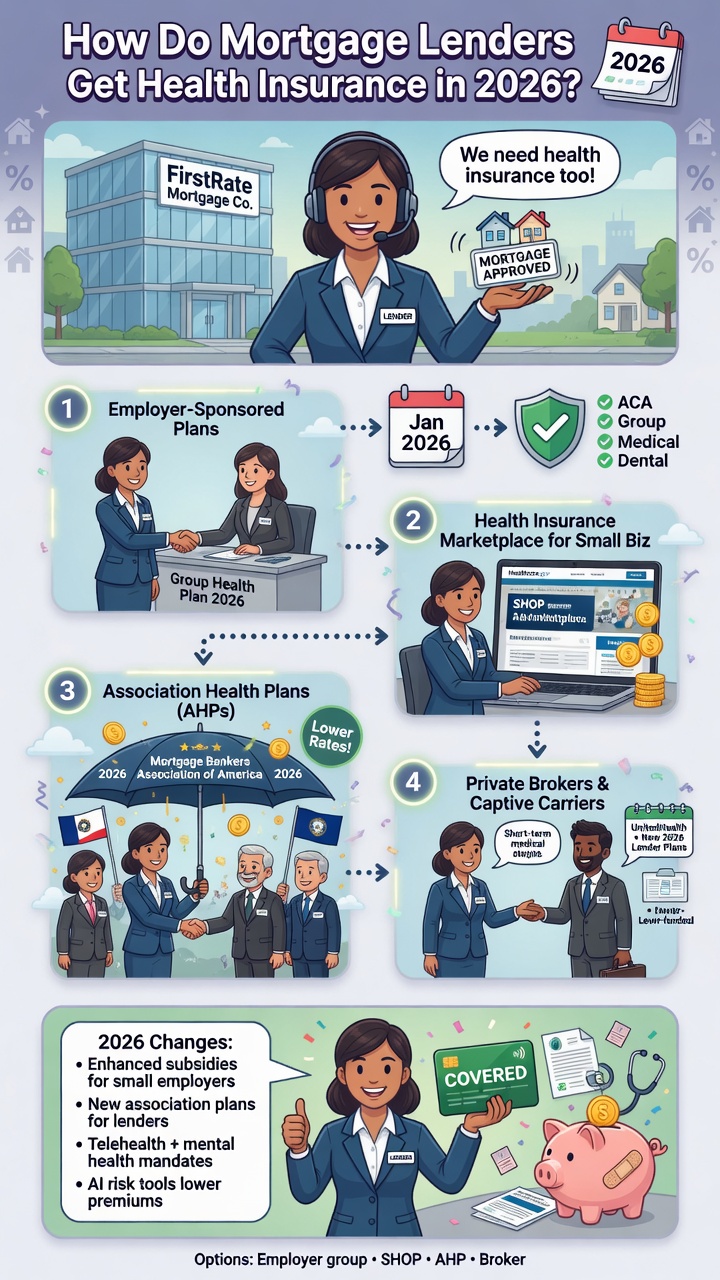
The mortgage industry has a brutal pattern: when rates drop, you can't keep up with volume. When rates rise, you can barely afford gas to get to closings. Most loan officers know this instinctively — but the implication for health insurance hits hardest in slow months. Your commission disappears, and the question becomes "do I keep paying $400/month for coverage that I might not even use this quarter?"
The answer depends on whether you're W-2 or 1099, what your spouse's coverage situation looks like, what you projected for income at the start of the year, and whether you've taken advantage of the specific tax levers the IRS offers self-employed loan officers. Most lenders haven't.
I'm Justin Bishop, an independent broker in Atlanta. I write health insurance for Atlanta-area mortgage loan officers regularly — at the big banks, at independent brokerages, branch managers, indie LOs, mortgage brokers who run their own shops. Here's how it actually works in 2026.
Building a small team? Do I Need Group Health Insurance for My Employees?.
The 30-Second Version
W-2 lenders (working at big banks — Wells Fargo, Chase, Bank of America, etc.) usually have employer-sponsored health insurance available. Take that and stop reading.
1099 lenders (independent mortgage brokers, indie LOs, contract loan officers) face the same self-employed health insurance puzzle as any 1099 worker.
Hybrid lenders (base salary + commission, smaller brokerages, regional banks) — depends on the employer plan structure. Verify what's offered.
Subsidy cliff is back at $60,240 single MAGI in 2026. High-producing LOs typically over the cliff; pulling specific tax levers can keep you eligible for help.
Slow rate environment cash flow problem is real — but the answer is rarely to drop coverage. It's usually to update Georgia Access with reduced projected income (which often triggers higher subsidy and lower premium for the rest of the year).
The W-2 vs 1099 Question (Most Important First Decision)
The first thing to figure out: how does your employer classify you?
W-2 with full benefits — typical at big banks (Wells Fargo, Chase, Bank of America, Truist, Regions, etc.). You usually have access to employer-sponsored health insurance with the employer paying 50-80% of premium. This is almost always the cheapest path. Take it.
W-2 with limited benefits or branch-classified — some smaller regional banks and credit unions classify branch staff as W-2 but offer skinnier benefit packages. Verify what's actually offered before assuming.
1099 independent contractor — most indie loan officers and many mortgage brokers fall here. No employer plan available. Marketplace or off-marketplace is your default.
Hybrid arrangement — some brokerages pay a base salary as W-2 (sometimes triggering benefits eligibility) while commissions are 1099. Carefully read your offer letter or ask HR explicitly.
Most independent mortgage loan officers and mortgage brokers are 1099. If you're at a small Atlanta-area mortgage shop or working as an independent originator, you're probably 1099 unless told otherwise.
The 4 Real Paths for 1099 Mortgage Lenders
If you're 1099 (or your employer plan is unaffordable / unavailable):
Path 1: ACA marketplace plans (Georgia Access). Default for most 1099 mortgage lenders. Subsidy-eligible if your projected MAGI is between roughly $15K and $60K (single in 2026). Full Georgia Access guide here.
Path 2: Spouse's employer plan. If your spouse has W-2 coverage, run the numbers — often the cheapest path for high-producing LOs over the subsidy cliff.
Path 3: Off-marketplace plans. Same insurance products as marketplace plans, bought directly from carriers. No subsidy applies. Useful when over the cliff.
Path 4: Short-term medical insurance. Cheap monthly premium but NOT ACA-compliant — doesn't cover pre-existing conditions, has annual benefit caps. Useful as a 1-3 month bridge during transition between brokerages, never as a long-term solution.
For most 1099 loan officers earning under $100K, marketplace + subsidy is where the math wins. Above $100K, run the numbers between marketplace, spouse's plan, and off-marketplace.
The Variable Income Problem (and the Rate Environment Wildcard)
Mortgage industry income is more volatile than almost any other 1099 profession. A high-producing LO in a low-rate environment can do $300K+; the same LO when rates jump 1.5 points might do $80K. The variability is faster and harder to predict than real estate agent income.
The realistic approach for marketplace projection:
Pull last year's net 1099 income (after expenses — license fees, MLS, phone, vehicle, marketing, education) as a starting point.
Reality-check against the rate environment. If 2026 rates are higher than 2025 rates and your pipeline is thinner, your projection should reflect that.
Project conservatively but not too low. Lowballing lets you over-claim subsidy, then owe back at tax time. Painful.
Update Georgia Access mid-year. If Q1 was strong or weak, log in and update. This is the most underused tool for 1099 lenders — your starting projection isn't binding for the whole year.
Build in a 10% buffer. Better to project slightly high.
Real example: an Atlanta-area indie loan officer who closed $25M in production at a 75 bps comp rate netted around $87K after brokerage splits and expenses in 2025. In 2026 with higher rates and slower volume, his projection might realistically drop to $55K — moving him from "over the cliff" to "marketplace subsidy eligible." A mid-year update to Georgia Access could save him $200-400/month in premium for the rest of the year. Most LOs don't do this update because they don't know they can.
The 2026 Subsidy Cliff for Mortgage Lenders
The federal enhanced premium tax credits expired December 31, 2025. The cliff is back at 400% FPL:
$60,240 for a single LO
$81,760 for an LO + spouse
$124,800 for an LO + spouse + 2 kids
In low-rate / high-volume years, top-producing LOs blow well past the cliff. In high-rate / slow-volume years, the same LO can land below it. The 2026 strategy is income-management more than usual because of how volatile the income is.
The same tax levers that work for any 1099 self-employed person work for mortgage lenders:
Solo 401(k): up to $23,500 employee contribution + 25% of net SE earnings as employer, capped at $70,000 total. Reduces MAGI dollar-for-dollar. Biggest lever.
SEP-IRA: simpler alternative, up to 25% of net SE earnings, capped at $70,000.
HSA: if enrolled in an HSA-eligible HDHP, up to $4,400 single / $8,750 family. Reduces MAGI.
Self-employed health insurance deduction: 100% of premiums deductible above-the-line.
Timing of expenses across year-end for cash-basis filers.
Full breakdown of the cliff and the 5 levers.
Strategic angle for high-volatility lenders: in the high-volume year, max out solo 401(k) ($70K combined). In the low-volume year, you've already got the buffer — and the contributions you made in good years actively reduce your MAGI in the slow years too (when growth and timing of withdrawals matters more).
The Tax Deduction Most Mortgage Lenders Forget
If you pay your own health insurance premiums and you're 1099, you can deduct 100% of those premiums on Schedule 1 of your 1040 as the self-employed health insurance deduction. Above-the-line. No itemizing required.
Quick math: an LO paying $500/month for a Silver plan ($6,000/year) at a 24% federal bracket saves roughly $1,440 in federal tax. Plus state tax savings. Plus the deduction reduces MAGI which can preserve marketplace subsidy.
Important rules:
The deduction can't exceed your net self-employment income for the year
Doesn't apply to months you were eligible for an employer plan (yours OR a spouse's)
Applies to medical, dental, and qualified long-term care premiums
Reduces income tax, NOT self-employment (FICA) tax
If you have a CPA, ask them about it. If you DIY, the tax software walks you through it — but it's missed often, especially by lenders who think of themselves as "in mortgage" rather than "self-employed business owners."
The HSA Move (Specifically for Mortgage Lenders)
If you're reasonably healthy, an HSA-eligible high-deductible health plan (HDHP) is one of the smartest moves available to 1099 mortgage lenders:
Lower monthly premium than non-HDHP plans (often $50-$80/month savings)
2026 HSA limits: $4,400 self-only, $8,750 family — every dollar reduces MAGI
Triple tax advantage: deductible going in, tax-free growth, tax-free withdrawals for qualified medical
Becomes a stealth retirement account at age 65 — withdrawals for any reason, only ordinary income tax
For mortgage lenders specifically, the HSA + high-volume year combo is powerful: you contribute the max in good years, the balance compounds tax-free, and you have a meaningful retirement asset by the time you're winding down. Full HSA guide here.
The catch: HDHPs have higher deductibles. If you have ongoing medical needs, the math may not work. Run both scenarios.
Real Estate Agents and Mortgage Lenders Often Work the Same Closings
If you're a mortgage lender, you probably know real estate agents who face nearly identical health insurance challenges (1099, commission-based, variable income, no employer plan). The post on real estate agent health insurance covers the same strategic playbook from the agent angle: Health Insurance for Real Estate Agents.
Worth knowing because:
Strategy is similar — same self-employed levers, same MAGI projection problem, same cliff math
Different income volatility patterns — agents are commission-driven by deal flow; lenders are commission-driven by rates. Different cycles, similar effect
Often share clients — if your closings include the same agents, you may want to compare notes
Common Mistakes I See
The specific mistakes that cost mortgage lenders real money:
Defaulting to COBRA when leaving a W-2 lending job. COBRA at full price is brutal — typically $700-$1,200/month for a single person. The marketplace is almost always cheaper.
Not updating Georgia Access mid-year when income shifts. This is the #1 missed move for high-volatility lenders. If the rate environment changed and your year is on track to be different from your projection, update — usually saves money.
Confusing W-2 sales reps with W-2 benefits-eligible employees. Some smaller mortgage shops issue W-2s without offering benefits. Read the offer letter or ask HR explicitly: "Am I eligible for the company health plan?"
Going without insurance during slow rate periods. One ER visit can wipe out 6 months of avoided premium. The math almost never works.
Buying short-term medical for long-term coverage. Useful as a 1-3 month bridge between brokerages; never as a primary plan.
Missing the self-employed health insurance deduction at tax time. Probably the most-missed deduction for 1099 LOs.
Not pairing the plan with retirement contributions. A solo 401(k) or SEP-IRA contribution can keep you under the subsidy cliff AND build tax-advantaged retirement savings — most 1099 lenders don't have either.
Want a Real Quote for Your Mortgage Lending Situation?
If you want a real number for your specific situation as a mortgage loan officer in Georgia, the fastest path is to text me at (706) 988-1930 with:
Your projected 2026 net 1099 income (after brokerage split and major expenses)
Whether you're W-2 with employer plan available, or 1099 self-employed
Marital status (and spouse's employment situation if relevant)
Atlanta-area zip code
What you currently pay (if anything) for health insurance
I'll come back inside 24 hours with 2-3 real plan options at real prices, after subsidy if you qualify. Plus I'll flag whether a solo 401(k) or HSA strategy could meaningfully change the picture given the rate environment.
Free. Independent broker. No follow-up sequence.
I work with self-employed Georgians, freelancers, and 1099 commission earners every week. Mortgage lenders are a regular part of that mix — the volatility patterns are unique to the industry, but the strategic levers are the same as any other 1099 worker. The 30-minute conversation is worth it.
Other coverage you might need
Mortgage loan officers with families also need life coverage tied to the income their family depends on. Run the math here: How Much Life Insurance Do You Actually Need in 2026?
For loan officers wondering which type of life insurance to buy, read the honest comparison: What's the Difference Between Term Life and Whole Life?.
Justin Bishop is the founder of That Young Insurance Guy, an independent insurance brokerage in Atlanta, GA, licensed in 31 states. He writes the Health Coverage Chaos newsletter on LinkedIn — and yes, he answers his own texts.
This post is general education, not medical, tax, or legal advice. Travel nurse compensation structures, agency insurance terms, and marketplace rules vary.