
How Do Real Estate Agents Get Health Insurance in 2026?
Author: Justin Bishop · May 5, 2026 · 7 min read
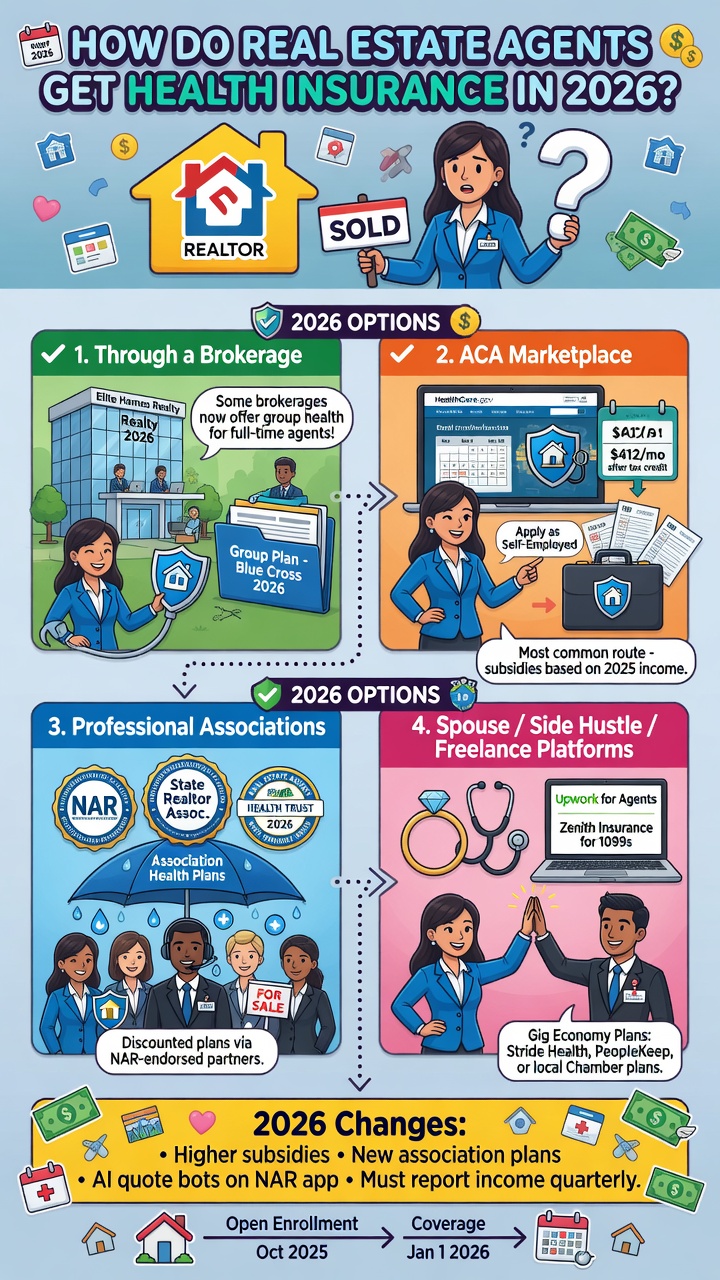
If you're a real estate agent, your brokerage isn't going to send you a benefits enrollment packet next month. Almost every REALTOR® in Atlanta is a 1099 independent contractor — and that means health insurance is on you. The brokerage might call you "their agent" but for tax and benefits purposes, you're a self-employed business owner who happens to work under their license.
The result: you have all the freedom of running your own shop, and all the responsibility of figuring out health insurance during commission feast and famine cycles, while a possibly-already-stressful market hands you a 60-day deal stretch with zero closings.
I'm Justin Bishop, an independent broker in Atlanta. I write health insurance for Atlanta-area real estate agents regularly — newer agents at small brokerages, top producers at the bigger firms, team leads, and indie agents who've gone independent. Here's how it actually works in 2026, the costs that match real commission income shapes, and the moves I see saving the most money.
Building a small team? Do I Need Group Health Insurance for My Employees?.
The 30-Second Version
You're 1099. No employer plan. The brokerage's "benefits" usually mean access to NAR member discounts, NOT actual employer-sponsored health insurance.
Marketplace (Georgia Access) is the default path for most real estate agents — same as any self-employed person.
Subsidies are based on projected MAGI. Variable commission income makes this harder than for W-2 employees.
The 2026 subsidy cliff is back at $60,240 single MAGI. Top producers earning $100K+ are over the cliff and pay full freight unless they pull specific levers.
You can deduct 100% of your health insurance premiums from federal income tax (above-the-line, no itemizing) as a self-employed person. This is huge and often missed.
Variable income strategies — solo 401(k), SEP-IRA, HSA contributions — can both reduce taxes AND keep you under the subsidy cliff.
That's the framework. The rest is the playbook.
Why Real Estate Agents Get a Different Picture Than W-2 Employees
Three structural realities that make health insurance harder for real estate agents than for traditionally-employed people:
No employer plan as a fallback. A bad year at a W-2 job still gets you employer coverage. A bad year as a real estate agent gets you nothing — you're on your own for the entire stack: health, dental, vision, disability, retirement.
Commission income is unpredictable. Q1 might be huge. Q2 might be silent. The marketplace asks "what's your projected MAGI for the year?" and you genuinely don't know. Most real estate agents project conservatively (lowballing) and end up owing back subsidies at tax time.
Brokerage "benefits" are usually NAR membership perks, not insurance. Many brokerages tell new agents about "benefits" — these are typically discounts on services, lockbox access, MLS membership, NOT health insurance. Don't confuse the two.
The good news: real estate agents have more tax levers than W-2 employees to manage MAGI. That matters in 2026 with the cliff back.
The 4 Real Paths to Coverage for Real Estate Agents
In rough order of how often they're the right answer:
Path 1: ACA marketplace plans (Georgia Access). Default for most real estate agents. Subsidized if projected MAGI is between roughly $15K and $60K (single in 2026). Full guide to Georgia Access here.
Path 2: Spouse's employer plan. If your spouse has W-2 coverage, run the numbers — sometimes it's the cheapest path overall, especially for high-earning agents over the subsidy cliff.
Path 3: Off-marketplace plans. Same insurance products as marketplace plans, bought directly from carriers. No subsidy applies. Useful when you're already over the cliff and shopping for specific plans the marketplace doesn't surface.
Path 4: NAR-affiliated insurance plans. Some real estate associations offer member-rate group plans. Quality varies wildly. Often more expensive than open-market alternatives once you compare the actual coverage. Worth a look but rarely the right answer.
For most real estate agents earning under $100K, Path 1 (Georgia Access marketplace) is where the math wins. Above $100K, it's a closer call between marketplace and Path 2 (spouse's plan) or Path 3 (off-marketplace).
The MAGI Projection Problem (and How to Solve It)
This is the hardest part of marketplace coverage as a real estate agent: projecting your income for the year when commissions are unpredictable.
Project too low, you owe back subsidies at tax time. Project too high, you overpay in premium. Either way costs you.
The realistic approach I walk real estate agent clients through:
Pull last year's net 1099 income (after brokerage splits, transaction fees, and business expenses). This is your starting baseline.
Account for market shifts. If volume is down 20% from last year (it probably is in 2026), reduce projection accordingly.
Subtract realistic business expenses — vehicle, marketing, MLS fees, lockboxes, photography, staging, education, association dues. Real estate agents have one of the highest legitimate-deduction profiles of any 1099 worker.
Build in a 10% buffer. Better to project slightly high and be pleasantly surprised at tax time than low and owe back.
Update Georgia Access mid-year. If your Q1 was huge or quiet, log into Georgia Access and update your projection. Small adjustment now beats a giant tax-time surprise.
Real example: an Atlanta agent who closed $4.5M in volume at a 3% co-op split (1.5% net to her), with a 70/30 brokerage split, netted around $47K after expenses. That's her MAGI for marketplace purposes — not her gross commissions of $200K+. The difference is what makes her subsidy-eligible vs not.
Most real estate agents over-project because they think in gross commission terms instead of net 1099 income.
The 2026 Subsidy Cliff for Real Estate Agents
The federal enhanced premium tax credits expired December 31, 2025. The 400% FPL cliff is back:
$60,240 for a single agent
$81,760 for an agent + spouse
$124,800 for an agent + spouse + 2 kids
Top-producing real estate agents net $100K-$300K+ in MAGI annually — well above the cliff. The 2026 reality: if your projected MAGI is over your household's threshold, you pay full marketplace freight (no subsidy at all) — typically $400-$700/month for a Silver plan.
The good news for high-earning real estate agents: you have specific tax levers that can drop MAGI:
Solo 401(k): contribute up to $23,500 employee + 25% of net SE earnings as employer, capped at $70,000 total. Reduces MAGI dollar-for-dollar. This is the biggest lever.
SEP-IRA: simpler alternative, contribute up to 25% of net SE earnings, capped at $70,000.
HSA: if enrolled in an HSA-eligible HDHP, contribute up to $4,400 single / $8,750 family. Reduces MAGI.
Self-employed health insurance deduction: 100% of premiums deductible above-the-line. Reduces AGI/MAGI.
Timing of income/expenses across year-end: for cash-basis filers, accelerate expenses or defer income to manage MAGI.
Real example: a top-producing agent earning $90K net is over the single cliff at $60,240. Contributing $30,000 to a solo 401(k) drops MAGI to $60K — back under the cliff. Saves an estimated $3,000-$8,000 in marketplace subsidy AND saves around $6,600 in federal income tax at the 22% bracket. Net effect: a $30,000 retirement contribution that effectively costs around $14,000-$16,000 after the layered tax savings.
Full breakdown of the cliff and the 5 levers in my subsidy cliff guide.
The Tax Deduction Most Real Estate Agents Forget
If you pay your own health insurance premiums and you're 1099, you can deduct 100% of those premiums on Schedule 1 of your 1040 as the self-employed health insurance deduction. Above-the-line. No itemizing required.
Quick math: an Atlanta agent paying $500/month for a Silver plan ($6,000/year) at a 22% federal tax bracket saves roughly $1,320 in federal tax — on top of any Georgia state tax savings. Plus the deduction reduces MAGI, which can preserve marketplace subsidy in some cases.
Important rules:
The deduction can't exceed your net self-employment income for the year
Doesn't apply to months you were eligible for an employer plan (yours OR a spouse's)
Applies to medical, dental, and qualified long-term care premiums
Reduces income tax, NOT self-employment (FICA) tax
Most CPAs catch this automatically. If you DIY through TurboTax or H&R Block, the software walks you through it — but make sure you're answering "yes" to "did you pay health insurance premiums and earn self-employment income."
The HSA Move (Underrated for Real Estate Agents)
If you're reasonably healthy and your income is moderate-to-high, an HSA-eligible high-deductible health plan (HDHP) is one of the smartest moves available to real estate agents:
Lower monthly premium than non-HDHP plans
2026 HSA limits: $4,400 self-only, $8,750 family — every dollar reduces MAGI
Triple tax advantage: deductible going in, tax-free growth, tax-free withdrawals for qualified medical
Becomes a stealth retirement account at age 65 — withdrawals for any reason, only ordinary income tax
For real estate agents specifically, HSA contributions stack with the subsidy cliff strategy. Every dollar contributed reduces MAGI AND builds tax-free retirement assets. Full HSA guide here.
The catch: HDHPs have higher deductibles. If you have ongoing medical needs (chronic conditions, frequent specialist care, major prescription costs), the math may not work. Run both scenarios before choosing.
What About Disability Insurance?
A separate but related issue every real estate agent should think about: disability insurance. If you can't work for 6 months because of an injury or illness, who pays your bills?
W-2 employees often have group disability built into their benefits. You don't. The only way you're covered is if you bought it yourself.
For real estate agents specifically, individual disability insurance typically runs $100-$300/month for a 35-year-old with a $5,000-$8,000/month benefit. It's not cheap, but it's the difference between "I had a tough quarter" and "I lost my career and house." Worth pricing alongside your health insurance.
(Disability isn't covered in this post in detail. If you want to talk through it, the same number works.)
Mortgage lenders face the same 1099 puzzle: Health Insurance for Mortgage Lenders
Common Mistakes I See
The specific mistakes that cost real estate agents real money:
Projecting gross commissions instead of net 1099 income when applying for marketplace subsidies. Marketplace eligibility is based on MAGI (net), not gross.
Skipping the marketplace because "I make too much." Many agents assume they don't qualify. They often do once they project net (after expenses, retirement contributions, the SE health insurance deduction).
Confusing brokerage "benefits" with actual health insurance. If your brokerage doesn't deduct health insurance premium from your paycheck (because you don't get a paycheck — you're 1099), you don't have employer-sponsored coverage.
Going without insurance "until I close another deal." Real estate agents are uniquely vulnerable to this trap because closings are unpredictable. One ER visit during an uninsured stretch can wipe out 6 months of net commission.
Not pairing the plan with retirement contributions. A solo 401(k) contribution can keep you under the subsidy cliff AND build tax-advantaged retirement savings — most real estate agents don't have either, and don't realize one decision unlocks both.
Letting coverage lapse during slow seasons. If you can't afford premium during a slow quarter, the answer isn't to drop coverage — it's to update Georgia Access with your reduced projected income (which usually triggers higher subsidy and lower premium for the rest of the year).
Forgetting the self-employed health insurance deduction at tax time. This is probably the most-missed deduction for real estate agents who file their own taxes. Worth reminding your CPA.
Want a Real Quote for Your Real Estate Practice?
If you want a real number for your specific situation as a real estate agent in Georgia, the fastest path is to text me at (706) 988-1930 with:
Your projected 2026 net 1099 income (net commissions after brokerage split and major expenses)
Marital status (and spouse's employment situation if applicable)
Atlanta-area zip code
Whether you're on any current health insurance and what you pay
I'll come back inside 24 hours with 2-3 real plan options at real prices, after subsidy if you qualify. Plus I'll flag whether a solo 401(k) or HSA strategy could meaningfully change the picture for your situation.
Free. Independent. No pressure. No follow-up sequence.
Most of my real estate agent clients save several hundred dollars per month over what they were paying — usually because they didn't realize a specific lever applied to their commission income. The 30-minute conversation is worth it.
Other coverage you might need
Real estate agents with families face the same income-replacement question. Calculate yours here: How Much Life Insurance Do You Actually Need in 2026?.
For real estate agents weighing life insurance options, read the honest comparison: What's the Difference Between Term Life and Whole Life?.
Justin Bishop is the founder of That Young Insurance Guy, an independent insurance brokerage in Atlanta, GA, licensed in 31 states. He writes the Health Coverage Chaos newsletter on LinkedIn — and yes, he answers his own texts.
This post is general education, not medical, tax, or legal advice. Travel nurse compensation structures, agency insurance terms, and marketplace rules vary.