
Final Expense Insurance: The Policy Most Atlantans Overlook
Author: Justin Bishop · May 15, 2026 · 7 min read
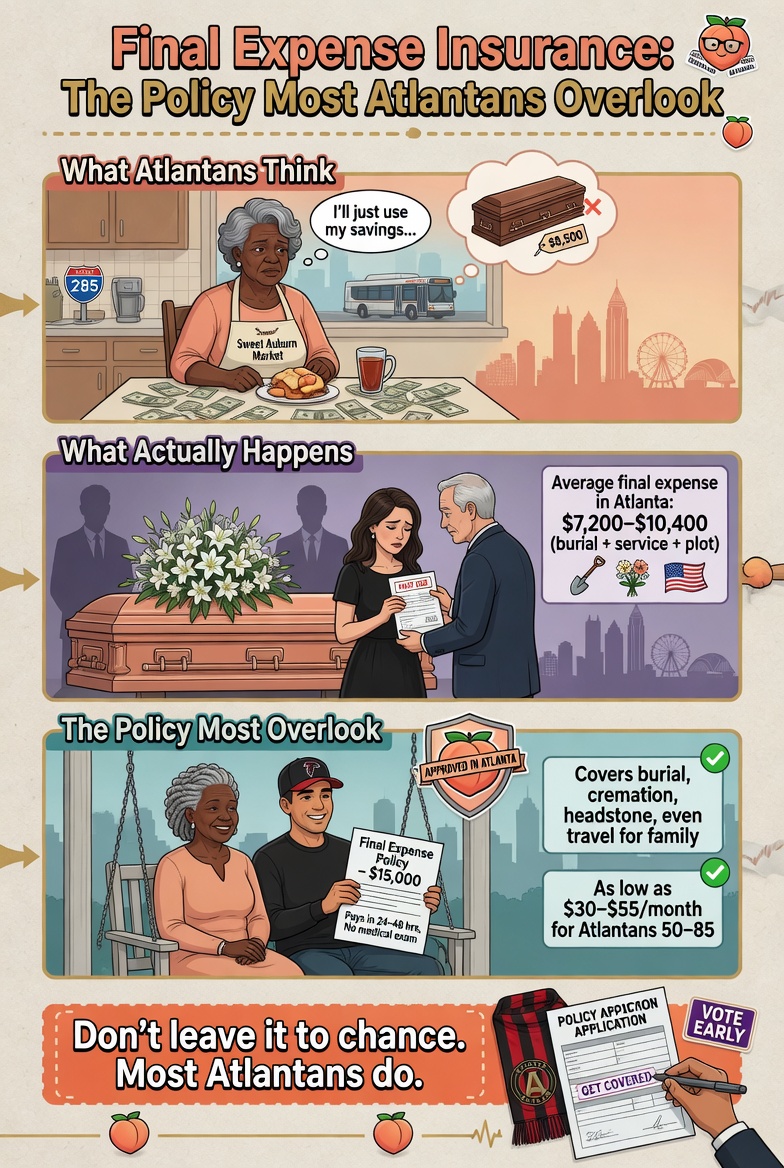
When most Atlanta families think about life insurance, they think about big term policies — $500K, $1M, enough to replace income and pay off a mortgage. For working parents that's the right answer. But there's a different policy designed for a different problem that gets ignored by almost everyone until it's too late: final expense insurance.
A typical Georgia funeral now costs $9,000 to $15,000. Cremation runs $3,000 to $6,000. These are the actual bills that land on grieving families within days of a death, and most Atlanta families have no plan for paying them. Medicare doesn't cover it. Social Security pays a $255 lump-sum death benefit (yes, that's the real number, set in 1954 and never updated). Most term life policies have expired by the time the cost becomes real.
This post walks through what final expense insurance actually is, what an Atlanta funeral really costs in 2026, who genuinely needs this policy, who doesn't, and the specific carriers writing final expense in Georgia.
I'm Justin Bishop, an independent broker in Atlanta. I write final expense policies for clients (and clients' aging parents) every week. Here's the honest breakdown.
The 30-Second Version
Final expense insurance is a small whole life policy ($5K-25K face amount) designed specifically to cover funeral, burial, and end-of-life expenses
Average Atlanta funeral cost in 2026: $9,000-15,000 for traditional burial, $3,000-6,000 for cremation
Best for: older adults (60-85), people without significant savings or other life insurance, those who can't qualify for traditional term life due to health
Not necessary for: anyone with adequate term/whole life already in place, people with $30K+ in liquid savings, or younger adults with assets
Typical Atlanta pricing in 2026: $30-90/month for a $10K policy at age 60-70
What Medicare DOESN'T cover: funeral costs. Period.
What Social Security DOES pay: $255 lump-sum death benefit (yes, really, since 1954)
If your aging parents don't have a plan for funeral costs and don't have $15K liquid in savings earmarked for it, someone in the family will pay out of pocket when the time comes. Final expense insurance solves that problem cleanly for $30-90/month.
What an Atlanta Funeral Actually Costs in 2026
The real numbers most families don't know:
Traditional burial in Atlanta metro:
Funeral home services (consultation, body preparation, viewing): $2,500-4,500
Casket: $1,500-5,000 (some go higher)
Cemetery plot: $1,500-4,000
Headstone/marker: $1,000-3,000
Burial vault: $1,000-2,000
Opening and closing of grave: $500-1,200
Hearse and limousine: $300-700
Death certificates (typically need 10-15 copies for legal/financial matters): $30-50 each = $300-750
Total typical range: $9,000-15,000+
Cremation in Atlanta metro:
Funeral home services + cremation: $2,000-3,500
Urn: $100-500 (much higher for premium options)
Memorial service: $500-2,000
Death certificates: $300-750
Total typical range: $3,000-6,000
What's NOT covered by Medicare or any health insurance: any of the above. What Social Security pays: $255 lump-sum death benefit to a qualifying surviving spouse or dependent. That's it. What VA benefits pay: for veterans, limited burial allowance ($874-1,978 for service-connected deaths, less for non-service-connected) — helpful but doesn't cover the full bill.
For most Atlanta families, the entire $9,000-15,000+ cost lands on adult children or surviving spouse within 72 hours of death.
What Final Expense Insurance Actually Is
Final expense (sometimes called "burial insurance" or "funeral insurance") is technically a small whole life insurance policy. The structure:
Face amount: typically $5,000 to $25,000 (some go to $50K)
Type: whole life (lasts as long as you pay; doesn't expire)
Premium: level for life (won't increase as you age)
Underwriting: "simplified issue" or "guaranteed issue" — much easier than traditional term life
Death benefit: paid quickly, often within 24-72 hours of claim filing
Tax treatment: death benefit is income-tax-free to beneficiaries
Two main types you'll see quoted:
Simplified Issue Final Expense:
Requires you answer 5-10 health questions
No medical exam
Approval typically within 24-48 hours
Best for: relatively healthy older adults
Lower premium than guaranteed issue
Guaranteed Issue Final Expense:
No medical questions at all — anyone qualifies (within age limits, typically 50-85)
Higher premium than simplified issue
Most carriers have a 2-3 year "graded benefit" period (if you die in the first 2-3 years, beneficiary gets return of premiums paid plus interest, not the full face amount)
Best for: older adults with serious health conditions who couldn't qualify for simplified issue
Who Actually Needs Final Expense Insurance
You're a strong candidate if any of these apply:
You're 60+ and don't have $15K+ liquid savings earmarked for funeral costs
You have an existing term life policy that will expire before you're likely to need it (e.g., 20-year term that expires at age 75)
You have health conditions that make traditional term life expensive or unavailable
You want to leave a modest legacy without burdening your spouse or adult children
You're a Georgia veteran but VA benefits won't cover the full funeral cost (most don't)
You're an adult child of aging parents who don't have a plan — you can be the policy owner and pay premium, with parent as the insured and the funeral home or family as beneficiary
The peace-of-mind argument matters here too. Many of my older Atlanta clients buy final expense not because they "need" it financially, but because they don't want their kids to have to scramble for cash during a grieving period. That's a legitimate use even when assets exist.
Who Probably Doesn't Need It
Skip final expense if any of these apply:
You have adequate term or whole life already in place ($100K+) that won't expire before age 80
You have $30K+ in liquid savings specifically set aside or easily accessible to family
You're under 50 and healthy — buy a longer-term policy that's cheaper per dollar of coverage
You have a working spouse who's well-funded and can absorb the funeral cost without strain
You qualify for full VA burial benefits as a service-connected veteran (run the math; benefits may cover most of the cost)
For these situations, final expense is unnecessary and you'd be paying for coverage you already have through other means.
Real 2026 Atlanta Final Expense Pricing
Typical monthly premiums for a $10,000 final expense policy in Atlanta (healthy non-smoker, simplified issue):
Age 50: $20-35/month
Age 55: $25-45/month
Age 60: $30-50/month
Age 65: $40-65/month
Age 70: $50-90/month
Age 75: $80-130/month
Age 80: $130-200/month
Age 85: $200-300/month
For a $25,000 policy at age 65: typically $80-130/month.
For guaranteed issue (no health questions), add 30-60% to the above premiums. Guaranteed issue also has the 2-3 year graded benefit period mentioned above.
Premium is level for life. Once you start paying, the rate doesn't increase as you age. That's a significant advantage over plan types that re-rate every year.
The Major Final Expense Carriers in Georgia
Carriers most active in the Atlanta final expense market for 2026:
Mutual of Omaha — strong brand, competitive simplified issue pricing
Royal Neighbors of America — fraternal benefit society; competitive for older ages
Trinity Life — strong for guaranteed issue placements
Aetna (Continental Life) — broad simplified issue product line
Foresters Financial — fraternal benefit society; competitive simplified issue
Transamerica — established brand, broad product line
Gerber Life — known for child policies; also offers adult final expense
Globe Life — heavily TV-advertised; comparison-shop before binding
Liberty Bankers — competitive in certain age bands
As an independent broker, I shop across all of these for each client. Same age, same health, same face amount — premiums vary $20-50/month between carriers. Comparison shopping matters.
How the Death Benefit Actually Gets to the Funeral Home
A common question: "How does the money actually reach the funeral home before they need payment?"
Three options that work:
Direct beneficiary assignment: designate the funeral home as the policy beneficiary. The death benefit goes directly to them. Cleanest path.
Family member as beneficiary: designate spouse or adult child as beneficiary. They receive the death benefit (typically within 24-72 hours of claim) and pay the funeral home directly.
Funeral home assignment of benefits: even if a family member is the named beneficiary, most funeral homes will accept an "assignment of benefits" — they wait for the insurance payout before requiring payment.
Most Atlanta funeral homes are familiar with all three structures. The death benefit reliably arrives faster than the funeral home needs payment.
Final Expense vs Pre-Need Funeral Plans
You may have heard about "pre-need" plans — these are different products sold by funeral homes themselves, where you pre-pay for a specific funeral arrangement.
Pre-need plan trade-offs:
Locks in current funeral home pricing (inflation hedge)
Pre-selects services, casket, plot, etc.
Money typically held in trust or annuity
BUT: tied to a specific funeral home; if you move or change preferences, money may be hard to recover
BUT: doesn't help if you die elsewhere or want a different funeral type
Final expense insurance trade-offs:
Money goes to a beneficiary in cash
Flexible — can be used however the family needs (full funeral, cremation, debts, anything)
NOT tied to a specific funeral home
Premium is level for life
BUT: doesn't lock in funeral pricing
For most Atlanta families, final expense insurance is more flexible. Pre-need plans make sense if you have a specific funeral home and arrangement you're committed to AND you want pricing locked in.
Common Final Expense Mistakes
Patterns I see weekly:
Buying TV-advertised policies without shopping. Heavy TV-advertised brands often charge 20-40% more than less-marketed carriers for identical coverage. Always comparison shop.
Buying too much coverage. A $50K policy when $15K covers everything is a waste. Match face amount to actual need.
Buying guaranteed issue when simplified issue would work. If you're reasonably healthy, simplified issue is cheaper AND pays full benefit from day one (no graded period).
Letting the policy lapse during a financial squeeze. Once it lapses and you're older, requalifying at the same rate is impossible. Pay the premium even when budgets are tight.
Naming a minor child as beneficiary. Death benefits to minors require court-supervised guardianship. Always name an adult or use a trust.
Forgetting to update beneficiaries after divorce, remarriage, or death of original beneficiary. Review every 3-5 years.
Buying for kids/grandkids without buying for yourself. Some Atlanta families insure children "as a future asset" before insuring the adults who actually need coverage now. Adults first.
Confusing it with pre-need plans. Different products. Make sure you know which you're buying.
Frequently Asked Questions
Does Medicare cover any funeral costs? No. Medicare is health insurance — it covers medical care. It doesn't cover any death-related expenses.
For the full breakdown of Medicare costs (and gaps), see What Does Medicare Cost in 2026?
Does Social Security pay anything for funerals? A one-time $255 lump-sum death benefit to a qualifying surviving spouse or dependent. This amount was set in 1954 and has never been adjusted. Effectively meaningless for actual funeral costs.
Does Medicaid pay for funerals if you're on it? Some Georgia counties have indigent burial programs for those with no assets. These are basic-service programs, not actual coverage. Not something to count on.
Can I qualify for final expense with cancer or heart conditions? Often yes, on guaranteed issue. Sometimes yes on simplified issue depending on specifics. An independent broker can place you with the right carrier based on your specific situation.
What if I outlive the policy? Whole life policies (which final expense is) don't expire. Coverage continues as long as you pay premiums. Some policies become "paid up" after 20-30 years (no further premiums required while coverage continues).
Can I cancel the policy and get money back? Whole life policies build small cash value over time. You can surrender for the cash value (much less than premiums paid in early years). For final expense, this is rarely the goal — keep paying to keep coverage in force.
What about life insurance through my pension or AARP? Many pension and AARP-marketed life policies are term policies that decrease or terminate at certain ages. Read the fine print. Some are decent; many are expensive for what they offer. Comparison shop.
Are policies portable if I move out of Georgia? Yes. Whole life policies (including final expense) follow you wherever you live in the US.
The Bottom Line
Final expense insurance solves a specific problem that most Atlanta families don't think about until it's too late: the $9,000-15,000 bill that lands within days of a death.
For older adults without significant savings or other life insurance, $30-90/month buys a $10,000 policy that covers a typical Georgia funeral and leaves a small legacy. For older adults with health issues that prevent traditional term life, final expense is often the only practical option.
For Atlanta families with aging parents, buying final expense on the parent (with the adult child as policy owner paying premium) is one of the cleanest ways to ensure end-of-life costs don't fall on the family during a grieving period.
If you're an Atlanta adult thinking about final expense for yourself or a parent, book a 15-minute call with me. I'll shop 8-10 carriers, identify the right face amount for your specific situation, and tell you whether final expense is the right answer or whether something else fits better. Costs you nothing — I'm paid by carriers, not by you.
Want to keep reading? Check out How Much Life Insurance Do You Actually Need in 2026?, What's the Difference Between Term Life and Whole Life?, or What's the Difference Between Medicare Advantage and Medigap? (Medicare-adjacent audience).
Other Medicare-adjacent decisions
Before settling Medicare logistics, make sure your enrollment timing is right: When Should I Sign Up for Medicare? The 6 Windows Explained
Justin Bishop is the founder of That Young Insurance Guy, an independent insurance brokerage in Atlanta, GA, licensed in 31 states. He writes the Health Coverage Chaos newsletter on LinkedIn — and yes, he answers his own texts.
This post is general education, not legal, tax, or financial advice. Final expense underwriting rules, premium rates, VA burial benefits, and Social Security death benefit thresholds change.