
Affordable Health Insurance Options in Georgia for 2026
Author: Justin Bishop · May 9, 2026 · 8 min read
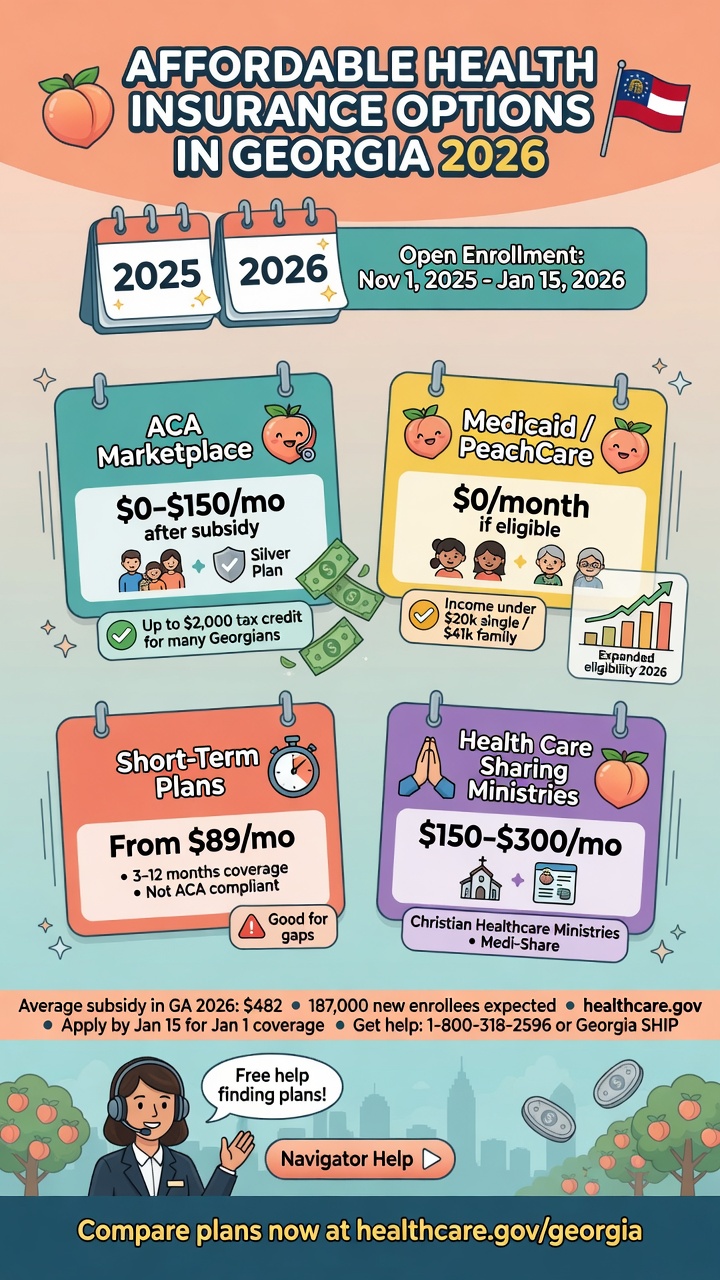
If you've shopped for health insurance in Georgia recently, you already know the sticker prices are brutal. A 2026 family plan with no subsidy can run north of $2,000 per month. A single non-smoker in their 40s might be quoted $700 for a Bronze plan with a $9,000 deductible.
Here's what most Georgians don't know: the sticker price isn't what most people actually pay. Between marketplace subsidies, the right plan structure, employer programs, and a few legitimate alternatives, there are real affordable paths to coverage in 2026 — even with the subsidy cliff back in effect.
This post walks through the 7 most affordable health insurance options for Georgia residents in 2026, what each one costs, who each one fits, and how to actually pick the right one.
I'm Justin Bishop, an independent broker in Atlanta. I help Georgians find the cheapest legitimate coverage every week. Here's what actually works.
The 30-Second Version
even affordable paths to coverage in Georgia for 2026:
Marketplace plans with premium tax credits (Georgia Access) — usually cheapest for incomes between roughly $15K and $60K single, $30K and $125K family
Medicaid + PeachCare for Kids — if you or your kids qualify, this is the cheapest path
Pathways to Coverage — Georgia's limited Medicaid for adults documenting 80+ work hours per month
Spouse's employer plan — often the cheapest option if your spouse has employer coverage
HSA-eligible High Deductible Health Plan (HDHP) — lower premium + triple tax savings
Healthcare sharing ministries — religious cost-sharing arrangements (NOT insurance, with caveats)
Direct Primary Care + Catastrophic — for healthy people willing to pay cash for primary care
The right answer depends on your income, family size, employment situation, and health profile. Below is the breakdown.
Option 1: Marketplace Plans with Subsidies (Georgia Access)
Best for: most working Georgians without employer coverage, especially incomes between roughly $15,000-$60,000 single ($30,000-$125,000 family).
The ACA marketplace — accessed in Georgia at gaaccess.com — is the default starting point for most Georgians. Plans are required to cover 10 essential health benefits and can't deny anyone for pre-existing conditions. Subsidies (premium tax credits) reduce your monthly cost based on income.
Real 2026 cost examples for Atlanta:
Single, age 30, $40,000/year income: Silver plan around $80-150/month after subsidy
Single, age 45, $50,000/year income: Silver plan around $200-350/month after subsidy
Family of 4, $80,000/year income: Silver plan around $400-700/month after subsidy
Family of 4, $130,000/year income: No subsidy (over the cliff). Same plan around $1,800-2,200/month
The 2026 subsidy cliff is back at 400% of the federal poverty level — single Georgians earning more than $60,240 and families of 4 over $124,800 don't qualify for premium tax credits. Full breakdown: The 2026 ACA Subsidy Cliff for Self-Employed Georgians.
For the broader Georgia marketplace overview: Georgia Health Insurance Marketplace: A 2026 Guide.
Once you've decided the marketplace is your path, the next question is which tier: Bronze vs Silver vs Gold: Which Plan Do You Actually Need?."
Option 2: Medicaid and PeachCare for Kids
Best for: very low-income individuals who qualify, or families with kids regardless of parent's coverage status.
Georgia did not expand traditional Medicaid under the ACA, so adult eligibility is narrow:
Pregnant women up to 220% of FPL
Parents with very young children up to ~35% of FPL
The disabled or those receiving SSI
The elderly (65+, paired with Medicare)
PeachCare for Kids (Georgia's CHIP program) is broader. It covers children in households up to roughly 247% of FPL — about $76,000/year for a family of 4. PeachCare premiums are $0-50/month per child depending on income.
If you have kids, always check PeachCare eligibility even if you don't qualify for Medicaid yourself. It's often the cheapest path for kids' coverage by a wide margin.
Option 3: Pathways to Coverage (Georgia's Work-Requirement Medicaid)
Best for: Georgia adults age 19-64 who can document at least 80 hours per month of work, school, job training, or volunteer activity.
Georgia launched Pathways in 2023 to partially fill the Medicaid coverage gap. Adults who can document the work requirement can qualify for limited Medicaid coverage even if their income is below the traditional Medicaid threshold.
What it covers: most essential health benefits, with copays and a small monthly premium for some income brackets.
Limitations: the work requirement disqualifies many of the people who need it most — newly laid-off, caregivers, those between jobs, those with disability that doesn't meet SSI standards. Enrollment has been slower than projected.
If you're in the Georgia coverage gap (too high for traditional Medicaid, too low for ACA subsidies), Pathways is worth checking. Apply via the Georgia Gateway portal.
Option 4: Spouse's Employer Plan
Best for: married Georgians whose spouse has employer-sponsored coverage available.
If your spouse has employer-sponsored insurance, adding you (and any dependents) to their plan is often the cheapest path because employers typically subsidize 70-85% of the family premium.
Real 2026 numbers for Atlanta employer plans:
Adding a spouse: typical out-of-pocket cost $200-450/month
Adding spouse + kids: typical out-of-pocket cost $400-700/month for the whole family
Compare this to a marketplace family plan over the subsidy cliff at $1,800-2,200/month — the spouse plan often beats it by $1,000+ per month.
Two timing rules to know:
Open Enrollment: your spouse's employer plan has its own open enrollment window (usually fall, before January 1). You can join then.
Special Enrollment: if you lose your previous coverage (job loss, marriage, divorce, etc.), the spouse's employer plan opens for a 30-day SEP.
Option 5: HSA-Eligible High Deductible Health Plan (HDHP)
Best for: healthy Georgians who don't expect heavy healthcare use and want lower premiums + tax-advantaged savings.
A HDHP is a marketplace or employer plan with a deductible above $1,650 single / $3,300 family (2026 IRS thresholds). The catch: high deductible. The benefit: lower premium AND HSA eligibility.
Health Savings Accounts (HSAs) give you triple tax benefits:
Tax-deductible contributions (pre-tax via payroll, or above-the-line on your tax return)
Tax-free growth (interest and investment gains)
Tax-free withdrawals for qualified medical expenses
2026 HSA contribution limits: $4,400 single / $8,750 family. Plus $1,000 catch-up at age 55+.
For a healthy Georgian who doesn't hit the deductible most years, the HDHP + HSA combo often costs less in total than a higher-premium "comprehensive" plan once you factor in tax savings. Full breakdown: HSA Contribution Limits 2026: How to Actually Use Them.
Option 6: Healthcare Sharing Ministries (Big Caveats)
Best for: healthy Georgians whose religious or values alignment fits a sharing ministry's requirements, who are willing to accept the trade-offs.
Healthcare sharing ministries (HSMs) — Christian Healthcare Ministries, Medi-Share, Samaritan Ministries, Liberty HealthShare — are religious cost-sharing arrangements. Members pay a monthly "share" amount, and qualifying medical expenses are paid from the shared pool.
What's appealing: monthly cost is typically 30-60% lower than comparable insurance.
What's concerning:
Not insurance, not regulated like insurance. No legal guarantee of payment.
Pre-existing conditions are typically not covered, often for the first 1-3 years and sometimes never.
Lifestyle requirements (no smoking, alcohol use restrictions, regular church attendance for some plans).
Not ACA-compliant — though Georgia residents with sharing ministry membership are exempt from the (now $0) ACA penalty.
Significant exclusions: maternity (some), mental health, preventive care, pre-existing conditions, etc.
For very healthy Georgians who genuinely fit the lifestyle requirements and have low expected healthcare needs, HSMs can be much cheaper. For everyone else, especially anyone with a pre-existing condition or planning a family, conventional insurance is safer. Talk to a broker before choosing this path.
Option 7: Direct Primary Care + Catastrophic Coverage
Best for: healthy Georgians under 30 (catastrophic-eligible) who pay cash for primary care via DPC and want coverage only for major events.
Direct Primary Care (DPC) is a flat-fee model where you pay a primary care doctor a monthly subscription ($50-150/month) and get unlimited primary care visits, basic labs, and care management. No insurance involved at the primary care level.
Pair DPC with a catastrophic-tier marketplace plan (available only to Georgians under 30 or with hardship exemption) and you have:
DPC subscription: $50-150/month for unlimited primary care
Catastrophic plan premium: $200-350/month for a 30-year-old in Atlanta
Total monthly: $250-500
High deductible: ~$9,000 in 2026 — major event protection only
This combo isn't for everyone — the high catastrophic deductible means a single hospitalization can hit you hard. But for healthy young Georgians who use primary care lots and rarely need anything else, it can be cheaper than a Bronze marketplace plan.
What "Affordable" Actually Means (Real Cost Comparison)
For an Atlanta single 35-year-old earning $50,000 in 2026, here's what each option might actually cost monthly:
Silver marketplace plan with subsidy: $200-350/month
Bronze marketplace plan with subsidy: $80-200/month (but higher deductible at point of care)
Spouse's employer plan (if applicable): $200-400/month for self-only
HDHP marketplace plan + HSA contribution: $150-280/month + tax savings
Healthcare sharing ministry: $150-250/month (with caveats)
DPC + catastrophic: $250-500/month total
Off-marketplace plan (no subsidy): $500-700/month
No insurance: $0/month — until something happens
The "right" affordable option depends entirely on your situation. A 28-year-old healthy single tech worker has different math than a 55-year-old with a chronic condition.
Common Mistakes That Make Coverage More Expensive
Patterns I see weekly with Atlanta clients:
Going to Healthcare.gov instead of Georgia Access — Georgia switched to its own state-based exchange in 2024-2025. Healthcare.gov no longer handles Georgia enrollment.
Picking Bronze "because it's the cheapest" without realizing Silver may cost less after subsidies AND cover more (especially with Cost-Sharing Reductions if you qualify).
Not projecting income realistically for the marketplace. Underestimating means owing back at tax time. Overestimating leaves subsidy on the table.
Skipping subsidy eligibility check because they assume they "make too much" — many Georgians qualify for partial subsidies they don't know about.
Buying short-term plans thinking they're real coverage. They're not ACA-compliant. They don't cover pre-existing conditions. They have annual benefit caps.
Not updating Georgia Access mid-year if income changes. This is the most underused tool — your subsidy adjusts mid-year if you tell it to.
Auto-renewing the same plan year over year without re-shopping. The cheapest plan from last year may not be the cheapest this year.
Going without coverage to save money — one ER visit can wipe out a year of premium savings.
How to Actually Pick the Right Affordable Option
A simple decision framework:
First, check Medicaid and PeachCare eligibility. If you (or your kids) qualify, this is the cheapest path. Apply through Georgia Gateway.
If not, do you have a working spouse with employer coverage? Run the numbers on adding to their plan. Often beats the marketplace.
If not, check the marketplace. Project your income honestly. The Silver tier is the benchmark for subsidies.
Are you healthy with low expected healthcare use? Consider an HDHP + HSA or (if eligible by age) catastrophic + DPC.
Do you fit a sharing ministry's requirements and accept the trade-offs? Compare a sharing ministry against your subsidized marketplace cost.
Are you over the subsidy cliff and self-employed? Talk to a broker about income planning strategies (HSA contributions, retirement contributions, legitimate business deductions) that can pull you back under the cliff.
Frequently Asked Questions
Can I qualify for Medicaid even if I have a job? In Georgia, traditional Medicaid eligibility is very narrow. Pathways to Coverage may apply if you can document 80+ hours per month of work, school, or volunteer activity. PeachCare for Kids is broader.
What if my employer offers insurance but it's still expensive? If your employer plan costs more than 9.12% of your household income (2026 IRS threshold), it's considered "unaffordable" and you can use the marketplace AND qualify for subsidies. Don't assume you're locked in.
Are short-term plans a good "affordable" option? Almost never. They're cheaper because they don't cover pre-existing conditions, have annual benefit caps, and aren't required to cover essential health benefits. Useful as a 1-3 month bridge between coverage; never as a long-term solution.
Can I have multiple types of coverage? Yes — and some Georgians do. A spouse's plan + supplemental accident coverage. A marketplace plan + DPC. An HDHP + HSA. Talk to a broker before stacking coverage to avoid double-coverage waste.
Does the marketplace check my income? Marketplace subsidies are based on your projected annual income. The IRS reconciles your projection against your actual income on Form 8962 when you file taxes. If you under-projected, you owe back. If you over-projected, you get a refund.
What happens if I miss Open Enrollment? You're locked out of marketplace plans until next November unless you have a qualifying life event (job loss, marriage, divorce, new baby, moving states, aging off a parent's plan, etc.). Medicaid and PeachCare don't have enrollment windows.
The Bottom Line
Health insurance in Georgia is expensive at sticker price, but most Georgians don't pay sticker price. Between marketplace subsidies, Medicaid and PeachCare, employer plans, HSA-eligible plans, and a few alternative paths, there are real affordable options for almost everyone — even Georgians caught in the coverage gap.
The trick is matching your situation to the right option. Income level, family size, employment situation, and health profile all matter. Picking the wrong "cheap" option (like a short-term plan or a sharing ministry that doesn't fit) can cost you more than the right option would have, especially if something goes wrong.
If your 2026 premium is making your stomach hurt, book a 15-minute call with me. I'll run real numbers across all five Georgia carriers, check Medicaid/PeachCare eligibility, evaluate any employer plan offers, and give you a straight take on the cheapest legitimate path for your situation. Costs you nothing — I'm paid by carriers, not by you.
Want to keep reading? Check out Georgia Health Insurance Marketplace: A 2026 Guide, The 2026 ACA Subsidy Cliff for Self-Employed Georgians, or HSA Contribution Limits 2026: How to Actually Use Them.
Justin Bishop is the founder of That Young Insurance Guy, an independent insurance brokerage in Atlanta, GA, licensed in 31 states. He writes the Health Coverage Chaos newsletter on LinkedIn — and yes, he answers his own texts.
This post is general education, not medical, tax, or legal advice. Marketplace rules, subsidy thresholds, FPL ranges, ACA provisions, Medicaid eligibility, Pathways requirements, HSA limits, and sharing ministry policies change.