
Affordable Health Insurance Options in Georgia for 2026
Author: Justin Bishop · May 9, 2026 · 8 min read
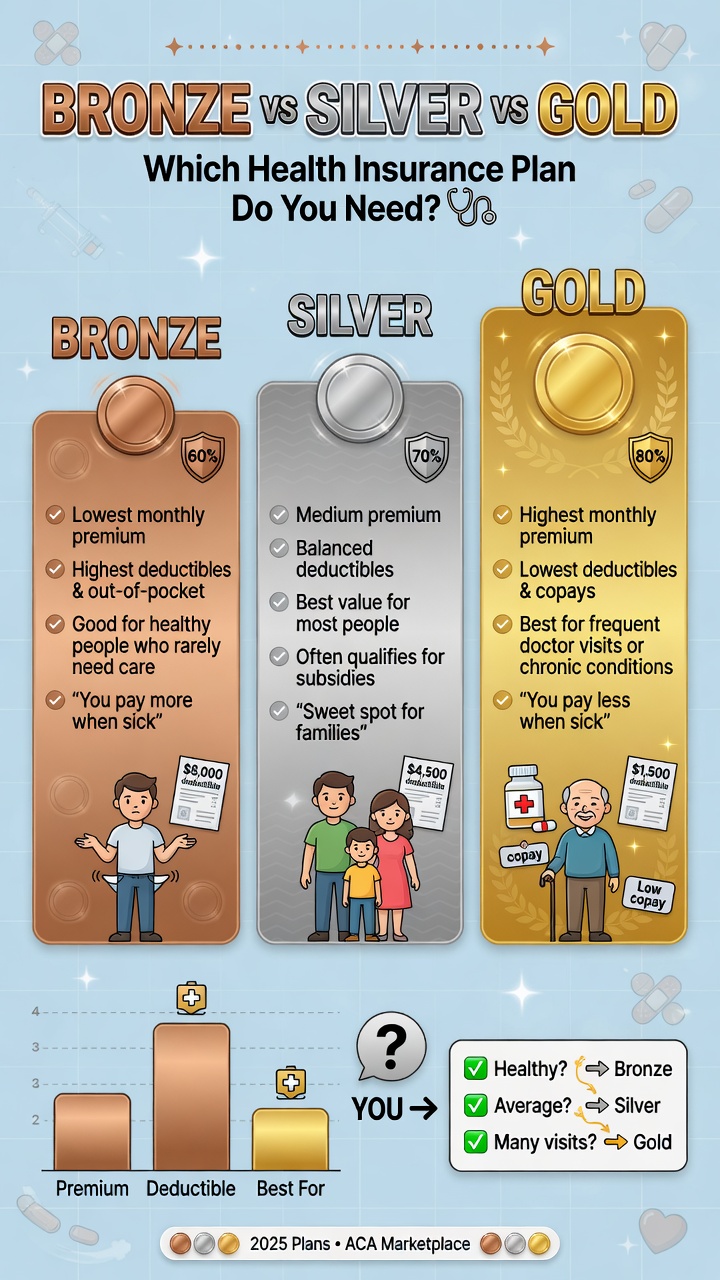
When you log into Georgia Access and start comparing 2026 marketplace plans, the platform sorts everything by metal tier: Bronze, Silver, Gold, and (sometimes) Platinum. Most people instinctively click Bronze because the monthly premium is lowest, congratulate themselves on saving money, and move on.
That's often the wrong move. For Georgians who qualify for subsidies — especially those between 100% and 250% of the federal poverty level — Silver almost always wins. Sometimes by hundreds of dollars per year. Sometimes by thousands at the point of care.
This post breaks down what each metal tier actually means, when each one wins, and the specific tier most Atlanta marketplace shoppers should default to in 2026.
I'm Justin Bishop, an independent broker in Atlanta. I help Georgians pick the right tier weekly. Here's how to actually decide.
The 30-Second Version
Bronze = lowest premium, highest deductible. Best for healthy people who want catastrophic protection only and won't qualify for subsidies anyway.
Silver = mid-tier premium, mid-tier deductible. The benchmark for subsidies and the only tier that triggers Cost-Sharing Reductions if your income is between 100-250% FPL. This is the smart-money pick for most subsidy-eligible Atlantans.
Gold = higher premium, lower deductible. Right when you use a lot of healthcare or have a chronic condition.
Platinum = highest premium, lowest deductible. Rarely the right call; barely available in Georgia.
Catastrophic = under-30s only, very high deductible (~$9,000 in 2026). Pair with Direct Primary Care for healthy young Atlantans.
The single most common mistake: picking Bronze "because it's cheapest" without realizing Silver costs less per month after subsidies AND covers way more at the point of care.
What the Metal Tiers Actually Mean
The metal tier tells you what percentage of average healthcare costs the plan pays for the average enrollee. The number isn't an exact promise for your specific bills — it's the carrier's average actuarial value.
Bronze: plan pays ~60% of average costs. You pay ~40%.
Silver: plan pays ~70%. You pay ~30%.
Gold: plan pays ~80%. You pay ~20%.
Platinum: plan pays ~90%. You pay ~10%.
That percentage shows up in your premium (lower for Bronze, higher for Platinum) and in your out-of-pocket costs at the point of care (deductibles, copays, coinsurance, max out-of-pocket).
Every metal-tier plan covers the same 10 essential health benefits required by the ACA. The differences are entirely about cost-sharing — when you go to the doctor, how much do you pay versus how much does the carrier pay.
Bronze: The Cheapest Premium, the Biggest Deductible
Best for: healthy Georgians over the subsidy cliff (>400% FPL — single $60,240, family of 4 $124,800) who want catastrophic protection only.
Bronze plans typically have:
Monthly premium (no subsidy, age 35 in Atlanta): $400-550
Deductible: $7,000-9,000 single / $14,000-18,000 family
Out-of-pocket max: $9,200 single / $18,400 family (2026 ACA cap)
Copays/coinsurance: mostly coinsurance after deductible (you pay 30-40%)
Translation: you pay a low premium every month, but if anything happens you pay nearly $9,000 before the plan kicks in for major care. A single ER visit can cost you $3,000-5,000 out of pocket on a Bronze plan even though you have insurance.
Bronze actually makes sense when:
You're over the subsidy cliff and want the lowest monthly cost while staying ACA-compliant
You're young, healthy, and have an emergency fund that can absorb the full deductible without distress
You're using the savings versus higher tiers to fund an HSA aggressively (most Bronze plans are HDHP/HSA-eligible)
Bronze does NOT make sense when:
You qualify for Cost-Sharing Reductions (then Silver wins by a wide margin)
You take regular prescriptions or see specialists frequently
You can't comfortably absorb a $9,000 hit if something happens.
Silver: The Smart-Money Pick (and the CSR Secret)
Best for: subsidy-eligible Georgians, especially those earning 100-250% of FPL.
This is the part the marketplace doesn't explain well. Silver plans have a feature called Cost-Sharing Reductions (CSR) that significantly lowers deductibles and copays — but only if your income is between 100% and 250% of FPL AND you pick a Silver plan.
For 2026, that income range is roughly:
Single: $15,060 – $37,650
Family of 4: $31,200 – $78,000
If you're in that range and pick Silver, your effective plan looks like a Gold or Platinum plan at the point of care, but you pay a Silver-level premium (after subsidy).
Real example for an Atlanta single 35-year-old earning $35,000:
Silver plan (with CSR) — monthly premium after subsidy: ~$120-180
Effective deductible after CSR: $1,500-3,000 (instead of the standard ~$5,500)
Effective max out-of-pocket: $3,500-5,500 (instead of the standard $9,200)
That same person picking Bronze would pay maybe $50-90/month less in premium but face a $7,500 deductible. One trip to urgent care would erase the entire premium savings.
This is why I tell most subsidy-eligible Atlanta clients: default to Silver unless there's a specific reason not to. The Bronze premium savings rarely cover the difference at the point of care.
For the broader Georgia marketplace context: Georgia Health Insurance Marketplace: A 2026 Guide.
Gold: When Higher Premium Pays Off
Best for: Georgians who use a lot of healthcare — chronic conditions, regular prescriptions, frequent specialist visits, planned procedures, or pregnancy.
Gold plans typically have:
Monthly premium (no subsidy, age 35 in Atlanta): $550-700
Deductible: $1,500-3,500
Out-of-pocket max: $6,000-8,000
Copays: smaller, more predictable (you pay $20-50 per visit instead of meeting a deductible first)
Gold makes sense when you can clearly see you'll hit the deductible. Run the math:
Monthly premium difference (Gold vs Silver): ~$150-200
Annual premium difference: ~$1,800-2,400
If your expected healthcare costs exceed that difference, Gold wins on total annual cost
A diabetic on insulin, a person with multiple regular specialist visits, someone going through cancer treatment, a planned surgery, or a pregnancy — all are situations where Gold's higher premium often saves money over the year because you're hitting the deductible regardless.
If you're CSR-eligible (income 100-250% FPL), Silver with CSR usually still beats Gold because the cost-sharing reduction effectively makes Silver function like Gold without the higher premium.
Platinum: Rarely the Right Call
Best for: very high healthcare utilization paired with the ability to absorb the highest premium.
Platinum plans pay roughly 90% of healthcare costs and have the lowest deductibles available — sometimes $0 deductible plans. The premium is typically 30-40% higher than Gold.
In Georgia, Platinum is uncommonly available. Few carriers offer Platinum plans in most counties. When they do, the math has to be very specific to make sense — generally, you'd need expected annual healthcare costs above $20,000 for Platinum to outperform Gold.
For most Georgians who think they want Platinum, the right answer is Gold + an HSA contribution to cover deductible exposure.
Option 6: Healthcare Sharing Ministries (Big Caveats)
Best for: healthy Georgians whose religious or values alignment fits a sharing ministry's requirements, who are willing to accept the trade-offs.
Healthcare sharing ministries (HSMs) — Christian Healthcare Ministries, Medi-Share, Samaritan Ministries, Liberty HealthShare — are religious cost-sharing arrangements. Members pay a monthly "share" amount, and qualifying medical expenses are paid from the shared pool.
What's appealing: monthly cost is typically 30-60% lower than comparable insurance.
What's concerning:
Not insurance, not regulated like insurance. No legal guarantee of payment.
Pre-existing conditions are typically not covered, often for the first 1-3 years and sometimes never.
Lifestyle requirements (no smoking, alcohol use restrictions, regular church attendance for some plans).
Not ACA-compliant — though Georgia residents with sharing ministry membership are exempt from the (now $0) ACA penalty.
Significant exclusions: maternity (some), mental health, preventive care, pre-existing conditions, etc.
For very healthy Georgians who genuinely fit the lifestyle requirements and have low expected healthcare needs, HSMs can be much cheaper. For everyone else, especially anyone with a pre-existing condition or planning a family, conventional insurance is safer. Talk to a broker before choosing this path.
Catastrophic: Under-30 Only (and a Specific Use Case)
Best for: healthy Georgians under age 30, willing to pair with Direct Primary Care.
Catastrophic plans are technically below Bronze in cost-sharing — they only kick in after a very high deductible (~$9,000 in 2026). They're available only to:
Anyone under 30
Anyone with a hardship exemption (rare)
You cannot use marketplace subsidies on a catastrophic plan, but the premium is so low it sometimes still beats subsidized Bronze.
The smart play: pair a catastrophic plan with Direct Primary Care ($50-150/month for unlimited primary care). Total monthly cost ~$250-500 for a healthy 25-year-old in Atlanta. The catastrophic plan covers the major-event risk; DPC covers everything else affordably.
The "Bronze Trap" — Why Cheap Costs More
The most common mistake I see weekly with Atlanta marketplace shoppers:
They sort plans by premium, see Bronze at the top, and pick the cheapest one
They never check whether they qualify for CSR
They never run the math on what they'd actually pay if something happens
A year goes by, they end up at urgent care, and they pay $400-800 out of pocket for what would have cost them a $30 copay on a Silver plan
For someone earning $32,000 single, the bronze plan looks like $30/month, the silver plan looks like $80/month after subsidy. Most people pick the $30 plan. They don't realize the silver plan with CSR has a $2,000 deductible while the bronze has a $7,500 deductible.
The $50/month premium difference becomes a $5,500 protection difference at the point of care. Bronze is only "cheaper" if you never use it.
Real 2026 Atlanta Numbers (for Comparison)
For a single 35-year-old non-smoker in Atlanta, Anthem Blue Cross Blue Shield, Fulton County, projected annual MAGI of $40,000:
Silver plan with subsidy: ~$160-220/month, ~$3,500 deductible, ~$7,000 max out-of-pocket
Bronze plan with subsidy: ~$80-130/month, ~$7,500 deductible, ~$9,200 max out-of-pocket
Gold plan with subsidy: ~$280-360/month, ~$1,800 deductible, ~$6,000 max out-of-pocket
If income drops to $30,000 (CSR-eligible territory):
Silver plan with CSR: ~$100-150/month, ~$1,500 deductible (huge improvement), ~$3,500 max out-of-pocket
Bronze plan: still ~$30-80/month, but no CSR — same $7,500 deductible as before
At $30,000 income, Silver becomes a no-brainer. The premium difference is small; the cost-sharing difference is enormous.
How to Actually Pick the Right Tier
Decision framework I use with Atlanta clients:
Check your projected income against 250% FPL (single $37,650 / family of 4 $78,000 in 2026). If you're under, Silver with CSR is almost certainly the right answer. Don't even compare Bronze.
Are you between 250-400% FPL? Silver vs Bronze depends on usage. If you take regular prescriptions or have a chronic condition, Silver. If you're healthy and want lowest premium, Bronze can work — but compare both quotes.
Are you over 400% FPL (no subsidy)? Bronze for healthy people who want low premium + HSA, Gold for higher utilization, Silver for the middle ground.
Do you have any planned medical events (surgery, pregnancy, diagnostic procedures)? Gold almost always wins here — you'll hit the deductible regardless.
Are you under 30 and very healthy? Catastrophic + DPC can beat anything else.
Common Mistakes That Cost Atlanta Enrollees
Patterns I see weekly:
Picking Bronze because it's "cheapest" without checking CSR eligibility on Silver
Not running the deductible math for a known event (pregnancy, chronic condition, planned surgery)
Picking Gold "to be safe" when the math supports Silver and the premium difference is wasted
Ignoring the network on price-only plans — the cheapest carrier may not have your doctor in-network
Auto-renewing the same tier without re-checking CSR eligibility if income changed
Confusing the metal tier with the carrier — a Silver plan from Anthem and a Silver plan from Ambetter have very different networks and prescription formularies
Frequently Asked Questions
Can I switch tiers mid-year? Generally no, unless you have a Special Enrollment Period (job loss, marriage, divorce, etc.). Pick carefully at Open Enrollment.
Does the metal tier affect which doctors I can see? Yes and no. The metal tier doesn't directly affect network — but the same metal tier from different carriers has different networks. Always search by your doctor and hospital before enrolling.
What if I qualify for CSR but pick Bronze anyway? You lose the CSR benefit. CSR is Silver-only. Pick Bronze and you get the standard Bronze cost-sharing, no enhancement.
Can I have an HSA on a Silver plan? Only if the Silver plan is also HDHP-qualified (deductible above $1,650 single / $3,300 family in 2026). Most Silver plans aren't HDHP-qualified because of the lower deductibles. If HSA matters to you, the choice usually comes down to Bronze (HDHP-qualified) or some specific Silver plans.
What's the difference between Silver plans from different carriers? Network, prescription formulary, and customer service. Same metal tier means same average actuarial value (~70%), but the doctors, hospitals, and drugs covered vary.
Are Platinum plans available everywhere in Georgia? No. Platinum availability is spotty in Georgia. Most counties have 0-2 Platinum options; some have none.
The Bottom Line
The metal tier you pick on Georgia Access is not just a premium decision — it's a decision about how much you pay when something actually happens.
For most subsidy-eligible Atlantans, Silver wins — especially if you qualify for CSR. The premium savings of Bronze rarely cover the cost-sharing difference at the point of care.
For higher-income Georgians without subsidies, the choice depends on your expected utilization. Healthy and rarely use healthcare? Bronze + HSA. Regular healthcare needs? Gold. Mid-range? Silver.
If you're staring at marketplace plans on Georgia Access and don't know which tier to pick, book a 15-minute call with me. I'll run the math for your specific income, family situation, and expected healthcare needs across all available carriers in your county. Costs you nothing — I'm paid by carriers, not by you.
Want to keep reading? Check out Affordable Health Insurance Options in Georgia for 2026, Georgia Health Insurance Marketplace: A 2026 Guide, or The 2026 ACA Subsidy Cliff for Self-Employed Georgians.
Justin Bishop is the founder of That Young Insurance Guy, an independent insurance brokerage in Atlanta, GA, licensed in 31 states. He writes the Health Coverage Chaos newsletter on LinkedIn — and yes, he answers his own texts.
This post is general education, not medical, tax, or legal advice. Marketplace rules, subsidy thresholds, FPL ranges, ACA provisions, Medicaid eligibility, Pathways requirements, HSA limits, and sharing ministry policies change.