Health Insurance for Gig Workers in Georgia: A Real Guide
Author: Justin Bishop · May 2, 2026 · 7 min read
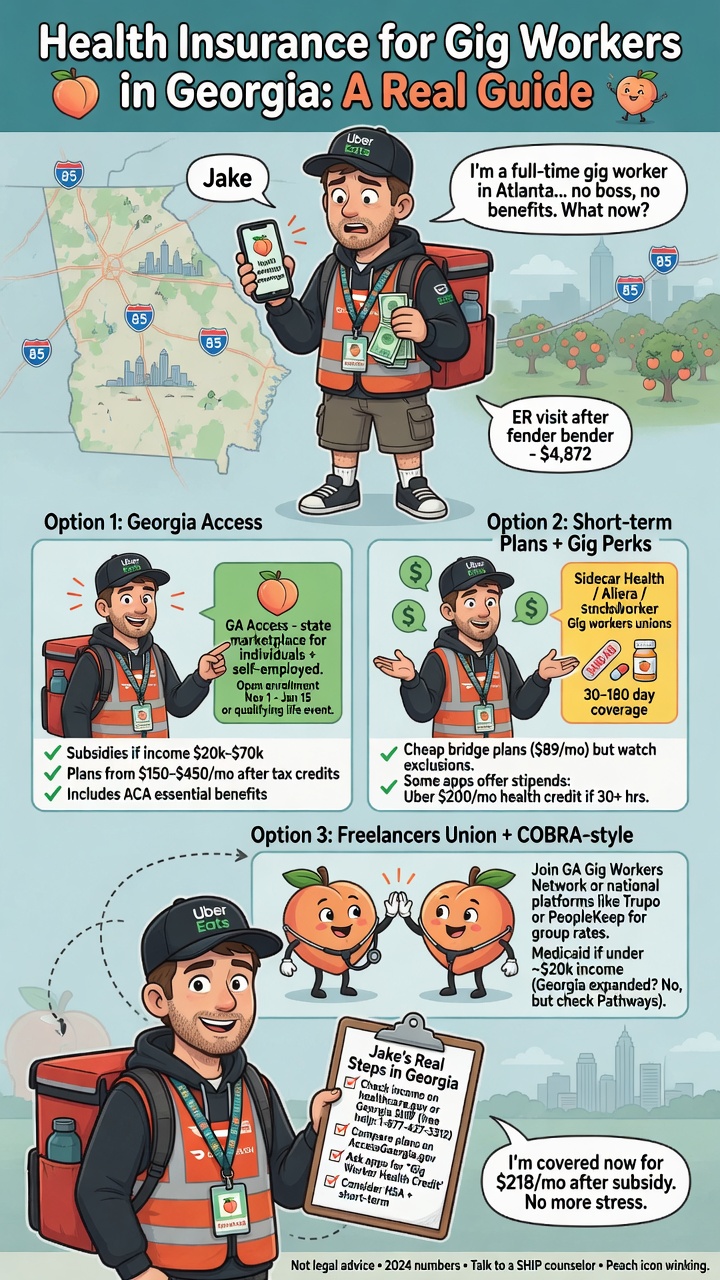
If you drive for Uber or Lyft, deliver for DoorDash or Instacart, freelance through Upwork or Fiverr, or earn primarily through 1099s, you have the same health insurance problem as every traditionally self-employed person — but with extra wrinkles. Your income is irregular. Your hours fluctuate. Your "employer" gives you tax forms but not benefits. And the health insurance system was built for a world where most people get coverage through a W-2 job.
For broader young-adult coverage decisions: Health Insurance for Young Adults.
For travel nurses specifically: Health Insurance for Travel Nurses.
For real estate agents specifically: Health Insurance for Real Estate Agents
For mortgage lenders specifically: Health Insurance for Mortgage Lenders.
The good news is that the marketplace works for you specifically — sometimes better than for traditional employees. The bad news is that the 2026 subsidy cliff is back, and gig workers earning above 400% of the federal poverty level just got hit with the biggest premium increase in years.
I'm Justin Bishop, an independent broker in Atlanta. I write a lot of marketplace plans for gig workers. Here's the practical version of what works, what doesn't, and the specific moves that save the most money.
The 30-Second Version
Yes, you qualify for marketplace health insurance. Being a gig worker doesn't disqualify you. Georgia Access (Georgia's marketplace) treats 1099 income the same as any other self-employment income.
You may qualify for premium subsidies. Most gig workers earning between $15,060 and $60,240 (single) get some level of help in 2026.
The 2026 subsidy cliff is back at 400% FPL. Earn $1 over and you lose all premium tax credits.
You can deduct 100% of your health insurance premium from federal income tax if you're self-employed (above-the-line deduction, no itemizing required).
HSA-eligible plans + retirement contributions can lower your MAGI to keep you under the cliff.
Open Enrollment runs Nov 1 - Jan 15. Outside that window, you need a Qualifying Life Event for a Special Enrollment Period.
That's the core. The rest is how to apply it.
Why Gig Workers Get Hit Differently
Three things make health insurance harder for gig workers than for traditional employees:
Irregular income. A great quarter on DoorDash followed by a slow one means your "annual income" is genuinely unpredictable. Marketplace eligibility uses your projected MAGI for the year — and getting that projection wrong creates problems either way (owe back subsidies or pay too much in premium).
No employer plan as a fallback. A W-2 employee whose subsidy disappears can usually take their employer plan. You don't have that option.
Multiple income streams. A lot of gig workers stack platforms — drive for Uber + deliver for DoorDash + freelance design on the side. That's three 1099 income sources to project, and three platforms that may issue 1099-NECs at different thresholds.
The good news: gig workers also have more levers to pull on MAGI than traditional W-2 employees. We'll cover those.
Your 4 Real Options for Health Coverage
Here's the realistic option set for an Atlanta gig worker:
Georgia Access marketplace plans (the default for most). Subsidized if your projected MAGI is between 100% and 400% of the federal poverty level. Same plans as traditional employees, same carriers (Blue Cross Blue Shield, UnitedHealthcare, Ambetter, Kaiser, Anthem). Full breakdown of Georgia Access here.
For the broader Georgia marketplace overview, see Georgia Health Insurance Marketplace: A 2026 Guide
For every affordable path beyond the marketplace, see Affordable Health Insurance Options in Georgia for 2026
Spouse's employer plan if available. If your spouse has W-2 coverage, run the numbers — sometimes it's cheaper than marketplace, especially if you're over the subsidy cliff.
Off-marketplace plans. Same insurance products as marketplace plans, bought directly from the carrier. No subsidy applied either way. Useful if you're already over the cliff and shopping for a specific plan the marketplace doesn't surface.
Short-term medical (limited use case). Not ACA-compliant, doesn't cover pre-existing conditions, has annual benefit caps. Useful as a 1-3 month bridge — not a long-term solution.
For most gig workers earning under $60K, Georgia Access marketplace with a subsidy is the right answer. The math gets more interesting above that.
The Income Projection Problem (and How to Solve It)
The single hardest thing about marketplace coverage as a gig worker is projecting your annual income. Project too low and you owe back subsidies at tax time. Project too high and you pay more in premium than you needed to.
The realistic approach I use with gig clients:
Pull last year's 1099s as a starting point. Add up gross income across all platforms (Uber, DoorDash, Upwork, etc.).
Subtract realistic business expenses — gas, mileage, phone, equipment depreciation. The IRS standard mileage rate ($0.67/mile in 2025, adjusts annually) covers most rideshare/delivery expenses. Don't forget platform fees.
Account for changes. If you're driving more or less this year than last, adjust. If you switched platforms, adjust.
Build in a 10% buffer. Better to project slightly high and be pleasantly surprised at tax time than to project low and owe.
Re-check mid-year. If you've had a particularly strong or slow Q1-Q2, update your Georgia Access projection to match. Georgia Access lets you change your projected income any time during the year.
Real example: an Uber driver who grossed $52,000 in 2025 with $14,000 of mileage/phone/expenses had a net 1099 income of $38,000 — well within the subsidy range. Projecting "$52,000" to Georgia Access (the gross) would have wrongly disqualified them from full subsidies. Projecting "$38,000" (the net) was the correct number.
The 2026 Subsidy Cliff (Why High-Earning Gig Workers Got Hit)
If you're a gig worker earning above $60,240 (single) or $124,800 (family of four) in projected MAGI, 2026 just got expensive.
The federal "enhanced" Premium Tax Credits expired December 31, 2025. As of January 1, 2026, the subsidy cliff is back at 400% of the federal poverty level. Earn one dollar over the threshold and you lose all premium tax credits — not a partial reduction.
For high-earning gig workers (full-time freelance designers, consultants, real estate agents, content creators), this can mean a marketplace plan jumping from $200/month to $700/month overnight.
The good news: gig workers have specific tools to manage MAGI:
Solo 401(k) or SEP-IRA contributions (the biggest one — see below)
HSA contributions if you're on an HSA-eligible plan (2026 HSA limits guide)
The self-employed health insurance deduction (100% of premiums)
Timing of expenses — accelerate business expenses before December 31 to lower current-year MAGI
The full deep-dive on the cliff and the 5 levers is in the 2026 subsidy cliff post. If you're earning anywhere near the cliff, that post is required reading.
The Tax Deduction Most Gig Workers Forget
If you pay your own health insurance premiums, you can deduct 100% of those premiums on your federal taxes — above the line, no itemizing required. This is on Schedule 1 of your 1040.
Quick example: a gig worker paying $400/month for a Georgia Access plan pays $4,800/year in premiums. At a 22% federal tax bracket, that's roughly $1,056 in tax savings per year — on top of any subsidy. Plus state tax savings.
Important rules:
The deduction can't exceed your net self-employment income. If you only made $3,000 from gig work, you can only deduct up to $3,000 in premiums.
You can't deduct premiums for months you were eligible for an employer plan (yours or a spouse's).
It applies to medical, dental, and qualified long-term care premiums — not just health insurance.
It reduces income tax, not self-employment tax (FICA).
Most decent CPAs catch this automatically. If you DIY your taxes through TurboTax/HRBlock, the software walks you through it — but make sure you're answering "yes" when it asks if you paid health insurance premiums and were self-employed.
The HSA Move (If You're Healthy and Earning Steadily)
If you have HSA-eligible high-deductible health plan coverage, an HSA is one of the most underrated moves in the gig worker toolkit:
Lower monthly premium than non-HDHP plans
2026 HSA contribution limits: $4,400 self-only, $8,750 family — every dollar reduces MAGI
Triple tax advantage: deductible going in, tax-free growth, tax-free withdrawals for qualified medical expenses
Becomes a stealth retirement account at age 65 — withdraw for any reason, only ordinary income tax
For a gig worker projected near the subsidy cliff, an HSA is a triple win: lower premium, tax-deductible contribution, MAGI reduction that keeps the subsidy. Full HSA guide here.
The catch: HDHPs have higher deductibles. If you have ongoing medical needs or expect a heavy spending year, the math may not work. Run both scenarios before committing.
Common Mistakes I See
The specific mistakes that cost gig workers the most money:
Projecting gross income instead of net. Always project your net — gross minus business expenses. Marketplace eligibility uses MAGI, not revenue.
Forgetting to update projection mid-year. If your Q1 was huge, log into Georgia Access and update — better to take the subsidy hit now than owe at tax time. Same applies in reverse if you've had a slow year.
Skipping the marketplace because "I make too much." Many gig workers assume they don't qualify — and don't even check. Run the numbers. Your net 1099 income after deductions is often lower than you think.
Letting coverage lapse between platforms. If you quit one gig and started another with a coverage gap, that gap is uncovered medical risk. Bridge with short-term medical or stay on a marketplace plan continuously.
Not pairing the plan with retirement contributions. A solo 401(k) contribution can keep you under the subsidy cliff AND build tax-advantaged retirement savings — most gig workers don't have either, and don't realize one decision unlocks both.
Choosing the cheapest premium without checking network. Atlanta carriers have meaningfully different networks. The plan that's $30 cheaper but doesn't include your doctor isn't actually cheaper.
Want to Run Your Numbers?
If you're a gig worker in Georgia and want to know exactly where you fall on subsidies — text me your projected net 1099 income, household size, and ZIP at (706) 988-1930. I'll come back with where you stand on the subsidy cliff, what you'd qualify for, and which Atlanta-area plans would work for your doctors and budget.
15 minutes. Free. Independent broker. No follow-up sequence.
I work with self-employed Georgians, freelancers, and gig workers every week. The marketplace looks intimidating from the outside — once you know how to project income correctly and which levers to pull, it's actually pretty manageable.
Justin Bishop is the founder of That Young Insurance Guy, an independent insurance brokerage in Atlanta, GA, licensed in 31 states. He writes the Health Coverage Chaos newsletter on LinkedIn.
This post is general education, not tax or legal advice. Marketplace platforms, carriers, and federal rules change.