
How to Get Health Insurance If I Just Lost My Job
Author: Justin Bishop · May 6, 2026 · 8 min read
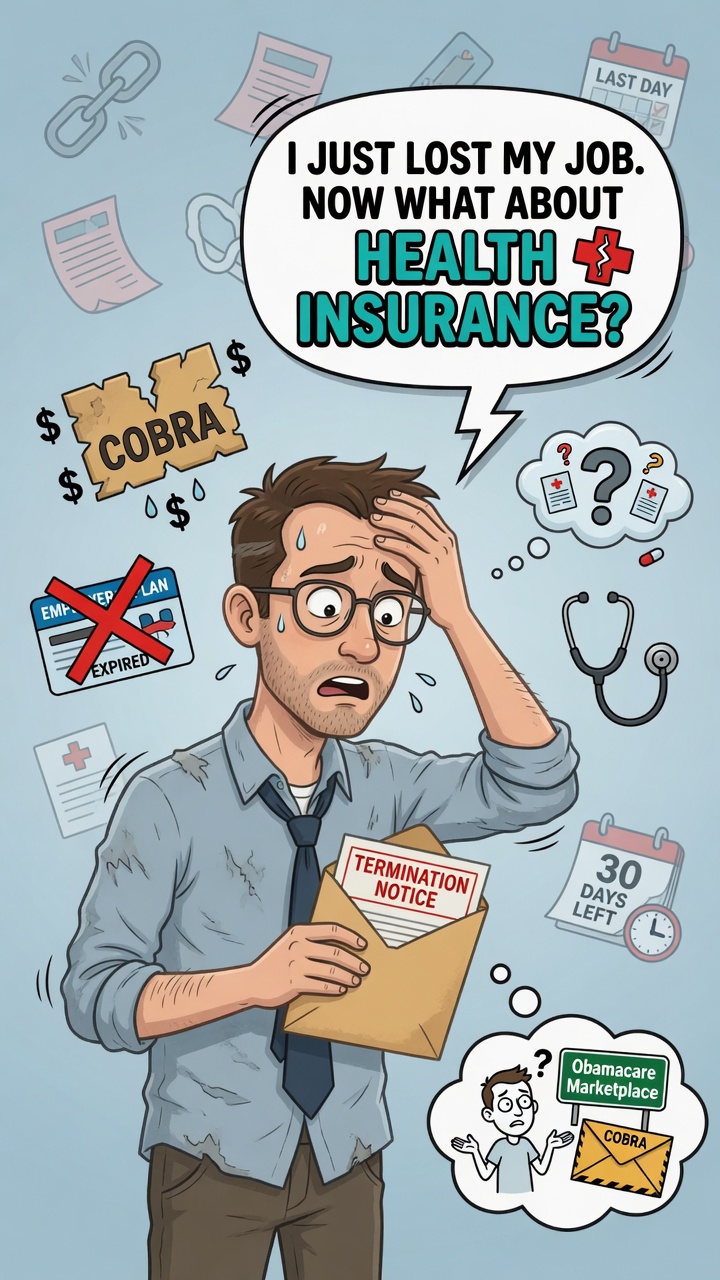
First, take a breath. Losing your job in Atlanta does not mean losing your access to health insurance. You have a 60-day window that triggers the day your old coverage ends, and within that window you have six real options — not just COBRA.
Most people default to COBRA because that's the only option HR mentions on the way out the door. For most laid-off Atlanta workers, COBRA is the most expensive option you can pick — sometimes 3x what you'd pay on the marketplace.
I'm Justin Bishop, an independent broker in Atlanta. I help people in this exact situation regularly — laid-off corporate folks, severance package recipients, fired-with-cause workers, end-of-contract layoffs. Here's what to actually do.
The 60-Day Window You Need to Know About
When you lose employer-sponsored coverage, you trigger what's called a Special Enrollment Period (SEP). You have 60 days from the date your old coverage ends to enroll in:
An ACA marketplace plan (through Georgia Access, our state-based exchange)
Once you've decided on the marketplace, the next question is which tier: Bronze vs Silver vs Gold: Which Plan Do You Actually Need?
A spouse's employer plan (their plan opens for a 30-day SEP)
A parent's plan (if you're under 26)
If you miss the 60-day window, you're locked out until Open Enrollment in November — and you'd have a coverage gap that could leave you exposed to medical bills you can't afford.
This is the single most important thing to remember. Set a calendar reminder for day 30 and day 50 from your last day of coverage. Do not let this window close.
For the full mechanics, see my ACA Special Enrollment Period guide.
Your 6 Real Options After Losing Your Job in Atlanta
Here are the actual paths, ranked roughly by who they fit best:
Option 1: Marketplace Plan with Subsidy (Georgia Access)
Best for: Most laid-off Atlanta workers. Especially anyone whose income just dropped to zero or to a much lower figure.
When you lose your job, your projected annual income for marketplace purposes drops dramatically. That usually means big premium tax credits — sometimes covering 90-100% of the premium for a Silver plan. A Silver plan that would normally cost $450/month might cost you $40-80/month after subsidies kick in.
You enroll through Georgia Access at gaaccess.com (or with help from a broker like me — same plans, same prices). You pick a plan that fits your needs. Coverage typically starts the first day of the next month.
This is the option most people should compare COBRA against — and most people don't, because nobody told them about it.
For every affordable Georgia path beyond COBRA and the marketplace, see Affordable Health Insurance Options in Georgia for 2026
Option 2: COBRA (Federal)
Best for: Workers who are mid-treatment for a serious condition and want to keep the same doctor and plan with zero gap.
COBRA lets you keep your old employer plan for up to 18 months — but you pay the full premium plus a 2% admin fee. That means whatever your employer was paying (which is usually 70-85% of the cost) is now your responsibility too.
Typical COBRA cost for an individual: $400-900/month
Typical COBRA cost for a family: $1,200-2,500/month
COBRA is only available if your former employer had 20 or more full-time employees. For most Atlanta workers at small businesses, COBRA is not on the menu — Georgia's mini-COBRA is.
Curious what your former employer is on the hook for during your COBRA window? Here's the employer-side breakdown: My Employee Just Quit. How Long Do They Stay on Group Health?.
Option 3: Georgia Mini-COBRA (State Law)
Best for: Workers laid off from small Atlanta businesses (2-19 employees) who need a short bridge to other coverage.
Georgia's mini-COBRA law applies to employers with 2-19 employees. It gives you up to 3 months of continued coverage — much shorter than federal COBRA's 18 months. Same cost structure: you pay full premium plus admin fee.
This is rarely the best long-term option. It's a short bridge while you sort out marketplace coverage.
Option 4: Spouse's Employer Plan
Best for: Married workers whose spouse has employer coverage available.
Your job loss triggers a 30-day Special Enrollment Period on your spouse's employer plan. Your spouse can add you (and any dependents) to their plan even though it's not Open Enrollment season.
This is often the cheapest path because employers typically subsidize 70-85% of the family premium. Run the numbers — a spouse-plan addition is often $200-500/month for the whole family. That can beat both COBRA and the marketplace.
Option 5: Parent's Plan (Under 26)
Best for: Workers under age 26 who haven't yet aged off a parent's plan.
Federal law lets you stay on a parent's employer plan or marketplace plan until your 26th birthday. Job loss doesn't change that. If you're under 26 and your parent has decent coverage, this is almost always the cheapest option.
For more on this audience, see my health insurance for young adults guide.
Option 6: Medicaid (and the Georgia Coverage Gap)
Best for: Workers whose income is very low and who have dependent children.
Georgia is one of 10 states that did not expand traditional Medicaid under the ACA. That means traditional Medicaid here is limited to specific categories — pregnant women, low-income parents with very young children, the disabled, and the elderly. Most able-bodied adults without dependents don't qualify even at $0 income.
Georgia launched the Pathways to Coverage program in 2023 — limited Medicaid for adults 19-64 who can document at least 80 hours per month of work, school, job training, volunteer work, or similar activity. The work requirement disqualifies many newly-laid-off workers right when they need coverage most.
If you have kids, PeachCare (Georgia's CHIP program) covers children in households up to roughly 247% of the federal poverty level. That's separate from your own coverage and worth checking.
The "Georgia coverage gap": if your projected annual income is between $0 and roughly $15,060 (single, 2026) and you don't qualify for traditional Medicaid, you also don't qualify for ACA subsidies on the marketplace. This is the gap nobody likes to talk about. If you're caught here, your best bet is usually to project your income at slightly above the subsidy threshold (assuming any unemployment, severance, or part-time work brings you there) so the marketplace subsidy kicks in.
Why Most People Default to COBRA (and Why That's Usually a Mistake)
Here's what happens to most laid-off workers:
HR hands you a COBRA election notice on your way out the door
The notice has dollar figures and specific instructions
You panic and elect COBRA because it's the option that's been put in front of you
You pay $700-1,500/month for coverage you could have gotten for $40-150/month on the marketplace
I'm not exaggerating. The marketplace beats COBRA on price 80-90% of the time for laid-off workers, because the marketplace subsidy adjusts to your new (lower) income.
The exception: if you're mid-treatment for a serious medical condition (cancer, ongoing surgery sequence, complex pregnancy) and switching plans means switching doctors mid-treatment, COBRA might be worth the cost to keep continuity of care.
For most other situations, always price the marketplace before electing COBRA. It costs you nothing to get a marketplace quote — and you have 60 days to decide.
How to Decide Which Option Is Best for Your Situation
Here's a quick decision framework:
Do you have a spouse with employer coverage? Run the math on adding to their plan. Usually wins.
Are you under 26? Get on a parent's plan. Almost always cheapest.
Are you mid-treatment for a serious condition? COBRA may be worth the price for continuity. Get a real quote.
Is your projected new income under ~$60,000 (single) or ~$125,000 (family of 4)? The marketplace will likely beat COBRA significantly. Run a real quote on Georgia Access or call a broker.
Is your projected new income above the subsidy cliff? Marketplace plans are still often cheaper than COBRA, just without the subsidy. Compare both.
Did you get a severance package? Severance is taxable income, but lump-sum severance doesn't always count toward MAGI in the way you'd think. Get a quote with and without the severance counted.
Common Mistakes I See (and How to Avoid Them)
Going uninsured "for a few weeks" while you figure things out. This is the most expensive mistake. A single ER visit can wipe out months of premium savings. And once you go uninsured for more than 60 days post-job-loss, your SEP closes.
Electing COBRA without comparing the marketplace. Costs you thousands per year on average.
Not updating your projected income after the layoff. Your projected income drives the subsidy. If you're estimating based on what you used to make, you're leaving subsidy on the table.
Buying a short-term medical plan and thinking you're covered. Short-term plans are NOT ACA-compliant. They don't cover pre-existing conditions, they have annual benefit caps, and they're for emergencies only — typically as a 1-3 month bridge.
Ignoring spouse-plan and parent-plan options because nobody mentioned them. Both trigger their own SEPs from your job loss.
Missing the 60-day deadline. Set the calendar reminder. Do not skip this.
Frequently Asked Questions
How long do I have to enroll after losing my job? 60 days from the date your old coverage ends. Coverage usually starts the first day of the next month after you enroll.
Can I change my mind after electing COBRA? Yes, but it's tricky. You can drop COBRA at any time, but dropping COBRA does not by itself trigger a new SEP for the marketplace. You need to plan ahead — compare COBRA and marketplace pricing before electing.
Will my old doctor be in network on a marketplace plan? Maybe. Georgia Access lets you search by doctor and hospital before enrolling. Major Atlanta hospitals (Emory, Piedmont, Wellstar, Northside) are in-network on most marketplace plans, but specific specialists vary by carrier.
What if I get a new job in 30 days? You can enroll in a marketplace plan as a bridge and drop it when your new employer plan kicks in. Most marketplace plans let you cancel any time with 14 days notice.
Does severance count as income? Yes, severance is taxable income — but for marketplace MAGI purposes, lump-sum severance and weekly severance are treated differently. If you got a big lump-sum, talk to a broker before estimating your MAGI.
Can I get health insurance if I had a high deductible plan and lost it? Yes. The marketplace doesn't care what your old plan looked like. You'll get fresh access to all available plans at all metal levels.
Over 65? If you're 65+ and losing employer coverage, Medicare enrollment timing becomes critical: When Should I Sign Up for Medicare? The 6 Windows Explained.
f you're 65+, Medicare cost planning becomes critical. See What Does Medicare Cost in 2026?
The Bottom Line
Losing your job is stressful enough without HR handing you a $1,200/month COBRA election notice and walking away. The truth: you have options, you have time, and most laid-off Atlanta workers will save 50-80% by choosing a marketplace plan over COBRA.
The single most important thing is to act inside the 60-day window. After that, you're locked out until November Open Enrollment, and any medical event in that gap is on you.
If you just got laid off in Atlanta and don't know which option is best for your situation, book a free 15-minute call with me. I'll run the actual numbers — COBRA vs marketplace vs spouse plan — and tell you which one wins for your situation. No charge, no hard sell. I make my money from carriers, not from you.
Want to keep reading? Check out Health Insurance for the Self-Employed, the 2026 Subsidy Cliff for Self-Employed Georgians, or Georgia Access vs Healthcare.gov: What Changed in 2024.
Justin Bishop is the founder of That Young Insurance Guy, an independent insurance brokerage in Atlanta, GA, licensed in 31 states. He writes the Health Coverage Chaos newsletter on LinkedIn — and yes, he answers his own texts.
This post is general education, not medical, tax, or legal advice. COBRA rules, marketplace subsidies, Georgia Medicaid eligibility, and Mini-COBRA provisions change.