
Atlanta Health Insurance in 2026: An Honest Buyer's Guide
Author: Justin Bishop · April 30, 2026 · 9 min read
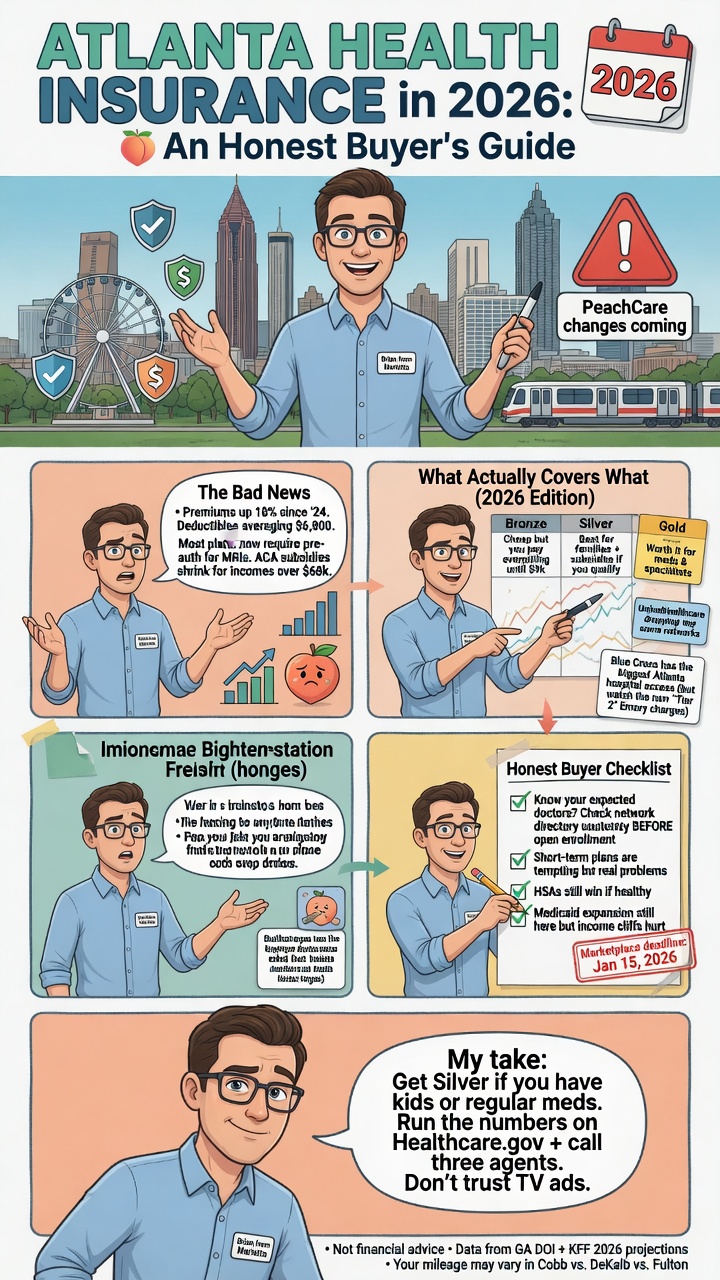
If you're shopping for health insurance in Atlanta in 2026, the rules just changed in ways that make most older advice wrong.
The federal government turned off four years of expanded ACA subsidies on December 31, 2025. Premiums jumped about 114% on average for unsubsidized buyers. Georgia Access — Georgia's state-run marketplace — is now in its second year and works slightly differently than the federal site. And the "subsidy cliff" at 400% of the federal poverty level is back, which means a $1 difference in projected income can cost you thousands.
I'm Justin Bishop, an independent broker in Atlanta. I write health insurance every week for individuals, families, freelancers, and small businesses across Georgia and 30 other states. This is the version of "how to buy health insurance in Atlanta" I'd give a friend who asked.
No fluff. Real numbers. The path I'd actually take.
Step 1: Figure Out Which Path Applies to You
There are four real paths to health insurance in Atlanta in 2026. Most people only know about one or two.
Path 1: Employer coverage. If you have a W-2 job that offers a health plan, this is usually the cheapest path. Employer plans aren't subject to the marketplace cliff and the employer typically covers 50-80% of your premium. If your employer plan is "affordable" by ACA standards (your share of the employee-only premium is under ~9.5% of household income), you're not eligible for marketplace subsidies anyway — so the employer plan is your default. Compare it carefully to a working spouse's plan if both are available.
Running a business with employees? See Atlanta Group Health Cost Guide.
Path 2: Georgia Access marketplace. This is the path for the self-employed, freelancers, 1099 contractors, anyone between jobs, anyone whose employer doesn't offer coverage, anyone whose employer plan is "unaffordable" by ACA definition, and many early retirees. We'll spend most of this guide here.
More on what changed when Georgia replaced Healthcare.gov: Georgia Access vs Healthcare.gov explainer.
Specifically for young adults: Health Insurance for Young Adults guide.
Specific to gig workers: Health Insurance for Gig Workers.
For the broader Georgia marketplace overview, see Georgia Health Insurance Marketplace: A 2026 Guide
For a full breakdown of affordable paths beyond the marketplace, see Affordable Health Insurance Options in Georgia for 2026
Path 3: Medicare (if you're 65+ or have certain disabilities). Different rules entirely. If this is you, see the Medicare guide instead.
Path 4: Off-marketplace plans. Same insurance products as marketplace plans, but bought directly from the carrier. No subsidies are available on these, but you bypass the marketplace site's limitations. Useful if you're above the subsidy cliff or want a plan the marketplace doesn't show.
The rest of this guide is mostly about Path 2 (Georgia Access) and Path 4 (off-marketplace) — the two that are most confusing and where most of the savings are hiding.
Step 2: Understand What Changed in 2026
Three things changed on January 1, 2026:
The subsidy cliff is back at 400% of the federal poverty level. For 2026 that's roughly:
$60,240 for a single person
$81,760 for a couple
$103,280 for a family of three
$124,800 for a family of four
Earn one dollar over the threshold for your household size and you lose all premium tax credits — not a partial reduction. The cliff is the biggest planning factor for self-employed Georgians in 2026; I wrote a deeper guide on it here.
Average premiums went up roughly 114% for unsubsidized buyers. If you were paying $300/month with subsidy help in 2025 and you're now over the cliff, expect to see $600-$800/month for the same plan in 2026.
Georgia Access is the only marketplace for Georgia residents. Healthcare.gov no longer enrolls Georgia residents. You enroll through Georgia Access (or through a licensed Georgia broker who has access to it).
The plans themselves haven't changed structurally. The carriers haven't changed. The subsidies didn't shrink — they cliffed. That distinction matters because the planning levers are different.
For a full breakdown of affordable paths beyond the marketplace, see Affordable Health Insurance Options in Georgia for 2026
Step 3: How Subsidies Actually Work in 2026
A premium tax credit is a federal subsidy that reduces your monthly health insurance premium. It's based on your projected MAGI (modified adjusted gross income) for the year, your household size, and the cost of plans where you live.
You qualify for some subsidy if: your projected MAGI is between 100% and 400% of the federal poverty level AND you don't have access to "affordable" employer coverage.
Rough subsidy math for Atlanta residents in 2026 (these are illustrative, run your actual numbers):
Household sizeMAGIApproximate monthly premium for Silver planSingle, age 35$25,000~$50/month after subsidySingle, age 35$50,000~$300/month after subsidySingle, age 35$61,000 (over cliff)~$650/month — full priceFamily of 4, head age 40$80,000~$200/month after subsidyFamily of 4, head age 40$125,000 (over cliff)~$1,800/month — full price
Your actual numbers depend on age, zip code, plan tier, and family composition. Atlanta's geographic rating area is generally among Georgia's more affordable. Run your real numbers with a broker or with the Georgia Access calculator before assuming.
Step 4: Pick Your Plan Tier (Bronze, Silver, Gold, Platinum)
Marketplace plans come in metal tiers. The metal name is just a shorthand for how the plan splits costs:
TierPlan paysYou pay (avg)PremiumBest for Bronze~60% of medical costs~40%LowestHealthy people who want catastrophic protection only Silver~70%~30%ModerateMost subsidy-eligible buyers — the subsidy math works best at Silver Gold~80%~20%HigherPeople with ongoing medical needs or expecting heavy spend Platinum~90%~10%HighestRare; usually only worth it for very heavy medical users
The cost-sharing reduction (CSR) trick: if your MAGI is below 250% of FPL (~$37K single, ~$77K family of four in 2026), Silver plans get an extra subsidy applied that lowers your deductible and out-of-pocket max significantly — sometimes turning a Silver plan into the equivalent of a Gold plan at a Bronze plan price. Below 250% FPL, Silver almost always beats Bronze. Above 250% FPL, Bronze can be cheaper overall depending on usage.
This is one of the most underused features of marketplace coverage. Most people pick Bronze for the lowest premium without realizing the Silver+CSR combination would save them money long-term.
For the deeper comparison of which metal tier wins for your situation, see Bronze vs Silver vs Gold: Which Plan Do You Actually Need?
Step 5: Check Your Doctors (Network Matters More Than Premium)
Every plan has a network — the list of doctors, hospitals, and pharmacies the plan covers in-network. Out-of-network care is either uncovered or covered at a much worse rate, depending on the plan.
Before picking any plan, run this checklist:
List your current doctors (primary care, any specialists, dentist if you have a dental rider).
List any hospital you'd want to be admitted to in an emergency (Atlanta-area: Emory, Piedmont, Northside, Wellstar, etc.).
List your prescriptions.
For each plan you're considering, check whether each is in-network.
The fastest way to do this: most carriers have a "find a doctor" tool on their site, but the data is occasionally stale. The reliable way is to call your doctor's office and ask them directly which plans they accept for the upcoming year.
A plan that's $100/month cheaper but doesn't include your kid's pediatrician is not actually cheaper. Network is the most-skipped step and the most-regretted.
Step 6: Consider an HSA-Eligible Plan (If You're Healthy)
If you're reasonably healthy, run consistent income, and don't expect heavy medical spending, an HSA-eligible high-deductible health plan (HDHP) is one of the smartest moves available — especially if you're self-employed.
Why:
Lower monthly premium than non-HDHP plans
Triple tax advantage on the HSA itself — contributions are tax-deductible, growth is tax-free, qualified medical withdrawals are tax-free. No other account does all three.
2026 contribution limits: $4,400 self-only, $8,750 family
No "use it or lose it" — HSA dollars roll over forever and become a stealth retirement account after 65
The catch: if you have a high-spending year (surgery, baby, big specialist work), the higher deductible bites. Run the worst-case scenario before committing.
For the deeper dive on contribution limits and strategy, see the HSA 2026 guide.
Step 7: Time It Right
Open Enrollment Period for 2026 ran November 1, 2025 through January 15, 2026. That window is closed.
To enroll outside Open Enrollment, you need a Special Enrollment Period (SEP). Triggers include:
Loss of other coverage (job loss, employer dropped plan, COBRA expiration, aged off parent's plan at 26)
Change in household (marriage, divorce, birth, adoption)
Change in residence (moved to a new ZIP code with different plans)
Change in income making you newly eligible for subsidies
Becoming a US citizen or lawful resident
If any of these just happened, you typically have 60 days from the event to enroll. Miss that window and you're waiting until the next Open Enrollment.
More on the SEP rules, triggers, and 60-day clock: Special Enrollment Periods guide.
Step 8: How to Actually Shop
Three options, in order of how I'd recommend them:
Option A — Through a licensed independent broker (free to you). A broker shops Georgia Access and off-marketplace plans, runs the subsidy math, checks your doctors against networks, and helps with claim issues year-round. Carriers pay broker commissions out of their marketing budget — you pay the same premium whether you go through a broker or direct. There's no premium markup for using a broker.
Option B — Directly through Georgia Access. Free, public, fine. You're on your own for plan comparison and any post-enrollment issues. Best for confident buyers who already know what they want.
Option C — Directly through a carrier. Locks you to that carrier's plans only. No subsidy if you go this route — only marketplace and broker-routed enrollments get the premium tax credit. Use this only for off-marketplace plans where you're confident the specific carrier is your best fit.
For most people, Option A is faster and more accurate at no cost. (If you'd like to talk through your specific situation, my number's at the bottom.)
Common Mistakes I See
Picking the cheapest premium without checking network. See Step 5. This is the #1 regret.
Underestimating MAGI projections. People project low to maximize subsidy, then earn more during the year, then owe back subsidies at tax time. Project realistically — even slightly high.
Skipping the HSA option without doing the math. Most people pick a plan because they recognize the network, without considering whether an HSA-eligible plan would save them more long-term.
Not updating Georgia Access mid-year when income changes. Especially relevant for self-employed people with variable income. If you're trending toward the cliff, update your projection. Better to adjust mid-year than to owe big at tax time.
Falling off COBRA without enrolling in something else. COBRA's 18-month window ends and many people don't realize the COBRA expiration is itself a Special Enrollment Period trigger. Don't let coverage lapse.
Only shopping the marketplace. Off-marketplace plans exist. Sometimes they're better. A broker shops both; the marketplace site only shows you marketplace plans.
Want a Real Number for Your Situation?
If you're shopping Atlanta health insurance and want to know exactly where you'd land — text me your projected MAGI, household size, and ZIP at (706) 988-1930. I'll come back with where you fall on the cliff, what plans your doctors are in-network with, and which option saves you the most over the year.
Free. Independent. No follow-up sequence.
I help self-employed Georgians, Atlanta families, and small business owners across 31 states. Most people I quote save more than they expected — usually because they didn't realize a specific lever applied to their situation.
Justin Bishop is the founder of That Young Insurance Guy, an independent insurance brokerage in Atlanta, GA. He writes the Health Coverage Chaos newsletter on LinkedIn.
This post is general education, not tax or legal advice. Subsidy thresholds, plan availability, and pricing change. For current numbers specific to your situation, talk to a licensed broker.