
Why You Should Probably Pick a Younger Insurance Broker (And When You Shouldn't)
Author: Justin Bishop · April 28, 2026 · 7 min read
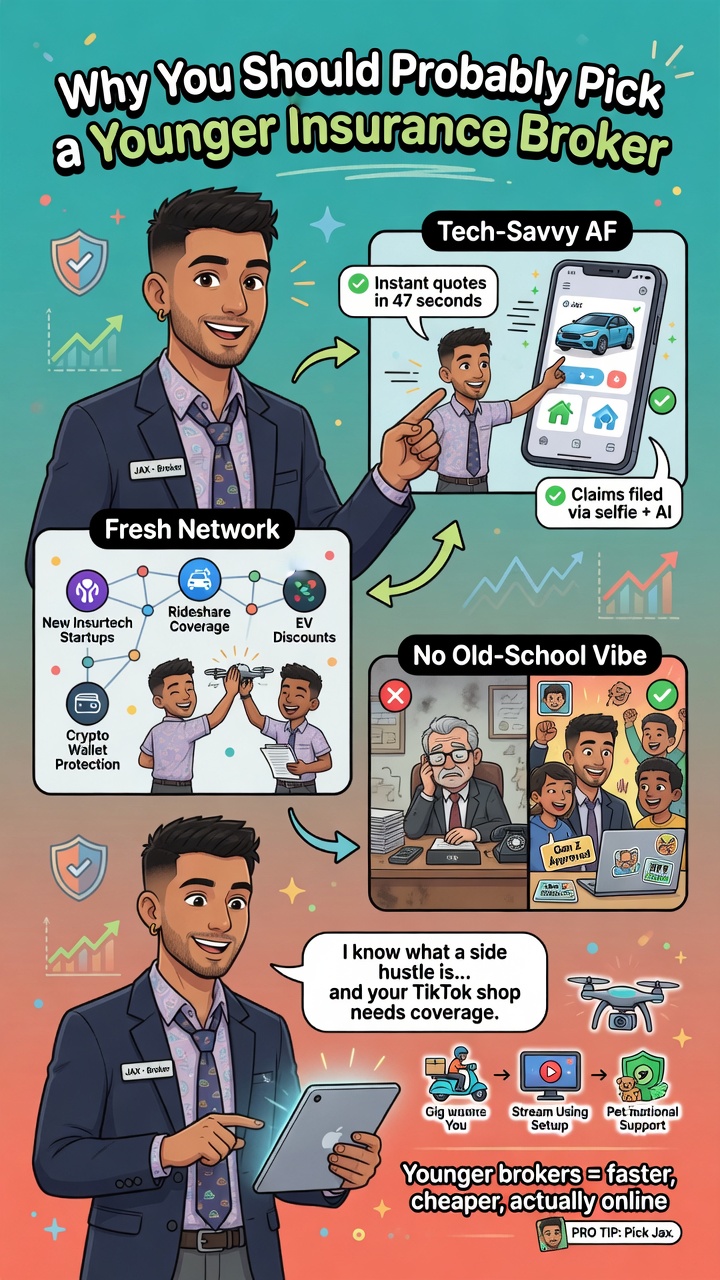
A few months back, I was on an intro call with a guy who needed health coverage for his wife and two kids. Halfway through, he laughed and said: "You sound young. How long have you been doing this?"
I told him five years. He paused. Then he said:
"Honestly? That actually makes me trust you more."
That call stuck with me. Because for years, people have been told the opposite — that experience equals expertise in financial services. That you want the gray-haired guy in the tie. That a 27-year-old insurance broker is a 27-year-old insurance broker, and a 57-year-old is the safe pick.
I want to push back on that. Not because I'm 27 (I am, give or take) and have a vested interest in pushing back — though I do. I want to push back because the reasoning is genuinely wrong about insurance specifically, even if it's right about a lot of other professions.
So here's an honest take: when a younger broker is probably the better pick, when they're probably the worse pick, and how to tell the difference no matter who you're talking to.
The Real Reason Insurance Got So Dad-Coded
Step into a typical American insurance agency and you'll meet a 55-year-old man named Steve who's been doing this for 27 years. Nice guy. Probably a member of his local Rotary. Probably has photos of his kids on the wall, all in college now.
Steve is competent. Steve has handled hundreds of claims. Steve is going to do right by you.
But Steve learned the business in 1998, when the workflow was: prospect calls, prospect drives to office, Steve fills out paper forms with a pen, mails them to the carrier, waits two weeks, calls prospect with a quote. Steve is excellent at that version of the job. Steve has not necessarily updated his approach for a world where his prospect is a freelance UX designer who:
Lives in Atlanta but works for clients in three other states
Earns a 1099 from one company, a W-2 from a part-time gig, and side income from Stripe
Has an HSA, an IRA, a SEP, an FSA at her part-time job, and a Roth conversion she's planning
Wants the whole conversation to happen by text and a 20-minute video call
Steve can serve this person. But Steve has to translate the new world into the old workflow. Every time. For every client like that.
That translation tax is the cost of hiring someone whose mental model was built for a different decade. It usually shows up as: long phone calls when you wanted texts. Recommendations that don't account for marketplace subsidies. Confusion about what an LLC owner can deduct. A whole lot of "let me get back to you on that."
You don't notice the tax day-to-day. You notice it when something complicated happens.
What a Younger Broker Actually Does Differently
I'm not going to pretend I'm magic. A lot of what I do is exactly what Steve does. Same carriers, same plans, same forms, same regulators.
But the toolkit is different. Here's what's actually different in practice — said honestly, not as a pitch:
1. The workflow is asynchronous. You text me at 9pm with a question, I answer in the morning. You don't have to "set up a meeting" to ask whether the dental plan covers a crown. Most of my client interactions are 60% text, 30% video, 10% phone — exactly inverted from how Steve runs his shop. If your default mode of communication isn't a phone call, that matters.
2. Multi-carrier comparison happens in 20 minutes, not 4 days. The software I use lets me pull live quotes from 8+ carriers side-by-side, in real time, on a screen share. Not because I'm smarter than Steve — because Steve is loyal to one carrier's quoting tool that he learned in 2003. I have no such loyalty. The newer the broker, generally, the more carriers they actually shop.
3. The new income types make sense to me. 1099 contractors, freelancers, single-member LLCs, S-corps with one employee, gig workers, content creators with 1099-NECs from six platforms — I work with these income shapes constantly. The marketplace site asks "what's your income?" and 90% of my clients can't answer that question without a half-hour conversation about how their business actually works. I can have that conversation in their language. (If you're self-employed in Georgia, that conversation matters more in 2026 than it did last year — the subsidy cliff is back.)
4. I think in 30-year arcs because I have one. Most insurance is a long relationship. Health insurance changes every year. Life insurance you might own for 40 years. Medicare planning starts a decade before it kicks in. If your broker is 60, the math on whether they're around when your situation gets complicated isn't great. If your broker is 28, you're probably picking the person who'll handle your kid's first life policy, your Medicare review at 65, and your spouse's Part D plan in 2055.
That last one is the case my dad made for using a younger doctor when he was choosing his primary. "I want the doctor who'll still be practicing when I'm 80." Same logic.
What Older Brokers Do Better (Be Honest)
If I just told you younger is always better, you should close this tab. So let me give the other side honestly.
Pattern matching from a thousand weird situations. A broker who's done this for 25 years has personally seen things I've only read about. Strange claim denials, edge-case underwriting decisions, a divorce that retroactively changed someone's coverage in a way nobody saw coming. Some of that pattern matching is real, hard-won expertise that I'll have when I'm 50 and don't have right now.
Relationships with carrier reps. Steve has been calling the same regional rep at Blue Cross for 18 years. When something complicated happens — a claim that's getting denied wrongly, an underwriting decision that needs human override — Steve knows whose extension to dial. I have to email a department.
Calm in a slow-moving crisis. When a client's spouse gets a scary diagnosis and they're calling because they don't know what their out-of-pocket max really means in the real world, a broker who has walked dozens of clients through that exact moment will say the right thing without thinking. I'm trying to be that calm voice. Some days I am, some days I'm working from a younger version of it.
These are real. Pretending they're not real makes the rest of this post less honest.
When You Should Probably Pick a Younger Broker
You're probably better off with a younger broker if:
You're under 50. A younger broker likely understands the income, savings vehicles, and life decisions you're making right now. They're making them too.
You're self-employed, 1099, freelance, gig, creator economy, or have non-standard income. This is where the workflow advantage compounds. Many older brokers default to "are you W-2 or are you self-employed?" and then route everyone into the same two buckets.
You prefer text and video over phone calls and office visits.
You're comfortable with software-driven processes. A modern broker's quoting and onboarding usually happens through web apps. Some clients hate this.
You're going to be alive in 30 years and want a continuous relationship.
You have a complex multi-line situation — health + life + business + auto + property — and you want one person who can hold all of it without 7 different specialty contacts.
When You Should Probably Pick an Older Broker
Honest answer:
You're 65+, comfortable with the way insurance has always worked, and would rather meet someone in person at a desk. Comfort matters. So does the human pacing of a real conversation.
You have a rare or specialized situation that requires deep institutional knowledge of one specific carrier (e.g., a niche workers' comp class, certain commercial lines, esoteric estate-planning life products).
You want a broker who knows your local town's funeral homes, real estate agents, and CPAs personally. That kind of relational depth takes decades.
You instinctively trust people who remind you of your parents, and you'd be fighting that instinct every time you talked to a younger broker. Trust is the whole point. Don't pick someone who feels off.
How to Evaluate Any Broker (Regardless of Age)
Forget age for a second. Here's what actually matters when you're picking a broker — same questions whether they're 27 or 67:
1. Are they independent, or do they work for one carrier? Captive agents (think: a State Farm agent) can only sell State Farm. Independent brokers can shop the market. For most people most of the time, you want independent. (I am, in case it matters.)
2. How many carriers did they actually quote for you? "I shop the market" is a phrase. Three real quotes from three real carriers is evidence.
3. Do they explain the math, or do they just point at one option? A good broker walks you through why one plan beats another for your specific situation — premium vs. deductible vs. network vs. prescription coverage vs. tax treatment. A weak broker hands you a quote and says "this is the best one."
4. Can you reach them when something goes wrong? The job isn't selling you the policy. The job is helping you when there's a claim issue, a billing problem, or a network change in February. Ask: "If I have a claim problem six months from now, who do I call?" The answer should be a person, not a 1-800 number.
5. Do they push the highest-commission product? Whole life, IUL, and final expense pay brokers more than term life. Medicare Advantage usually pays more than Medicare Supplement. A broker who always steers toward the higher-commission option, regardless of your situation, is selling themselves, not advising you.
6. Are they licensed in your state? Sounds basic. Surprisingly common issue when buying online.
If your broker — young or old — passes those six tests, age genuinely doesn't matter. Pick the human you trust most.
So What Should You Actually Do?
If you're reading this and you've been putting off shopping for coverage because the whole industry feels stuck in 1998 — yeah, I get it. That's exactly why I started That Young Insurance Guy in October 2020, right out of college. I figured the work was important and the experience around it shouldn't suck.
If you want to talk through your situation, the easiest path is to call or text (706) 988-1930. We'll do 15 minutes. I'll ask a few questions, you'll ask a few, and either I'm the right fit or I'll point you somewhere better.
I work mostly in Atlanta and Georgia, but I'm licensed in 31 states — so if you're somewhere else and reading this, that's still fine.
No pressure. No follow-up sequence. Just a real conversation.
Justin Bishop is the founder of That Young Insurance Guy, an independent insurance brokerage in Atlanta, GA. He writes the Health Coverage Chaos newsletter on LinkedIn.